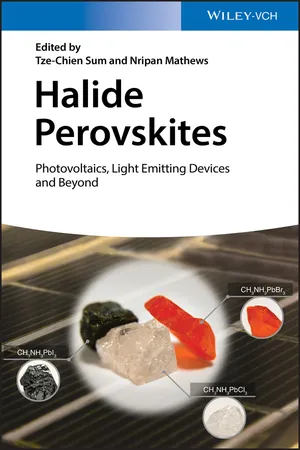
Real insight from leading experts in the field into the causes of the unique photovoltaic performance of perovskite solar cells, describing the fundamentals of perovskite materials and device architectures. The authors cover materials research and development, device fabrication and engineering methodologies, as well as current knowledge extending beyond perovskite photovoltaics, such as the novel spin physics and multiferroic properties of this family of materials. Aimed at a better and clearer understanding of the latest developments in the hybrid perovskite field, this is a must-have for material scientists, chemists, physicists and engineers entering or already working in this booming field.
Part I Basic Properties and Early Works in Organic–Inorganic Perovskites
1.1 Structural, Optical, and Related Properties of Some Perovskites Based on Lead and Tin Halides: The Effects on Going from Bulk to Small Particles
George C. Papavassiliou1, George A. Mousdis1 and Ioannis Koutselas2
1Theoretical and Physical Chemistry Institute, National Hellenic Research Foundation, 48, Vasileos Constantinou Avenue, 11635 Athens, Greece
2University of Patras, Department of Materials Science, Patras, 26504, Greece
1.1.1 Introduction
The preparation or/and investigation of perovskites, based on PbXy and SnXy (X = Cl, Br, I) units, was the subject of publications in a number of papers (see, for instance, [1–63]). The majority of these compounds consist either of a small cation (SC) group, such as K+, Cs+, and CH3NH3+, or of a big cation (BC) group, such as C10H21NH3+, CH3C6H4CH2NH3+, and C10H7CH2NH3+, or both of them (SC, BC). Several combinations of the PbXy or/and SnXy units give a large number of frameworks; when these are combined with the numerous possibilities of SC and BC compounds, a large number of final compounds can be synthesized. Some of them, having the general formula (SC)n−1(BC)2MnX3n+1, exhibit a variety of structural, optical, and other properties. They can be prepared from simple starting materials, for example, PbX2, SnX2, CH3NH2, C10H21NH2, CH3C6H4CH2NH2, and C10H7CH2NH2, according to the following reactions:
1.1.1
1.1.2
or generally,
1.1.3
where n = 1,2, …, ∞, the number of inorganic layers.
A number of observations (grinding effects, behavior of suspensions, etc.) showed that these reactions are reversible [30–41]. In this chapter, some important findings concerning the structural, optical, and related properties of semiconducting perovskites of the type (SC)n−1(BC)2MnX3n+1n = 1, 2, …, ∞, when they are in the bulk (e.g. single‐crystal, polycrystalline pellets) and/or in the particulate forms, are briefly reviewed. In these materials, the organic part could be a saturated molecule (or a weakly conjugated molecule) or non‐saturated, while the inorganic part consists of an infinite number of interacting units in a three‐dimensional (3D) framework, or a finite number of interacting MXy units in a 3D framework, or an infinite number of interacting MXy units in a two‐dimensional (2D) framework, or in similar patterns for lower dimensional cases. In these materials, the organic moiety possesses the role of a barrier. In a second series of perovskites, the organic moiety consists of non‐saturated molecules.
1.1.2 Materials Based on Saturated Organic Moiety
1.1.2.1 Bulk Perovskites (SC)MX3
These are the products of reaction (1.1.1) or that of reaction (1.1.3) with n = ∞. The crystals of (SC)MX3 perovskites consist of an infinitive number of interacting MXy units, which form a 3D framework [4, 9, 11]. The published papers [1–5] concerning the preparation as well as the structural, optical, and related properties of CH3NH3PbI3 (and similar compounds) led the authors of Ref. [42] to use these compounds as the light sensitizer components of solar cells. Moreover, it has been found that the compounds of the type (SC)MX3 exhibit a variety of properties. Crystals of compounds with MI3 group are black, crystals with MBr3 group are red, and crystals with MCl3 group are yellowish [1, 2, 11, 40–52]. The stability in air is on the order of MI3 < MBr3 < MCl3. Figure 1.1.1A shows a simplified picture of the structure of (SC)MX3 (3D). The X–Pb–X distance is c. 6.4, 5.8, and 5.4 Å for X = I, Br, and Cl, respectively [11]. In the past years, a number of 3...
Table of contents
Cover
Table of Contents
Dedication
Part I: Basic Properties and Early Works in Organic–Inorganic Perovskites
Part II: Organic–Inorganic Perovskite Solar Cells
Part III: Perovskite Light Emitting Devices
Part IV: Beyond Perovskite Photovoltaics
Index
End User License Agreement
Trusted by 375,005 students
Access to over 1.5 million titles for a fair monthly price.
Study more efficiently using our study tools.
Frequently asked questions
Yes, you can cancel anytime from the Subscription tab in your account settings on the Perlego website. Your subscription will stay active until the end of your current billing period. Learn how to cancel your subscription
No, books cannot be downloaded as external files, such as PDFs, for use outside of Perlego. However, you can download books within the Perlego app for offline reading on mobile or tablet. Learn how to download books offline
Perlego offers two plans: Essential and Complete
Essential is ideal for learners and professionals who enjoy exploring a wide range of subjects. Access the Essential Library with 800,000+ trusted titles and best-sellers across business, personal growth, and the humanities. Includes unlimited reading time and Standard Read Aloud voice.
Complete: Perfect for advanced learners and researchers needing full, unrestricted access. Unlock 1.5M+ books across hundreds of subjects, including academic and specialized titles. The Complete Plan also includes advanced features like Premium Read Aloud and Research Assistant.
Both plans are available with monthly, semester, or annual billing cycles.
We are an online textbook subscription service, where you can get access to an entire online library for less than the price of a single book per month. With over 1.5 million books across 990+ topics, we’ve got you covered! Learn about our mission
Look out for the read-aloud symbol on your next book to see if you can listen to it. The read-aloud tool reads text aloud for you, highlighting the text as it is being read. You can pause it, speed it up and slow it down. Learn more about Read Aloud
Yes! You can use the Perlego app on both iOS and Android devices to read anytime, anywhere — even offline. Perfect for commutes or when you’re on the go. Please note we cannot support devices running on iOS 13 and Android 7 or earlier. Learn more about using the app
Yes, you can access Halide Perovskites by Tze-Chien Sum, Nripan Mathews, Tze-Chien Sum,Nripan Mathews in PDF and/or ePUB format, as well as other popular books in Tecnologia e ingegneria & Scienza dei materiali. We have over 1.5 million books available in our catalogue for you to explore.