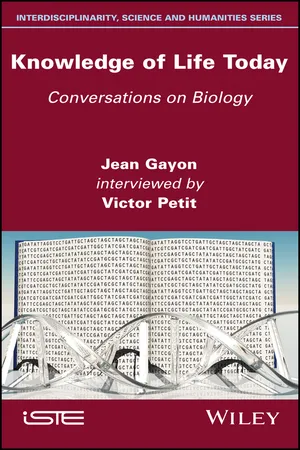
Knowledge of Life Today presents the thoughts of Jean Gayon, a major philosopher of science in France who is recognized across the Atlantic, especially for his work in philosophy and the history of life sciences. The book is structured around Gayon's personal answers to questions put forward by Victor Petit. This approach combines scientific rigor and risk-taking in answers that go back to the fundamentals of the subject.
As well as the relationship between philosophy and the history of science, Gayon discusses the main questions of the history and philosophy of biology that marked his intellectual journey: Darwin, evolutionary biology, genetics and molecular biology, human evolution, and various aspects of the relationship between biology and society in contemporary times (racism, eugenics, biotechnology, biomedicine, etc.).
eBook - ePub
Knowledge of Life Today
Conversations on Biology (Jean Gayon interviewed by Victor Petit)
- English
- ePUB (mobile friendly)
- Available on iOS & Android
eBook - ePub
Knowledge of Life Today
Conversations on Biology (Jean Gayon interviewed by Victor Petit)
About this book
Information
1
Philosophy of Biology
As a philosophy student, prior to discovering your work, I thought that the philosophy of biology began and ended with Canguilhem. You introduced this field of research in France. Before going into detail concerning the concepts involved, I’d like to know “what the philosophy of biology is not”, to cite the title of David Hull’s famous article1.
The “philosophy of biology” was not a new concept at the time Hull was writing, in the late 1960s. The expression was first used in English by William Whewell in 1850, and cropped up periodically, taking a variety of interchangeable forms such as biological philosophy or philosophy of the life sciences. In French, “philosophy of biology” was rarely encountered prior to the 1980s; philosophie biologique (biological philosophy), philosophie des sciences de la vie (philosophy of the life sciences) or “épistémologie des sciences de la vie” (epistemology of life sciences) were used from time to time. David Hull’s article, “What the philosophy of biology is not”, was an act of rebellion by its author against the way in which philosophers of science of the analytical tradition and/or neo-positivist philosophers approached the biological sciences. In 1969, David Hull was 34. His 1969 manifesto (for it was a manifesto) was his eighth publication; the author’s first work was published in 1964. Hull objected to the non-critical application of concepts and methods inspired by ahistorical and general analyses of scientific discourse, which were themselves implicitly rooted in physical theories. For example, Hull lampooned the attempts made by Joseph Henry Woodger (1894–1981)2, an English philosopher, to axiomatize biological theories, particularly in the field of genetics. Hull felt that this type of activity was inherently sterile, having no effect on real scientific practices. Karl Popper’s reflections on refutability and parsimony, on the other hand, had a considerable impact on a number of scientific domains, particularly in the cladistic branch of biology. Hull thus called for philosophers with an interest in biology to interact directly with biologists themselves, addressing methodological issues alongside more pointed questions relating to specific scientific content and rooted in areas of actual research.
Collaborative work of this type did, in fact, begin to take shape from the 1970s onwards. A number of individuals began to define themselves as “philosophers of biology”, breaking away somewhat from a more general philosophy of science to focus on the concepts, theories and methods involved in contemporary biology. This development was not solely a response to David Hull’s exhortations. Figures such as Marjorie Grene, Michael Ruse and others, some of whom are mentioned in Hull’s 1969 article, had already begun work in this area. However, Hull’s article had a significant impact in lexical terms. Prior to 1970, the terms “philosophy of biology”, “biological philosophy” and “philosophy of the life sciences” were used interchangeably. Following on from “What the philosophy of biology is not” – which could just have well been called “What the philosophy of biology should be” – the expression “philosophy of biology” became the banner beneath which the domain’s supporters came together, aiming to establish a field of philosophical reflection in direct relation to applied biological research.
At this juncture, I would like to note that the emergence of the philosophy of biology, as a separate sub-discipline within the philosophy of science, resonates, in some ways, with a similar development which took place in the history of science during the same period. The “new” history of science fought back against the perceived dominance of abstract philosophical models, calling for a new focus on “science in action”, as in the philosophy of biology. The development of disciplinespecific philosophies of science over the last four decades has largely focused on an increased integration with “actual” science.
1.1. The philosophy of biology
1.1.1. Laws in physics and biology
As a philosopher of biology, you have obviously considered the scientific specificity of biology. In your article “La biologie entre loi et histoire (Biology, from laws to history)”3, you spoke of biology as a “science without laws”. What do you mean by this?
Philosophers more or less universally agree that biology, and evolutionary biology in particular, has presented significant challenges to a number of traditional concepts in the general philosophy of science, including the notion of natural law, at least in terms of its application to the life sciences.
The statement that “there are no laws in biology” refers to the concept of law promulgated by the neopositivist philosophers of science (particularly Carl Hempel and Ernest Nagel). For the neopositivits, laws are empirically true statements with a universal logical form. However, this formulation is insufficient, as, applied in its strictest sense, it implies that all accidental generalizations (e.g. “all of the coins in my pocket are one-euro coins”, a phrase which has the logical form of a universal statement) are laws, which would be absurd. It was therefore necessary to clarify that enigmatic property of the laws of nature which philosophers, starting with David Hume in the 18th Century, referred to as “natural necessity”. The result was the formulation according to which a law is a statement of unlimited universal scope, that is containing no spatio-temporal limitations, whether explicit or implicit. Nelson Goodman4 modified this formulation by adding a modal criterion. For Goodman, a nomological statement is a statement which supports (i.e. justifies or permits) counterfactual statements, that is statements which are contrary to fact. For example, when we say that sugar is water-soluble, we implicitly accept the following counter-factual statement: “if I put this sugar cube in my cup of coffee, it would dissolve”. The two propositions in this phrase are counterfactual, as the specific sugar cube involved in our thought experience is not in my coffee, and is therefore not dissolved hic et nunc in this world. The strength of a nomological statement lies precisely in the fact that it is not only valid in this world, but in any other possible world resulting from a different sequence of events and obeying the same laws. Thought experiments based on counterfactuals offer a powerful tool for identifying generalizations which are not laws but are simply accidental, that is de facto generalizations limited to a particular portion of space and time. Returning to the example of the coins, the phrase “all of the coins in my purse are one-euro coins” does not allow us to infer that “if this ten-cent piece in my hand were in my pocket, it would be (or would become) a one-euro coin”.
Nelson Goodman developed a linguistic criterion which is remarkably effective in detecting statements which take the form of universal logic, but which are inextricably linked to particular temporal conditions (i.e. accidental generalizations). This proposal has attracted considerable attention within the field of philosophy. It has been criticized on the grounds that the notion of “possible worlds” it uses is too vague. David Lewis suggested a more restrictive formula, according to which universal statements which are empirically true may only be considered to be laws if they are true in all nomologically-accessible worlds5. The restriction to “nomologically-accessible worlds” excludes possible worlds governed by laws which are completely different to those which we know, or “non-nomological” worlds, that is worlds without order.
This modern understanding of the laws of nature is easy to apply in the field of physics, but problematic in biology. Within the life sciences, it is hard to find generalizations with unlimited universal scope. Most biological generalizations appear to be limited to a small portion of the history of the universe, that corresponding to the history of life on our planet.
As far back as the 19th Century, the French philosopher and mathematician Antoine-Augustin Cournot noted that the life sciences are faced with collections of singular entities (species), each of which appears to be governed by its own laws. According to Cournot, instead of universal laws, each species seemed to be subject to unique decrees, the result of coups d’État, which the author compared to Napoleon’s coup of 18 Brumaire, a historical event. In biology, therefore, there are no (timeless) laws, but rather a series of unique decrees, each resulting from a coup d’État6.
But the term “laws” is still used in biology. Is a term such as “Mendel’s laws” still epistemologically relevant?
Not if we understand the concept of laws in the way I just described. Lewis’ criterion may be usefully applied in determining whether or not “Mendel’s laws” are genuine laws of nature7. The reason “Mendel’s laws” cannot be considered to be genuine in the same way as Newton, Maxwell or Einstein’s laws is that it is possible to imagine worlds governed by the same laws (i.e. all existing laws with the exception of Mendel’s) in which Mendel’s “laws” would not be respected. For example, there is nothing to prevent us from imagining that sexually reproducing animals may have evolved on an exoplanet, independently of the history of life on Earth. These animals would exist in a physical environment obeying the same laws found on Earth and throughout the whole universe, and would also be structurally and functionally similar to terrestrial animals; for example, they would be made up of macromolecules such as nucleic acids, proteins and carbohydrates. They would have an articulated internal skeleton and would share many physiological properties with animals on earth. However, meiosis, that is the mode of division which produces haploid gametes (n chromosomes) fro...
Table of contents
- Cover
- Table of Contents
- Preface by Jean Gayon
- Introduction by Victor Petit
- 1 Philosophy of Biology
- 2 Darwin and Darwinism
- 3 Genetics
- 4 Biology and Society
- Bibliography by Jean Gayon
- Index of Names
- Index of Notions
- End User License Agreement
Trusted by 375,005 students
Access to over 1.5 million titles for a fair monthly price.
Study more efficiently using our study tools.
Frequently asked questions
Yes, you can cancel anytime from the Subscription tab in your account settings on the Perlego website. Your subscription will stay active until the end of your current billing period. Learn how to cancel your subscription
No, books cannot be downloaded as external files, such as PDFs, for use outside of Perlego. However, you can download books within the Perlego app for offline reading on mobile or tablet. Learn how to download books offline
Perlego offers two plans: Essential and Complete
- Essential is ideal for learners and professionals who enjoy exploring a wide range of subjects. Access the Essential Library with 800,000+ trusted titles and best-sellers across business, personal growth, and the humanities. Includes unlimited reading time and Standard Read Aloud voice.
- Complete: Perfect for advanced learners and researchers needing full, unrestricted access. Unlock 1.5M+ books across hundreds of subjects, including academic and specialized titles. The Complete Plan also includes advanced features like Premium Read Aloud and Research Assistant.
We are an online textbook subscription service, where you can get access to an entire online library for less than the price of a single book per month. With over 1.5 million books across 990+ topics, we’ve got you covered! Learn about our mission
Look out for the read-aloud symbol on your next book to see if you can listen to it. The read-aloud tool reads text aloud for you, highlighting the text as it is being read. You can pause it, speed it up and slow it down. Learn more about Read Aloud
Yes! You can use the Perlego app on both iOS and Android devices to read anytime, anywhere — even offline. Perfect for commutes or when you’re on the go.
Please note we cannot support devices running on iOS 13 and Android 7 or earlier. Learn more about using the app
Please note we cannot support devices running on iOS 13 and Android 7 or earlier. Learn more about using the app
Yes, you can access Knowledge of Life Today by Jean Gayon,Victor Petit in PDF and/or ePUB format, as well as other popular books in Biological Sciences & Biology. We have over 1.5 million books available in our catalogue for you to explore.