Every day, most working professionals entrust their most important messages to a form of communication that doesn't build trust, provide differentiation, or communicate clearly enough. It's easy to point to the sheer volume of emails, text messages, voicemails, and even social messaging as the problem that reduces our reply rates and diminishes our effectiveness. But the faceless nature of that communication is also to blame.
Rehumanize Your Business explains how to dramatically improve relationships and results with your customers, prospects, employees, and recruits by adding personal videos to emails, text messages, and social messages. It explains the what, why, and how behind this new movement toward simple, authentic videos—and when to replace some of your plain, typed-out communication with webcam and smartphone recordings.
• Restore face-to-face communication for clarity and connection
• Add a personal, human touch to your emails and other messages
• Meet people who've sent thousands of videos
• Learn to implement your own video habit in an easy, time-saving way • Boost your replies, appointments, conversion, referrals, and results dramatically
If you're ready to influence, teach, sell, or serve in a more personal way, Rehumanize Your Business is your guide.
CHAPTER 1 The New Way to Communicate, Connect, and Convert
We see each other once or twice a year, but my sister doesn't call often. My wife talks with her more often than I do. We keep up through social media, text messages, and a phone call every now and then. So, when she called on a weekday in the late afternoon, I knew I needed to answer.
“Hey, what's up?” I asked.
“Umm … Mom's dead,” she quietly replied. Calm, but without confidence, she followed with an apology. “Sorry to be so blunt. I didn't know how else to say it.”
Our mom died unexpectedly in early 2018. She felt dizzy, fell down, and never got back up. She was at home with my dad, sister, and nephew doing what she often did—rushing back into the kitchen to get that one final dish to complete a dinner already on the table. A two-time cancer survivor, she was in a great phase of her life after losing weight, replacing a knee, working out with a personal trainer, and traveling a lot more to see her kids, her grandkids, her friends, and the tropics. All that positive momentum made the phone call even harder to take than it would have been otherwise.
A few days later, I flew back to my hometown of Grand Rapids, Michigan. The first visitation was on a Friday evening. Prior to it, we put together a few photo boards from the hundreds, if not thousands, of prints she'd made over the years; framed and magnet-pinned photos of family and friends lined her walls and bookshelves. Seeing her face through the years and seeing her with so many other smiling, familiar faces was a pleasure. We saw many of them in person that night; the volume and warmth of support for her and for our family was wonderful.
The next morning, we hosted the second visitation, which was followed by the funeral service. You know how these social occasions go. You don't keep your gaze fixed when you're in a conversation. With no disrespect to the person with whom you're talking, you glance around the room. As I stood and spoke with a supportive family friend that morning, I saw a familiar face over her shoulder. But it was an unexpected face; it didn't make complete sense in the moment. It felt like seeing your dental hygienist at Costco—without the uniform and the context of the office, you don't recognize the person as quickly. After I wrapped up the conversation, I headed over to him.
This gentleman greeted me with a soft smile and warm hug, as did his wife. I'd never met either of them in person. I'd never spoken with them on the phone. Neither one of them knew or had ever met my mom. Neither of them knew a single one of my family members. They knew no one else at the visitation. And yet they drove two hours across the state to spend three or four minutes with me. The gesture was incredibly meaningful; I can still feel the moment when my mind put together what they'd done.
What inspired them to invest more than half a day to create that brief, in-person meeting? Relationship. Our relationship was built through simple video messages recorded and sent back and forth, off and on over a couple years' time. And it's a real relationship. I felt as though I knew him before I ever met him—and I know he'd say the same about me. When we later swapped video messages about their visiting with me that day, he speculated, “That never would have happened through regular email. It was the video portion of our emails that caused that to happen. And that just enriches life.”
Video builds psychological proximity between people, even in the absence of physical proximity.
I now call Andy Alger a longtime BombBomb customer-turned-friend. A real estate agent in Grand Blanc, Michigan, he generates nearly all of his business from his database of past clients. Staying in contact meaningfully with just a few hundred people creates repeat business and personal referrals. Relationships, then, are fundamental to his success. I suspect he's made gestures like the one I experienced many times before in other people's lives.
To stay in touch with the new ways people are using video, we regularly look at the top customers in our database in terms of videos recorded and sent per day. We often reach out to learn about their motivations, strategies, and outcomes; this book is, in large part, the result of these efforts. Andy showed up on my radar pretty quickly. He signed up nearly five years ago and, in that time, has sent 4,000 videos. Back in April 2014, I reached out to learn more about what he was doing and why he was doing it. At the time, he was closing in on his 500th video. By one-to-one video, of course, he told me: “Personal videos make what I do fun again. And my clients respond to it very well—and, really, that's why I do it. I started it because I thought it was a neat idea, but then I saw the reaction of my clients and it's great. They love it. I love it.”
To stay connected with the people who matter most to his business, Andy used to block out time on his calendar to make phone calls. But he increasingly felt like he was intruding on their day and interrupting their lives. A phone call became an imposition on his clients' time with which he grew less and less comfortable. Recording and sending videos, however, could be done on his own time. And each person plays his video and experiences the message whenever it's most convenient. One person might open it and see Andy immediately. Another might see it 10 minutes later, another two hours later, and another three days later—whenever it's convenient.
The asynchronicity of recording and sending personal videos provides convenience for both the sender and the receiver.
Because they provided a more effective and more satisfying way to work, simple webcam videos replaced phone calls as Andy's preferred way to stay in touch. In the same amount of time he'd block out for calls, he could record and send a couple dozen truly personal messages. One video for each person, couple, or family. Like a voicemail, but with his face, voice, personality, sincerity, enthusiasm, and all the elements that can't be delivered through faceless, digital communication. He delivers himself, in person, at scale. And unlike voicemail, video email allows him to know exactly who's opening the email and playing the video—and exactly when.
This method is less demanding and more respectful of people's time. Andy treats people as he himself prefers to be treated, getting his message across more personally, more often. This is what it can look like to rehumanize your business.
A SIMPLE VIDEO MAKES A BIG DIFFERENCE
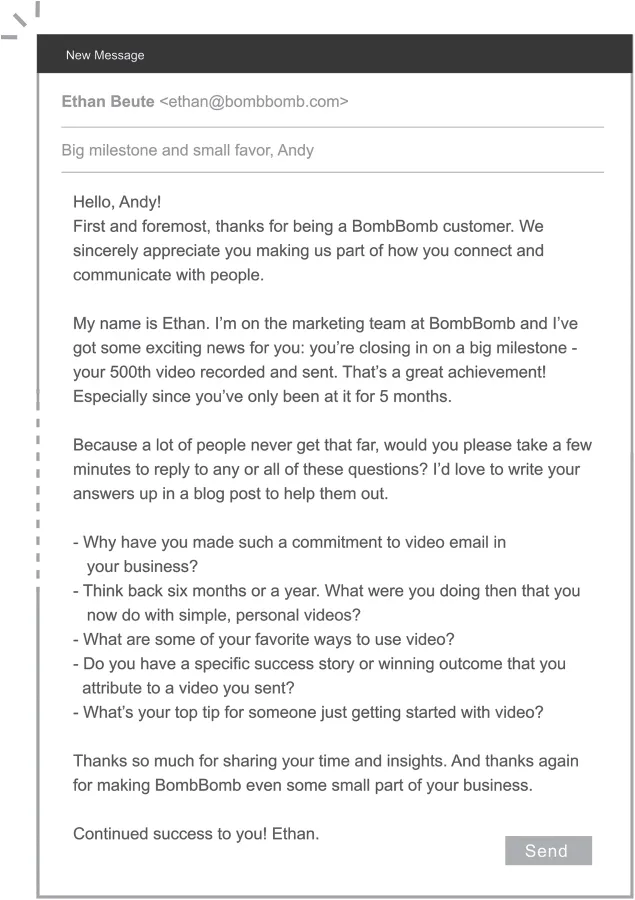
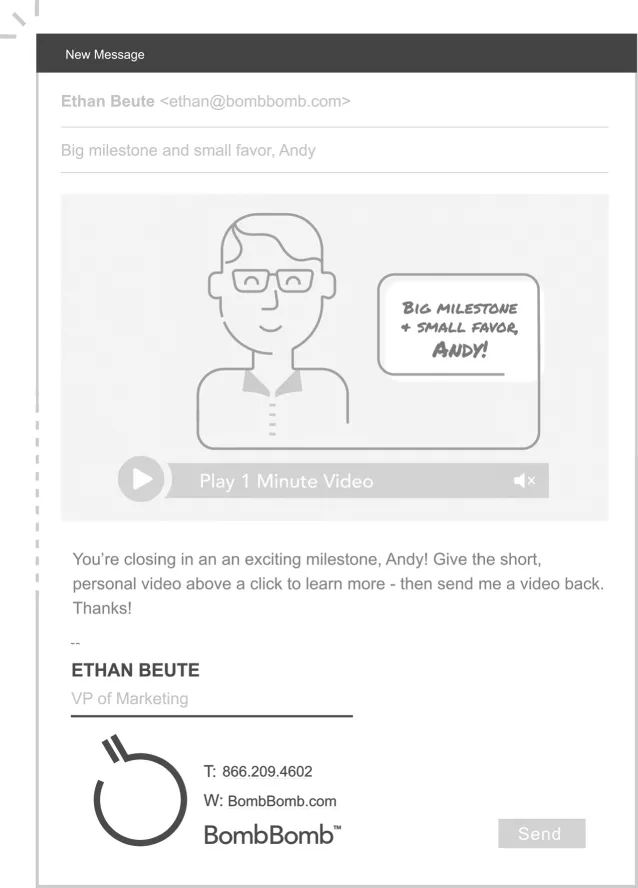
Andy sprinted out of the gates with 488 videos sent in under five months. Averaging more than 100 videos per month and more than three videos per day every day of the week, he'd obviously found a few very specific ways to use video and committed to them. At that rate, the videos are always personal, one-to-one sends. To learn best practices and to teach others, I've regularly reached out over the years to people like Andy to share their tips, insights, and successes with others. Here are two ways I could've reached out to him. Figure 1.1 shows a nice, traditional email and Figure 1.2 represents a more personal approach.
Option One: Plain, Typed-Out Text
FIGURE 1.1 Traditional Email
Option Two: Personal Video Email
FIGURE 1.2 Video Email
The Difference
Instead of constructing the 200-word email in Figure 1.1, I simply clicked “Record” and talked to Andy as if we were casually meeting in person. Instead of spending three or four minutes organizing my ideas into a well-structured email that didn't come across as pushy or demanding and didn't contain typos, misspellings, improper grammar, or egregious punctuation, I spent about 90 seconds speaking to him from my office through my webcam. Instead of relying on ALL CAPS, exclamation points, or emoticons to convey my excitement, I used an honest smile and my sincere enthusiasm to let him know how much I appreciated him and the milestone he was approaching. Instead of sending a laundry list of questions to answer, I asked the...
Table of contents
COVER
TABLE OF CONTENTS
ACKNOWLEDGMENTS
ABOUT THE AUTHORS
INTRODUCTION
PART 1: Why It's Time to Rehumanize Your Business
PART 2: When to Rehumanize with Video
PART 3: How to Record and Send Videos
PART 4: Improving Video Results
INDEX
END USER LICENSE AGREEMENT
Trusted by 375,005 students
Access to over 1.5 million titles for a fair monthly price.
Study more efficiently using our study tools.
Frequently asked questions
Yes, you can cancel anytime from the Subscription tab in your account settings on the Perlego website. Your subscription will stay active until the end of your current billing period. Learn how to cancel your subscription
No, books cannot be downloaded as external files, such as PDFs, for use outside of Perlego. However, you can download books within the Perlego app for offline reading on mobile or tablet. Learn how to download books offline
Perlego offers two plans: Essential and Complete
Essential is ideal for learners and professionals who enjoy exploring a wide range of subjects. Access the Essential Library with 800,000+ trusted titles and best-sellers across business, personal growth, and the humanities. Includes unlimited reading time and Standard Read Aloud voice.
Complete: Perfect for advanced learners and researchers needing full, unrestricted access. Unlock 1.5M+ books across hundreds of subjects, including academic and specialized titles. The Complete Plan also includes advanced features like Premium Read Aloud and Research Assistant.
Both plans are available with monthly, semester, or annual billing cycles.
We are an online textbook subscription service, where you can get access to an entire online library for less than the price of a single book per month. With over 1.5 million books across 990+ topics, we’ve got you covered! Learn about our mission
Look out for the read-aloud symbol on your next book to see if you can listen to it. The read-aloud tool reads text aloud for you, highlighting the text as it is being read. You can pause it, speed it up and slow it down. Learn more about Read Aloud
Yes! You can use the Perlego app on both iOS and Android devices to read anytime, anywhere — even offline. Perfect for commutes or when you’re on the go. Please note we cannot support devices running on iOS 13 and Android 7 or earlier. Learn more about using the app
Yes, you can access Rehumanize Your Business by Ethan Beute,Stephen Pacinelli in PDF and/or ePUB format, as well as other popular books in Business & Business Communication. We have over 1.5 million books available in our catalogue for you to explore.