Written for industrial and academic researchers and development scientists in the life sciences industry, Bioprocessing Technology for Production of Biopharmaceuticals and Bioproducts is a guide to the tools, approaches, and useful developments in bioprocessing. This important guide:
• Summarizes state-of-the-art bioprocessing methods and reviews applications in life science industries
• Includes illustrative case studies that review six milestone bio-products
• Discuses a wide selection of host strain types and disruptive bioprocess technologies
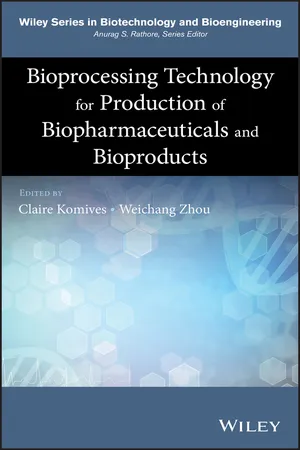
eBook - ePub
Bioprocessing Technology for Production of Biopharmaceuticals and Bioproducts
- English
- ePUB (mobile friendly)
- Available on iOS & Android
eBook - ePub
Bioprocessing Technology for Production of Biopharmaceuticals and Bioproducts
About this book
Information
Part I
Case Study
1
Bacillus and the Story of Protein Secretion and Production
Giulia Barbieri1, Anthony Calabria2, Gopal Chotani2, and Eugenio Ferrari1
1Dipartimento de Genetica Molecolare Batterica, Universidad di Pavia, Pavia PV, Italy
2DuPont Industrial Biosciences, Palo Alto, CA, USA
1.1 Bacillus as a Production Host: Introduction and Historical Account
Contrary to logical thinking, the use of enzymes in daily activities may actually predate the development of modern agricultural societies. Nomad populations of hunters and gatherers exploited rennin produced by the stomach of ruminants for the cheese‐making process; while the development of fermentation processes for alcohol can be traced back to more than 7000 years (McGovern et al. 2004; Alba‐Lois and Segal‐Kischinevzky 2010). However, it is only in the nineteenth‐century that enzymes were identified as responsible factors for century old processes such as leather tanning and conversion of starch to sugar (Payen and Persoz 1833).
At the beginning of the twentieth‐century, thanks to the work of Otto Rohm, enzymes started playing a wider role in industrial processes as well as in household applications (Wallerstein 1939; Maurer 2010). Two US patents were granted on the use of enzymes for the conversion of starch to sugar; one filed by Schultz et al. (1939) describing the use of a Bacillus mesentericus “extract,” and the other by Dale and Langlois (1940) claiming the use of fungal saccharifying enzymes.
In the mid‐1950s, microbial enzymes started being used extensively in several applications. Large‐scale enzyme preparations, obtained via microbial fermentation thus prominently entered the industrial world (Underkofler et al. 1958). The 1960s saw the dawn of Bacillus as a production workhorse. Toward the end of the decade, Bacillus‐derived proteases took hold as essential components of laundry detergents (Roald and De Tieme 1969). At about the same time, high temperature‐resistant amylases, useful in the saccharification process, were identified in Bacillus licheniformis and Bacillus amyloliquefaciens. At first, due to the insufficient genetic characterization, the strains used in large‐scale fermentation were isolated via a labor‐intensive and time‐consuming approach of mutagenesis and screening. Most likely, several thousand mutants were tested for improved production characteristics, such as relief of catabolite repression, antibiotic resistance (most likely mutation in one or more ribosomal components), and sporulation deficiency (Ingle and Boyer 1976). The choice of sporulation mutations is particularly important since it allows extending production time in fermentors and, due to poor survival of nonsporulating cells in the environment, precludes isolation of production strains by competitors. The advent of genetic engineering allowed making rapid targeted changes in enzymes and accelerated construction of ad hoc production strains starting from laboratory strains, allowing budding industrial biotechnology companies, such as Genencor, to introduce the first detergent alkaline protease produced by a recombinant microorganism in 1984 (E. Ferrari, unpublished).
For the reasons mentioned above, and for their ease of growth in large‐scale submerged fermentation, members of the genus Bacillus play a very important role in the manufacture of a number of industrially important products. While the use of Bacilli has been explored for the synthesis of pharmaceutical products, their most important commercial role is in the production of industrial enzymes (Aehle 2007). It is estimated that in the current greater than $4‐billion industrial enzyme market, Bacilli produce about 50% of the enzymes (G. Nedwin, personal communication). These products are employed in a variety of important commercial applications such as laundry, dishwashing, starch‐derived ethanol and sweeteners, baking, animal feed, textile, and leather (for review see Aehle 2007).
Several traits make the genus Bacillus attractive for protein production especially since B. subtilis has a long history of safe use. Bacillus natto, a very close relative of the laboratory strain B. subtilis, has been used to obtain natto, a staple of Japanese cuisine from soybean fermentation, for over a thousand years (Nishito et al. 2010). Furthermore, what makes the use of Bacillus for the production of industrial enzymes particularly attractive is its ability to secrete proteins in the culture fluid. This is a necessary feature to keep the cost of the enzymes low, an essential aspect for this class of product. In fact, in most cases, the cost of enzyme production has to be below the $500 kg−1 mark, hence the necessity to have low recovery‐associated costs. Over the years, a number of tools have been developed to ease and speed up Bacillus genetic manipulation. The availability of the sequenced genomes of both B. subtilis (Kunst et al. 1997) and B. licheniformis (Rey et al. 2004; Veith et al. 2004) has allowed studies aimed at better understanding their behavior during growth and production (Buescher et al. 2012; Nicolas et al. 2012). Moreover, the well‐characterized fermentation, its relatively short time, and the possibility to use cheap feedstock add to the appeal of using these bacteria for the production of industrial enzymes.
This chapter is divided in two main sections: the first section focuses on the genetic tools and strategies useful for the efficient cl...
Table of contents
- Cover
- Table of Contents
- List of Contributors
- Part I: Case Study
- Part II: Bioreactors
- Part III: Host Strain Technologies
- Index
- End User License Agreement
Trusted by 375,005 students
Access to over 1.5 million titles for a fair monthly price.
Study more efficiently using our study tools.
Frequently asked questions
Yes, you can cancel anytime from the Subscription tab in your account settings on the Perlego website. Your subscription will stay active until the end of your current billing period. Learn how to cancel your subscription
No, books cannot be downloaded as external files, such as PDFs, for use outside of Perlego. However, you can download books within the Perlego app for offline reading on mobile or tablet. Learn how to download books offline
Perlego offers two plans: Essential and Complete
- Essential is ideal for learners and professionals who enjoy exploring a wide range of subjects. Access the Essential Library with 800,000+ trusted titles and best-sellers across business, personal growth, and the humanities. Includes unlimited reading time and Standard Read Aloud voice.
- Complete: Perfect for advanced learners and researchers needing full, unrestricted access. Unlock 1.5M+ books across hundreds of subjects, including academic and specialized titles. The Complete Plan also includes advanced features like Premium Read Aloud and Research Assistant.
We are an online textbook subscription service, where you can get access to an entire online library for less than the price of a single book per month. With over 1.5 million books across 990+ topics, we’ve got you covered! Learn about our mission
Look out for the read-aloud symbol on your next book to see if you can listen to it. The read-aloud tool reads text aloud for you, highlighting the text as it is being read. You can pause it, speed it up and slow it down. Learn more about Read Aloud
Yes! You can use the Perlego app on both iOS and Android devices to read anytime, anywhere — even offline. Perfect for commutes or when you’re on the go.
Please note we cannot support devices running on iOS 13 and Android 7 or earlier. Learn more about using the app
Please note we cannot support devices running on iOS 13 and Android 7 or earlier. Learn more about using the app
Yes, you can access Bioprocessing Technology for Production of Biopharmaceuticals and Bioproducts by Claire Komives, Weichang Zhou, Claire Komives,Weichang Zhou in PDF and/or ePUB format, as well as other popular books in Biological Sciences & Biochemistry. We have over 1.5 million books available in our catalogue for you to explore.