Endoscopy for the Veterinary Technician is a comprehensive resource for the proper care and handling of endoscopes and accompanying instrumentation for a variety of procedures.
An inclusive reference on the proper care and handling of endoscopes and instrumentation
Provides step-by-step details on a variety of endoscopic procedures, highlighting patient preparation, needed equipment, anesthesia, post-procedure care, and complications
Offers numerous color images to help identify equipment and provide a visual guide to procedures
Includes specific technician tips throughout the text
William R. Pritchard Veterinary Medical Teaching Hospital, University of California–Davis, Davis, California, USA
The endoscope is a medical instrument used for the visual examination of a body cavity or a hollow organ such as the lung, abdomen, ileum, colon, bladder, duodenum, nasal passages, or stomach. It is a rigid or flexible hollow tube fitted with a lens system and/or fiber-optic bundles to aid in the diagnosis and potential treatment of the patient. The function of the endoscope is to allow visualization of the mucosal surface to assess the degree of disease and allow tissue sampling for histopathology, culture, and cytology.
Endoscopy procedures have been a part of veterinary medicine since the 1970s. Today, these procedures are routinely performed in veterinary practices throughout the world. Types include bronchoscopy, esophagoscopy, gastroduodenoscopy, colonoscopy, nasopharyngoscopy, rhinoscopy, laparoscopy, and arthroscopy.
Endoscopes
Endoscopes are manufactured in a variety of sizes with different function capabilities, depending on the needs of the endoscopist. Endoscopes are divided into two groups: rigid and flexible. Both types of endoscopes start with the construction of a hollow tube. To drive light through the endoscope, thin fiber-optic filaments assembled into bundles are used to transmit light (non-coherent), and the image (coherent) to the distal tip. The different uses of fiber-optics in endoscopes include the way in which images are transmitted back to the endoscopist and the functional characteristics of the endoscope. While all-fiber-optic endoscopes use coherent fiber-optic bundles to transmit the image, video endoscopes use a video chip and rigid telescopes utilize a lens/rod system.
Rigid Endoscopes
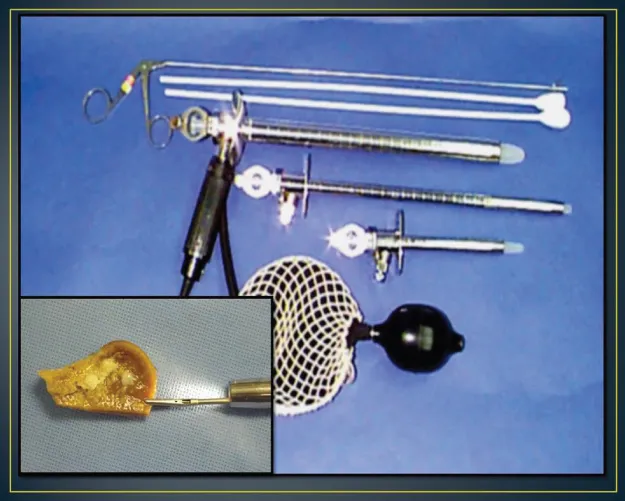
Rigid endoscopes include sigmoidoscopes, pictured in Figure 1.1, and telescopes. The sigmoidoscope is used for visualization of the descending colon and rectum, and can be used in the esophagus to aid in the removal of foreign bodies. The sigmoidoscope is a hollow tube that can range from 10 to 19 mm in outer diameter (o.d.) with a length of 5–25 cm. When the viewing window is closed and the bulb insufflator engaged, a luminal view is obtained. Visualization is magnified through the lens of the viewing window and light is transmitted through fiber-optic bundles that encircle the inner recesses of the tube. Owing to the large inner diameter, multiple types of biopsy and retrieval forceps may be inserted when the viewing window is opened.
Figure 1.1 Sigmoidoscope with (from top) rigid biopsy forceps, large cotton tip applicators, sigmoidoscope with light handle and obturator. Inset: example of foreign body retrieved.
Telescopes are a higher quality medical-grade rigid endoscope. The hollow tube houses a series of glass rod lenses that magnify the image back to the eyepiece. The image is viewed on a monitor via an attached camera or with the naked eye. Light is transmitted from a remote light source through light cables that attach at the light guidepost. Fiber-optic light bundles pass through the insertion tube to the distal tip. Light cables may be steam sterilized for laparoscopy and cystoscopy, and most models can be immersed for disinfection (check with the manufacturer). Be sure that the light cables in your inventory attach securely to the telescope. Adapters are available for different models.
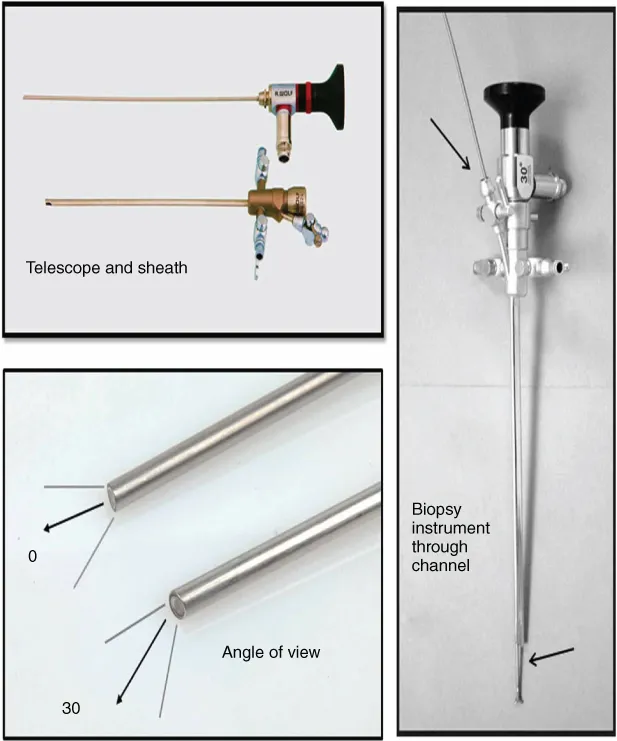
Rigid telescopes differ in outer diameters, viewing angles, and lengths, depending on their use (shown in Figure 1.2). These differences make them a versatile endoscope, especially when used in conjunction with an operating sheath. The o.d. can range from 1 to 10 mm, with lengths ranging from 18 to 30 cm. The most common telescope used in veterinary medicine is 2.7 mm by 18 cm with a 25 or 30° viewing lens.
Figure 1.2 Rigid telescope.
The viewing angle refers to the middle of the viewing field, shown in Figure 1.2. A 0° tip will allow for a frontward view, whereas an angled tip allows for an increased field of view by rotating the instrument. The angle of the tip can range from 10 to 120°.
Operating sheaths surround the rigid scope by attachment at the base of the eyepiece. Although the operating sheath will increase the outer diameter of the scope, it will also increase the telescope's versatility. Sheaths possess different functioning components. Fixed stopcocks positioned at the proximal end allow attachment for irrigation, or suction. Sheaths that have a working channel allow flexible instruments to pass beyond the telescope for biopsies and retrieval of foreign bodies. Levers on the stopcock control whether the port is opened or closed. When these features are utilized, the telescope becomes a multipurpose scope used to perform procedures such as cystoscopy, rhinoscopy, and arthroscopy.
Flexible Endoscopes
Flexible endoscopes are categorized into video and all-fiber-optic endoscopes. Fiber-optic endoscopes are commonly used in the veterinary setting since they are less expensive to operate, despite the fact they lack the superior technology of a video endoscope.
Video endoscopes ...
Table of contents
Cover
Title Page
Copyright
Table of Contents
List of contributors
Introduction
Chapter 1: Endoscopy equipment
Chapter 2: Endoscope care and cleaning
Chapter 3: Anesthesia considerations for the endoscopy patient
Chapter 4: Upper gastrointestinal tract endoscopy
Chapter 5: Lower gastrointestinal tract endoscopy
Chapter 6: Upper airway endoscopy
Chapter 7: Lower airway endoscopy
Chapter 8: Urogenital endoscopy
Chapter 9: Laparoscopy and thoracoscopy
Chapter 10: Arthroscopy
Chapter 11: The ultimate endoscopy suite
Index
End User License Agreement
Trusted by 375,005 students
Access to over 1.5 million titles for a fair monthly price.
Study more efficiently using our study tools.
Frequently asked questions
Yes, you can cancel anytime from the Subscription tab in your account settings on the Perlego website. Your subscription will stay active until the end of your current billing period. Learn how to cancel your subscription
No, books cannot be downloaded as external files, such as PDFs, for use outside of Perlego. However, you can download books within the Perlego app for offline reading on mobile or tablet. Learn how to download books offline
Perlego offers two plans: Essential and Complete
Essential is ideal for learners and professionals who enjoy exploring a wide range of subjects. Access the Essential Library with 800,000+ trusted titles and best-sellers across business, personal growth, and the humanities. Includes unlimited reading time and Standard Read Aloud voice.
Complete: Perfect for advanced learners and researchers needing full, unrestricted access. Unlock 1.5M+ books across hundreds of subjects, including academic and specialized titles. The Complete Plan also includes advanced features like Premium Read Aloud and Research Assistant.
Both plans are available with monthly, semester, or annual billing cycles.
We are an online textbook subscription service, where you can get access to an entire online library for less than the price of a single book per month. With over 1.5 million books across 990+ topics, we’ve got you covered! Learn about our mission
Look out for the read-aloud symbol on your next book to see if you can listen to it. The read-aloud tool reads text aloud for you, highlighting the text as it is being read. You can pause it, speed it up and slow it down. Learn more about Read Aloud
Yes! You can use the Perlego app on both iOS and Android devices to read anytime, anywhere — even offline. Perfect for commutes or when you’re on the go. Please note we cannot support devices running on iOS 13 and Android 7 or earlier. Learn more about using the app
Yes, you can access Endoscopy for the Veterinary Technician by Susan Cox in PDF and/or ePUB format, as well as other popular books in Medicine & Veterinary Medicine. We have over 1.5 million books available in our catalogue for you to explore.