- Brings together the most cutting edge, in-depth, and interesting scholarship on arguably the greatest living Asian filmmaker, from a multinational group of established and rising film scholars and critics
- Covers a huge breadth of topics such as the tradition of the jianghu in Wong's films; queering Wong's films not in terms of gender but through the artist's liminality; the phenomenological Wong; Wong's intertextuality; America through Wong's eyes; the optics of intensities, thresholds, and transfers of energy in Wong's cinema; and the diasporic presence of some ladies from Shanghai in Wong's Hong Kong
- Examines the political, historical, and sociological influence of Wong and his work, and discusses his work from a variety of perspectives including modern, post-modern, postcolonial, and queer theory
- Includes two appendices which examine Wong's work in Hong Kong television and commercials
- English
- ePUB (mobile friendly)
- Available on iOS & Android
eBook - ePub
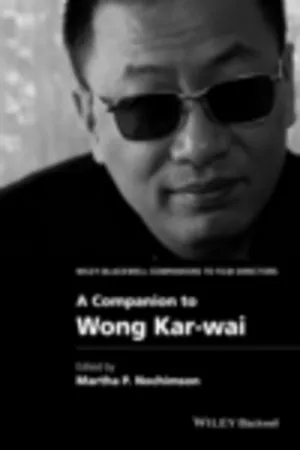
A Companion to Wong Kar-wai
About this book
With 25 essays that embrace a wide spectrum of topics and perspectives including intertextuality, transnationality, gender representation, repetition, the use of music, color, and sound, depiction of time and space in human affairs, and Wong's highly original portrayal of violence, A Companion to Wong Kar-Wai is a singular examination of the prestigious filmmaker known around the world for the innovation, beauty, and passion he brings to filmmaking.
Information
Part One
Introduction
Wong Kar-wai
Invoking the Universal and the Local
Martha P. Nochimson
Although he had been working in film and television in Hong Kong since the early 1980s, Wong Kar-wai began to come to the attention of the Western world only in 1994 with Chungking Express. His rise was meteoric. By 1995, he had won awards for Express in Hong Kong, Italy, and Sweden. By 1997, Express had also been nominated for several awards in the USA. The corridors of film schools echoed with excitement about his cinema. Since then, Wong has become an increasingly strong presence on the international film festival circuit, collecting nominations and awards at the prestigious Cannes film festival and at many other festivals from New York to Australia. Although he has never had an international following in the millions, beginning with Express he began to amass a sizable, devoted, world-wide constituency of moviegoers with a taste for innovation, beauty, and passion, and he continues to exert a powerful influence on young filmmakers.
Asian filmmakers in general only began to make their presence felt outside of their home countries when Akira Kurosawa's Rashomon won the Golden Lion at the Venice Film Festival in 1951, introducing the West to a history of narrative, visual, and aural presentation very different from that of European and American filmmaking. Since Rashomon, these alternate traditions have increasingly inspired Western filmmakers and intrigued Western filmgoers. Wong, with his astonishingly fluid camera, his stunning use of color, his extraordinarily modern sensitivity to the flow of time and the mysteries of objects in space, and his magisterial command of the vocabulary of human emotions, is one of the most prominent of the Asian filmmakers to let a torrent of fresh air into filmmaking practices.
While Wong's fellow directors have been dazzled by the gorgeous surfaces of Wong's cinema, critics have been another story. At first Western critics tended to view him almost entirely through the lens of cultural criticism, in terms of his Chinese/Hong Kong identity, seizing on the prevalence of clocks and calendars in Wong's films as proof that the engine of his cinema was an anxiety about the 1997 handover of Hong Kong by Great Britain to China. Even after 1997, many critics focused on what they saw as a post-handover malaise. Other early analyses attempted to expose the way Wong embedded images in his films of the modern commodification of Hong Kong by the West. This Companion follows in part in that tradition, containing a number of essays that interpret Wong's depiction of the politics of image, and images of politics, and also the history of Wong's achievement of an international niche as an arthouse filmmaker.
For example, in “Wong Kar-wai's Ladies From Shanghai” Gina Marchetti explores how Wong operates within the system of clichés, stereotypes, and historical conventions that have grown up in Asia, as well as in the Western world, about Shanghai. Marchetti points out a general tendency to encapsulate the tropes of Shanghai's glamour and “tendency to decadence” in the figure of a woman, for example Elsa Bannister, the gorgeous femme fatale played by Rita Hayworth in Orson Welles' The Lady From Shanghai (1947). Emphasizing how many women from Shanghai appear in Wong's films. Marchetti further illuminates how Wong plays with the existing conventions both to make use of their power and to express historical change in Hong Kong by transforming them.
In “The Sinophone Cinema of Wong Kar-wai” Audrey Yue explores Wong's nuanced manipulation of linguistic systems in a way that, in her words, introduces, “difference and heterogeneities to the singularity of China and Chinese-centrism.” Yue traces the ways in which Wong, instead of using different Chinese dialects in a way that reproduces an emphasis on ethnicity and nationality, employs Sinitic variations in a way that “redefines the boundaries of groups, ethnicities, and national affiliations.”
David Desser's reception study, “Chungking Express, Quentin Tarantino and the Making of a Reputation,” explores Wong's transnational existence as a filmmaker from a socio-economic perspective. With the meticulousness of a Holmesian detective, Desser traces the evolution of the reputation of Wong's breakout film, Chungking Express, and what it means to Wong's reputation and power as a transnational filmmaker. Marshaling historical and legal facts, Desser argues that the reputation of the film and Wong's reputation as a director were an outgrowth of the interplay of the traditions governing art film, including those that rule the festival circuit: changing laws and movie-going habits in the USA, changing dynamics in the relationship between European and Asian films in the international film community, the ascension of importance of the USA in the commercial viability of international film, and the influence of auteurs like Quentin Tarantino and Jean-Luc Godard.
Like Marchetti, Yue, and Desser, a number of other contributors to this Companion seek to expose and explore underlying ideologies in a given work by Wong or a given group of works by Wong. They emerge from a school of media literacy that has, since the 1960s, held the dominant position among film critics. Its pedigree has many times been traced to the well-known and widely quoted works of, in no particular order, Foucault, Greenblatt, Freud and Lacan, Lévi-Strauss, Marx, Derrida, and many of the foundational texts of feminism. It is therefore unnecessary to review the philosophical map that comprises these familiar thinkers in order to create a context for those essays to follow which have benefitted from their influence. However, not all the contributors to this volume are inheritors of this broadly based, influential school of criticism. Some of the contributors prefer other critical byways, those less taken, that focus not on what is invisible under the surface of the film, but on the meaning and import of Wong's exciting and sophistication cinematic surfaces. They do call for some extended introduction. This Companion has a heterogeneous nature.
Queer theorist Eve Kosofsky Sedgwick is responsible for inspiring one alternate family of theoretical writings that have a bearing on a number of the alternate approaches to Wong in this Companion. These approaches can be defined in contrast to the above-mentioned theorists or at least to the way they have been used to facilitate numerous forms of criticism, but that would be to demean them; it would be to present them as the not-Freudian and/or Lacanian, the not-Marxist and so forth. Sedgwick provides a way to define them from a point of view that engages what they are doing, not what they are not doing. Not that she or this volume is unappreciative of the influence of the works of Freud, Lacan, Marx, and others. It goes without saying that they have provided theory that has been instrumental in exposing the political nature of all film, revisioning patriarchy and its discontents, protecting difference, and protesting carefully disguised injustices. There are, of course, numerous disagreements from various quarters with various aspects of this critical approach. The one pertinent to this volume is its categorical rejection of biology as an inherent reality, its insistence that we only experience what we believe to be the energy of biology through the lens of cultural constructs. Because Wong's cinema is so heavily reliant on promoting in the audience a visceral response to bodies and physical nature through his use of sound and image, the profound distrust of biology in the constructionist school of thought has created impediments for critics interested in excavating this extremely prominent part of his artistry.
The distancing of the cultural critics from the biological is a sticking point for Sedgwick, a point she makes very clear in “Paranoid Reading and Reparative Reading,” an essay collected in Touching Feeling (2003, 123–151). Happily, Sedgwick's attempts to recover a belief in direct experience of the biological and the natural have implications for the essays by scholar contributors to this volume that are particularly focused on spectatorial experience of the sensuousness of Wong's images and the visceral affect of his use of sound and music. Particularly useful in this respect is Sedgwick's classification of the ways of making critical meaning into strong theory and weak theory.
Strong theory, weak theory. This classification, invented by Sedgwick, affirms the existence of validly different styles of thinking that some may find oppositional and some may find supplementary. If ever there were a case for the conclusion that they are supplementary, it is the critical literature about Wong Kar-wai. Simply put, Wong's critics fall into both camps. Bypassing the sensuousness of Wong's surface images, some form a necessary part of the critical literature about Wong by looking to the established frameworks and seeking universal statements about his cinema that reveal the ideological structures below Wong's surfaces. This circumnavigation of Wong's physicality in the name of universality is what Sedgwick identifies as the hallmark of strong theory. Those whom she would identify as strong critics in this volume, do just that. They seek to link Wong to the larger context of political and economic beliefs, and follow the same path as the first critics who wrote about Wong's films. Their work is an important part of the story about Wong, but it is a part. As will be clear below, if these estimable ideological analyses, typical of strong theorists and strong theory, add to our understanding of how Wong's cinema interfaces with culture, they leave untouched the lion's share of what appears on screen in Wong's films. When almost all the criticism in print was of this variety, it meant that there was an uneasy silence about much of what we see onscreen.
The alternate criticism in this volume ends that silence. It focuses on Wong's images, taking the approach that Sedgwick has identified as weak theory. To use Sedgwick's vocabulary, weak theory makes meaning from the local, sensual, and emotional textures of life and art, and numerous essays in this Companion are local in concept. Taking for their subject what we see, not what lurks invisibly beneath the surface, richly commenting of the textures of specific films in order to suggest ways of making meaning that depend not on abstractions of the symbolic order, but on emotional responses, they supplement our understanding of Wong by exploring his films through close reading. Sedgwick's weak theory, and its resuscitation of close reading, which strong theorists often reject as impressionistic and potentially in collusion with the naturalizations created by patriarchy, throws a new light on their efforts.
While weak theory has established its own intellectual pedigree since the 1980s, it is not yet as familiar as the constructionist debates among the strong theorists, so the first job of this introduction will be to unpack weak theory for the reader and to introduce its pertinence to Wong's art. Sedgwick acknowledges that the direction constructionist criticism has taken has a noble intent that has indeed been useful and successful in its goals. And indeed it would be difficult to deny that the dominant theorists, their cohort, and their inheritors, deploying the universalizing strategies of strong theory, make enormous intellectual gains through their practices of exposing, revealing, and delving into the hidden injustices, repressions, hegemonic tyrannies of naturalized, glamorized, and inordinately valorized cultural constructs, in life and in art. Sedgwick, on the other hand, found the theoretical leap into weak theory necessary because, as she cautions, the very victories of strong theory have at this point produced an important intellectual imbalance.
In Sedgwick's opinion, the extreme prejudice against the visceral truths of the sensory aspects of art and against any confidence in direct apprehension of nature are not theoretically necessary for maintaining exposure of concealed cultural lies. Furthermore, she contends that abandoning the sensory aspects of art prevent a total engagement with either it or life. The natures of strong theory and weak theory will be articulated more precisely below, but it is beyond the scope of this book to argue all aspects of Sedgwick's case about the advantages and disadvantages of weak and strong theory. That would involve delving into her depiction of the current intellectual climate as one permeated with fear, humiliation, and paranoia that she believes is the result of its dominion, indicated by her use of the words “paranoia” and “reparative” in the title of the essay mentioned above. Since Sedgwick asserts that the imbalances created by the dominant critical style have become counterproductive to the goals of feminism, queer theory, and many kinds of criticism with a reparative intent, debating these issues is seminal to the larger endeavors of philosophy and psychology. But they are tangential to the purposes of this Companion and would involve moving away from Wong's cinema and the critical essays contained herein.
What is germane here is Sedgwick's insistence on the simple fact of an imbalance in the way critical practices are carried out, which this volume does endorse. As I have noted above, this volume includes important new contributions to the literature about Wong that adhere to the ideals of strong criticism, but asserts that this is not the full story. We contend that it is necessary also to take a leap into what Sedgwick has labeled weak theory in order to make sense of the insights of the critics who concentrate on the indisputable presence in abundance of sensuousness. As we shall soon see, while the strong theorists in this Companion are continuing the strong theoretical traditions of ideological exposure, the weak theorists are recovering for the critical literature about Wong the importance of the persistence of his visual and sound images, which suffuse his cinema, but were almost invisible in early Wong criticism.
At the same time, it is also the contention of this Companion that Wong's is a cinema of liminality; liminality studies is still another family of criticism that tends to depart from dominant strong theory. While looking through the prism of strong theory, ...
Table of contents
- Cover
- Wiley Blackwell Companions to Film Directors
- Title page
- Copyright
- Notes on Contributors
- Acknowledgments
- Part One Introduction
- Part Two Mapping Wong's Liminality
- Part Three Thresholds of Texture and Mood
- Part Four In the Corridors of History and Culture
- Part Five Close-up of Wong's Inflections of Time and Space
- Part Six Focus on Individual Films
- Filmography
- Appendix I Wong Works in Television
- Appendix II Wong Works in Advertising
- Selected Bibliography
- Index
- EULA
Trusted by 375,005 students
Access to over 1.5 million titles for a fair monthly price.
Study more efficiently using our study tools.
Frequently asked questions
Yes, you can cancel anytime from the Subscription tab in your account settings on the Perlego website. Your subscription will stay active until the end of your current billing period. Learn how to cancel your subscription
No, books cannot be downloaded as external files, such as PDFs, for use outside of Perlego. However, you can download books within the Perlego app for offline reading on mobile or tablet. Learn how to download books offline
Perlego offers two plans: Essential and Complete
- Essential is ideal for learners and professionals who enjoy exploring a wide range of subjects. Access the Essential Library with 800,000+ trusted titles and best-sellers across business, personal growth, and the humanities. Includes unlimited reading time and Standard Read Aloud voice.
- Complete: Perfect for advanced learners and researchers needing full, unrestricted access. Unlock 1.5M+ books across hundreds of subjects, including academic and specialized titles. The Complete Plan also includes advanced features like Premium Read Aloud and Research Assistant.
We are an online textbook subscription service, where you can get access to an entire online library for less than the price of a single book per month. With over 1.5 million books across 990+ topics, we’ve got you covered! Learn about our mission
Look out for the read-aloud symbol on your next book to see if you can listen to it. The read-aloud tool reads text aloud for you, highlighting the text as it is being read. You can pause it, speed it up and slow it down. Learn more about Read Aloud
Yes! You can use the Perlego app on both iOS and Android devices to read anytime, anywhere — even offline. Perfect for commutes or when you’re on the go.
Please note we cannot support devices running on iOS 13 and Android 7 or earlier. Learn more about using the app
Please note we cannot support devices running on iOS 13 and Android 7 or earlier. Learn more about using the app
Yes, you can access A Companion to Wong Kar-wai by Martha P. Nochimson in PDF and/or ePUB format, as well as other popular books in Media & Performing Arts & Film History & Criticism. We have over 1.5 million books available in our catalogue for you to explore.