Inherited Bleeding Disorders in Women
  1. English
  2. ePUB (mobile friendly)
  3. Available on iOS & Android
eBook - ePub

About this book

The essential guide for understanding and treating women with inherited bleeding disorders, revised and updated

Now in its second edition, Inherited Bleeding Disorders in Women includes the most recent developments and research in the field. This important guide offers the most current information available for the effective management of these complex and difficult to diagnose disorders. Treating women with inherited bleeding disorders can be challenging and requires close collaboration among practitioners in different specialties.

This important guide is written by a team of international experts who offer advice and practical suggestions for treating women with inherited bleeding disorders. Inherited Bleeding Disorders in Women comprehensively covers obstetric and gynecological issues for carriers of hemophilia, women with von Willebrand disease, rare bleeding disorders and inherited platelet disorders. This important resource:

  • Offers an updated guide for hematologists, obstetricans and gynecologists and other clinicians treating women with inherited bleeding disorders
  • Includes information for treating both common and rare bleeding disorders
  • Contains the most recent developments and advances in the field for the treatment and management of inherited bleeding disorders in women
  • Presents information from noted experts in the field
  • Offers a multidisciplinary approach to the topic

Written for hematologists, obstetricians and gynecologists and other clinicians working with women, Inherited Bleeding Disorders in Women has been fully revised and updated and continues to serve as a trusted guide for the management and treatment of women with inherited bleeding disorders.
Frequently asked questions

Yes, you can cancel anytime from the Subscription tab in your account settings on the Perlego website. Your subscription will stay active until the end of your current billing period. Learn how to cancel your subscription.
No, books cannot be downloaded as external files, such as PDFs, for use outside of Perlego. However, you can download books within the Perlego app for offline reading on mobile or tablet. Learn more here.
Perlego offers two plans: Essential and Complete
  • Essential is ideal for learners and professionals who enjoy exploring a wide range of subjects. Access the Essential Library with 800,000+ trusted titles and best-sellers across business, personal growth, and the humanities. Includes unlimited reading time and Standard Read Aloud voice.
  • Complete: Perfect for advanced learners and researchers needing full, unrestricted access. Unlock 1.4M+ books across hundreds of subjects, including academic and specialized titles. The Complete Plan also includes advanced features like Premium Read Aloud and Research Assistant.
Both plans are available with monthly, semester, or annual billing cycles.
We are an online textbook subscription service, where you can get access to an entire online library for less than the price of a single book per month. With over 1 million books across 1000+ topics, we’ve got you covered! Learn more here.
Look out for the read-aloud symbol on your next book to see if you can listen to it. The read-aloud tool reads text aloud for you, highlighting the text as it is being read. You can pause it, speed it up and slow it down. Learn more here.
Yes! You can use the Perlego app on both iOS or Android devices to read anytime, anywhere — even offline. Perfect for commutes or when you’re on the go.
Please note we cannot support devices running on iOS 13 and Android 7 or earlier. Learn more about using the app.
Yes, you can access Inherited Bleeding Disorders in Women by Rezan A. Kadir, Paula D. James, Christine A. Lee, Rezan A. Kadir,Paula D. James,Christine A. Lee in PDF and/or ePUB format, as well as other popular books in Medicina & Hematología. We have over one million books available in our catalogue for you to explore.

Information

Year
2018
Print ISBN
9781119426028
eBook ISBN
9781119426066
Edition
2
Subtopic
Hematología

1
Hematological Assessment of a Patient with an Inherited Bleeding Disorder

Sue Pavord and Henna Wong
Oxford University Hospitals NHS Foundation Trust, Oxford, UK

1.1 Introduction

The inherited bleeding disorders (IBDs) are a heterogeneous group of disorders affecting the hemostatic system. In individuals in whom the underlying abnormality has been identified, the majority of IBDs are due to von Willebrand disease (VWD) and disorders of coagulation factors; a small proportion are due to abnormalities in platelet count or function or defects in the fibrinolytic system [1]. Around 2% of patients registered with a bleeding disorder do not have a classifiable disorder [1].
Individuals with IBDs may give a life‐long history of excessive bruising or bleeding, but many only manifest when faced with a hemostatic challenge or are picked up incidentally by abnormal coagulation tests. Indeed some, such as certain cases of factor XI (FXI) deficiency, may not have a bleeding phenotype at all, even when exposed to hemostatic challenges. IBDs can affect all genders, but women with IBDs face added challenges related to menstruation, pregnancy, and childbirth. Undiagnosed bleeding disorders can often be the cause of heavy menstrual bleeding and also the cause of or a contributory factor for other gynecological problems, such as bleeding from the corpus luteum [2].
Women with IBDs may present with a positive bleeding history or have a known family history. Manifestations of bleeding can vary, even within the same type of disorder, because of the influence of concomitant inherited and acquired factors. An integrated clinical and laboratory assessment is therefore essential in the diagnostic work‐up.
This chapter will cover the mechanisms of normal hemostasis and an approach to the clinical and laboratory hematological assessment of a patient with a suspected IBD.

1.2 Normal Hemostasis

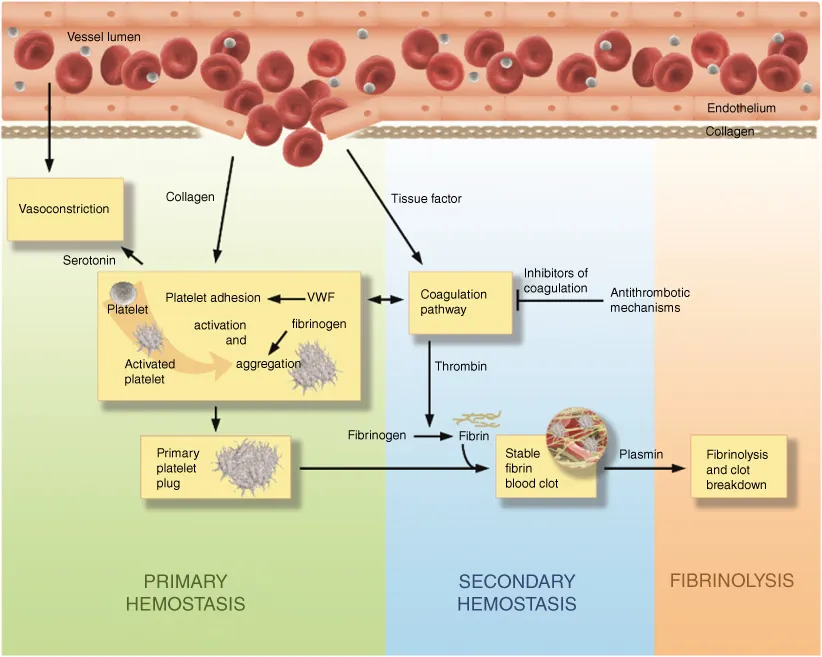
After damage to the lining of the blood vessel wall, the body responds with physiological mechanisms to stop bleeding and maintain hemostasis, without causing more widespread thrombosis. This co‐ordinated process involves components of the blood, including platelets and clotting factors, with the overall aim of forming a stable blood clot (Figure 1.1). Hemostasis is achieved through a delicate balance of pro‐ and anticoagulant factors to stop bleeding while simultaneously avoiding development of pathological thrombi [3].
Schematic overview depicting the processes of primary hemostasis, secondary hemostasis, and fibrinolysis.
Figure 1.1 Overview of hemostasis and key components. A vascular injury exposes collagen that allows platelets to adhere via VWF to the subendothelium. Activation of platelets occurs and platelets aggregate together via VWF and fibrinogen. Primary hemostasis results in the formation of the initial platelet plug. Tissue factor activates the coagulation pathway in parallel with platelet activation; both pathways enhance each other. Fibrinolysis prevents excessive thrombus formation, through the generation of plasmin followed by the digestion of fibrin.
Source: Modified from www.thrombocyte.com/hemostasis‐definition.

1.2.1 Primary Hemostasis

In the early stages after vessel injury, interactions between platelets, the subendothelium, and adhesive proteins lead to the formation of a platelet plug (primary hemostasis). The three main steps of primary hemostasis are as follows.
  1. Platelet adhesion: following vessel injury, von Willebrand factor (VWF) binds to specific sites on exposed collagen. Platelets adhere to the exposed subendothelial matrix (directly or indirectly via VWF). This is mediated through binding of VWF with the platelet glycoprotein GP1b, while GPVI interacts with collagen, and platelet β1 integrin with laminin, collagen, and fibronectin. These interactions enable firm adhesion of platelets to the exposed subendothelial matrix [3].
  2. Platelet activation: platelet adhesion to the subendothelium triggers shape change and release of platelet α and dense granule contents. This activation recruits and activates additional platelets to the injured site. (Thrombin, produced by the coagulation pathway, adds to the activation of platelets.)
  3. Platelet aggregation and platelet plug formation: thrombin cleaves fibrinogen and the resulting fibrin monomers form a bridge between activated platelets, causing platelets to aggregate together, forming a platelet plug. The GPIIb/IIIa platelet receptor is converted into its high‐affinity conformation, allowing for stable interactions between the receptor and fibrin, VWF, and fibronectin.

1.2.2 Secondary Hemostasis

Secondary hemostasis usually occurs simultaneously with primary hemostasis. After endothelial damage, tissue factor (TF) is exposed, which binds to and activates FVII. The TF‐FVIIa complex then stimulates generation of small amounts of thrombin and FXIa through the extrinsic pathway. Thrombin generation is amplified through the intrinsic pathway starting with FXI and through the downstream cascade including co‐factors FVIII and FV (Figure 1.2). These enzymatic reactions occur on the surface of platelets and other cell surfaces. This leads to the formation of FXa on the platelet surface which, aided by its co‐factor, FVa, generates an explosive burst of thrombin. Thrombin catalyze...

Table of contents

  1. Cover
  2. Table of Contents
  3. Preface to Second Edition
  4. Preface to First Edition
  5. List of Contributors
  6. 1 Hematological Assessment of a Patient with an Inherited Bleeding Disorder
  7. 2 Bleeding Assessment Tools
  8. 3 Physiology of Menstruation
  9. 4 Gynecology
  10. 5 Carriers of Hemophilia A and Hemophilia B
  11. 6 Von Willebrand Disease
  12. 7 Factor XI Deficiency
  13. 8 Rare Bleeding Disorders
  14. 9 Inherited Platelet Defects
  15. 10 Genetic and Laboratory Diagnosis
  16. 11 Antenatal Diagnosis
  17. 12 Analgesia and Anesthesia for Pregnant Women with Inherited Bleeding Disorders
  18. 13 The Newborn
  19. 14 Women with Inherited Bleeding Disorders in Different Cultural Settings
  20. Index
  21. End User License Agreement