- English
- ePUB (mobile friendly)
- Available on iOS & Android
eBook - ePub
About this book
The eighth volume in a series of handbooks on graphene research and applications
The Handbook of Graphene, Volume 8: Technology and Innovations discusses the role of graphene-based applications in technological advancements. Topics include graphene materials used in circuit board repairs; RFID antenna and sensor fabrication; and wearable healthcare electronics. Chapters present detailed information on: modeling methods used in graphene research; applications of graphene-on-silicon photonic integrated circuits; the development of graphene for engineering applications; and other graphene subjects of interest to scientists, chemists and physicists.
Frequently asked questions
Yes, you can cancel anytime from the Subscription tab in your account settings on the Perlego website. Your subscription will stay active until the end of your current billing period. Learn how to cancel your subscription.
No, books cannot be downloaded as external files, such as PDFs, for use outside of Perlego. However, you can download books within the Perlego app for offline reading on mobile or tablet. Learn more here.
Perlego offers two plans: Essential and Complete
- Essential is ideal for learners and professionals who enjoy exploring a wide range of subjects. Access the Essential Library with 800,000+ trusted titles and best-sellers across business, personal growth, and the humanities. Includes unlimited reading time and Standard Read Aloud voice.
- Complete: Perfect for advanced learners and researchers needing full, unrestricted access. Unlock 1.4M+ books across hundreds of subjects, including academic and specialized titles. The Complete Plan also includes advanced features like Premium Read Aloud and Research Assistant.
We are an online textbook subscription service, where you can get access to an entire online library for less than the price of a single book per month. With over 1 million books across 1000+ topics, weāve got you covered! Learn more here.
Look out for the read-aloud symbol on your next book to see if you can listen to it. The read-aloud tool reads text aloud for you, highlighting the text as it is being read. You can pause it, speed it up and slow it down. Learn more here.
Yes! You can use the Perlego app on both iOS or Android devices to read anytime, anywhere ā even offline. Perfect for commutes or when youāre on the go.
Please note we cannot support devices running on iOS 13 and Android 7 or earlier. Learn more about using the app.
Yes, you can access Handbook of Graphene, Volume 8 by Sulaiman Wadi Harun in PDF and/or ePUB format, as well as other popular books in Technology & Engineering & Materials Science. We have over one million books available in our catalogue for you to explore.
Information
Chapter 1
Reworking Defective Soldering Joints With Graphene Sheets and Gold Nanoparticles
Ezzat G. Bakhoum
University of West Florida, Pensacola, Florida, USA
Email: [email protected]
Abstract
This chapter describes a novel use of graphene that was recently published by the author: the repair of defective soldering joints in densely packed printed circuit boards and multi-chip modules. Gold nanoparticles are first deposited on the surface of a miniature graphene sheet. The graphene sheet is then attached or placed on the solder pad or joint that must be reworked, and a low-power laser with a wavelength in the range of 500ā800 nm is directed to the area where the graphene sheet is present. Gold nanoparticles absorb the electromagnetic radiation at such wavelengths very effectively, and intense surface plasmons are generated in the nanoparticles. The surface plasmons cause the nanoparticlesāand the graphene sheet to which the nanoparticles are attachedāto heat up, where the temperature can reach several hundred degrees Celsius. This in turn causes the solder that is in contact with the graphene sheet to melt, while other solder joints in the vicinity remain unaffected. The narrow wavelength range of 540ā572 was determined to be the optimal range of wavelengths for the present application.
Keywords: Precision soldering, applications of gold nanoparticles, low power laser in industrial applications, applications of graphene, heating profile in soldering
1.1 Introduction
This chapter describes some recent major improvements to a very old application: manual soldering. Traditionally, the ubiquitous soldering iron is the tool of choice for fixing defective soldering joints. Continuous miniaturization of consumer products during the past two decades, however, has led to printed circuit (PC) boards and multi-chip modules that are very densely packed with components. The inter-lead spacing in many integrated circuit (IC) chips nowadays is typically 0.5 mm, and the inter-component spacing on most PC boards is even less. Reworking a single defective soldering joint on a PC board has therefore become very challenging, because it is practically impossible to touch a joint with a soldering iron without also touching the neighboring joints. For this reason, a research group led by the author has recently developed and published a totally new technique for reworking/repairing defective soldering joints in PC boards and multi-chip modules [1]. The technique is not based on traditional soldering methods or tools, but rather on the remarkable properties of graphene and gold nanoparticles (GNPs).
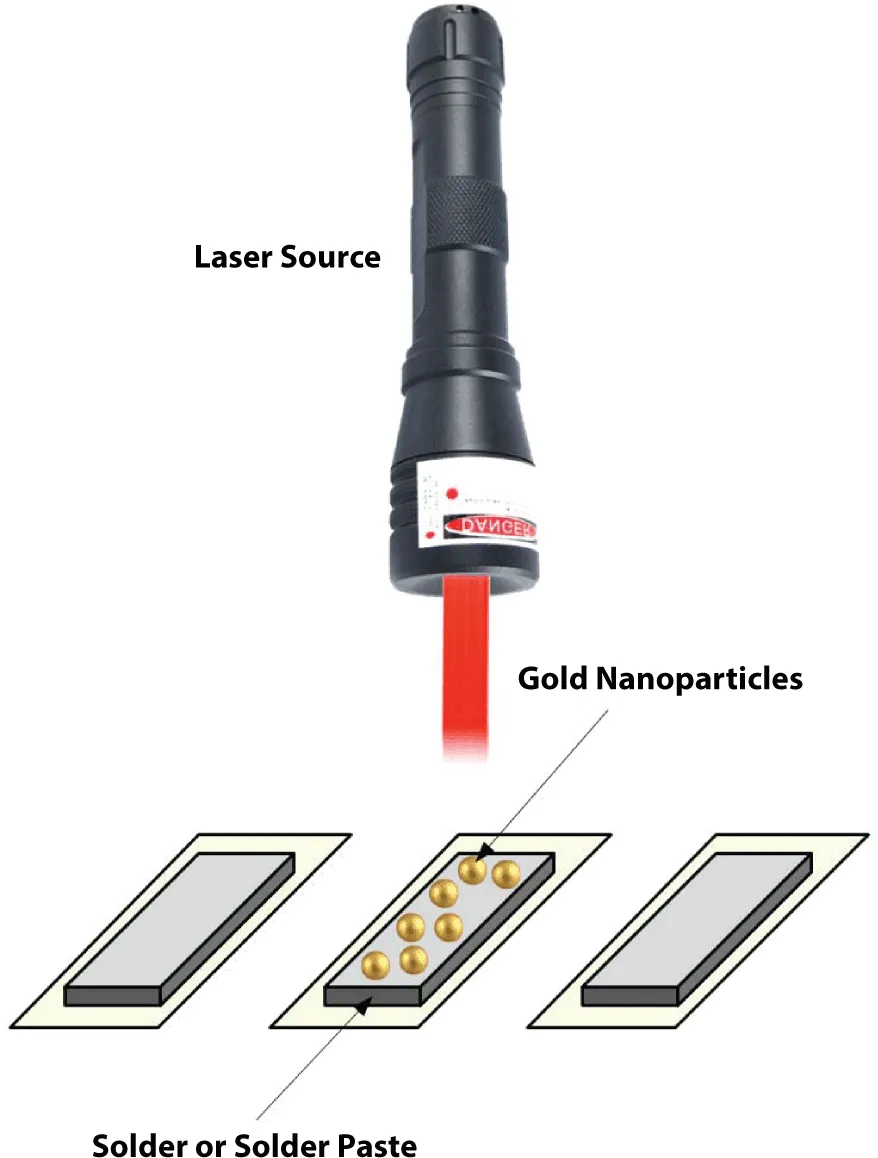
Figure 1.1 shows the fundamental principle of the new precision soldering technique. In recent years, it was discovered that GNPs have the ability to absorb electromagnetic radiation in the wavelength range of 500ā800 nm (green to infrared) very effectively, where the absorption of electromagnetic energy at such wavelengths results in intense surface plasmons in the gold nanoparticle [2ā7]. It was observed that the presence of such surface plasmons instantly raises the temperature of the GNPs several hundred degrees Celsius. In the present application, GNPs are deposited on a pad or solder joint that must be reworked. A low-power laser is directed to the area where the gold nanoparticles are present. The GNPs heat up, where the temperature can quickly reach several hundred degrees. This causes the solder that is in contact with the nanoparticles to melt, while other solder joints in the vicinity remain unaffected. It is important to point out that the laser beam in Figure 1.1 may cover a large area (one or more pads), but only the pads or joints where the GNPs are present will experience a rise in temperature.

Figure 1.1 Fundamental principle of the new precision soldering technique: gold nanoparticles (dimensions greatly exaggerated) are deposited on a pad or solder joint that must be reworked. A low-power laser is directed to the area where the gold nanoparticles are present. Surface plasmons in the nanoparticles cause the nanoparticles to heat up, where the temperature can reach several hund...
Table of contents
- Cover
- Title Page
- Copyright
- Preface
- Chapter 1: Reworking Defective Soldering Joints With Graphene Sheets and Gold Nanoparticles
- Chapter 2: Printed Graphene Radio Frequency and Sensing Applications for Internet of Things
- Chapter 3: Modeling and Characterization of the Metal Contact and the Channel in a Graphene Device
- Chapter 4: Modeling of Graphene-Based Electronics: From Material Properties to Circuit Simulations
- Chapter 5: Hybrid GrapheneāSilicon Photonic and Optoelectronic Integrated Devices
- Chapter 6: Sustainability, Research, and Development of Graphene for Engineering Applications
- Chapter 7: Graphene Oxide Multilayers Obtained from Bamboo: New Synthesis Method, Basic Properties, and Future Electronic Applications
- Chapter 8: Laser Direct-Writing Graphene Oxide to GrapheneāMechanisms to Applications
- Chapter 9: Wave Propagation Responses of Double-Layered Graphene Sheets in Hygrothermal Environment
- Chapter 10: Graphene Terahertz Leaky-Wave Antennas
- Chapter 11: Terahertz Applications of Graphene
- Chapter 12: Modelling of Graphene Nanoribbons Antenna Based on MoM-GEC Method to Enhance Nanocommunications in Terahertz Range
- Chapter 13: Graphene-Based Plasmonic Components for THz Applications: Planar Ring Array Devices
- Chapter 14: Continuous Graphene Oxide Fiber and Its Applications
- Chapter 15: Buckling Characteristics of Bilayer Graphene Sheets Subjected to Humid Thermomechanical Loading
- Chapter 16: Polymer/Graphene Nanomaterials: A Platform for Current High-Tech Applications
- Chapter 17: Graphene-Based Advanced Nanostructures
- Index
- End User License Agreement