Small Unmanned Fixed-wing Aircraft Design is the essential guide to designing, building and testing fixed wing UAVs (or drones). It deals with aircraft from two to 150 kg in weight and is based on the first-hand experiences of the world renowned UAV team at the UK's University of Southampton.
The book covers both the practical aspects of designing, manufacturing and flight testing and outlines and the essential calculations needed to underpin successful designs. It describes the entire process of UAV design from requirements definition to configuration layout and sizing, through preliminary design and analysis using simple panel codes and spreadsheets to full CFD and FEA models and on to detailed design with parametric CAD tools. Its focus is on modest cost approaches that draw heavily on the latest digital design and manufacturing methods, including a strong emphasis on utilizing off-the-shelf components, low cost analysis, automated geometry modelling and 3D printing.
It deliberately avoids a deep theoretical coverage of aerodynamics or structural mechanics; rather it provides a design team with sufficient insights and guidance to get the essentials undertaken more pragmatically. The book contains many all-colour illustrations of the dozens of aircraft built by the authors and their students over the last ten years giving much detailed information on what works best. It is predominantly aimed at under-graduate and MSc level student design and build projects, but will be of interest to anyone engaged in the practical problems of getting quite complex unmanned aircraft flying. It should also appeal to the more sophisticated aero-modeller and those engaged on research based around fixed wing UAVs.
Fixed-wing aircraft have now been successfully designed and flown for over 100 years. Aero-modelers have been flying quite large aircraft at low subsonic speeds for decades, sometimes at scales as large as one-third the full size. Given the accumulated experience, it is therefore a relatively straightforward task to design, build, and fly a workable fixed-wing unmanned air vehicle (UAV) platform, armed with one of the many textbooks available on aircraft design (perhaps the most famous of these being that by Torenbeek [1], though there are many others). Even a cursory search of the Web will reveal hundreds of UAVs, many of them fixed-wing, and a number being offered for sale commercially. What is much less simple is to quickly make robust and reliable airframes in a repeatable manner at low cost, tailored to specific missions and suitable for commercial-grade operations.
If one has to rely on the craft skills of a highly gifted model-maker to construct an aircraft, costs rapidly rise, timescales lengthen, and repeatability becomes difficult to ensure. The use of bespoke molds and various forms of composites allows a much higher standard of airframe, but the initial production costs become then high and the ability to alter designs becomes very limited. Conversely, by using commodity off-the-shelf components combined with computer-aided design (CAD)-based digital manufacture, craft skills can be eliminated, costs lowered, and repeatability guaranteed. Clearly, if one has always to manually adapt an existing design to come up with a specification for a new aircraft, much design flexibility is lost; if, instead, lightweight decision support tools are linked to sophisticated parametric CAD models, high-quality design concepts can be rapidly developed to specific needs.
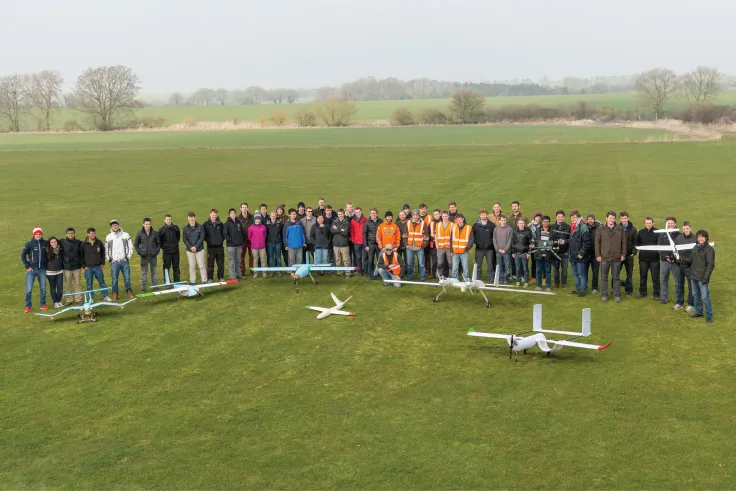
This is the fundamental design philosophy adopted by the UAV team at the University of Southampton (Figure 1.1) and forms the guiding approach of this book. The basic idea is to work in a digital, online world, buying parts where possible and manufacturing custom items only where absolutely necessary – essentially the aim is to source a kit of components either from part suppliers or companies offering online CAD-based manufacture, which then simply requires assembly to produce the finished aircraft. This means that the resulting UAVs are of a high and repeatable quality with as much emphasis on smart design as possible. This philosophy has become possible largely because of a revolution in bespoke digital manufacturing capabilities afforded by advanced CAD, Internet-based sourcing, low-cost computer numerical controlled (CNC) machining, and the widespread availability of 3D printing of functional components. In particular, the use of SLS nylon and metal has transformed the way in which main fuselage components and bespoke aircraft fittings can now be made. The core aims throughout our work have been to seek
1. low costs with highly repeatable and robust products,
2. rapid conversion of design changes into flying aircraft to meet new requirements, and
3. flexible payload systems
combined with
1. duplication of all flight critical systems,
2. sufficiently sophisticated avionics to allow fully autonomous takeoff, flight, and landing,
3. large and strong fixtures and joints to provide tolerance of uneven landing sites and day-to-day ground handling, and
4. low take-off and landing speeds to minimize risks of damage during operations.
Figure 1.1 The University of Southampton UAV team with eight of our aircraft, March 2015.
See also https://www.youtube.com/c/SotonUAV and https://www.sotonuav.uk/.
These aims ensure long-lived and robust commercial-grade aircraft, which can survive hundreds of flight cycles and thousands of flight hours – something that model aircraft never see.
1.1 Externally Sourced Components
To test our evolving design environments and build capabilities, a range of aircraft types have been considered. In all cases, these started with the knowledge that some of the major airframe components have to be externally sourced and that one has therefore to work with what is readily available in appropriate sizes. The following list of such components forms a key starting point for what follows. To maintain low costs, some things simply have to be sourced off the shelf:
1.Engines. Either petrol or glow-plug internal combustion engines ranging from 10 up to 200 cc (cm
) in single-, twin-, three-, and four-cylinder configurations;
2.Electric motors. Usually rare-earth permanent magnet motors with digital speed controllers – which are available in a wide range of sizes;
3.Starters and generators. External or in-built starters, direct drive or coupled via drive belts;
4.Propellers. Pusher and tractor propellers available in wood, nylon, and carbon-fiber-reinforced plastic (CFRP) with between two and six blades;
5.Batteries. NiMH, LiFe, or LiPo aircraft-grade batteries;
6.Receiver/transmitter systems for primary flight control. High end aero-modeler systems from companies such as Futaba (which now support two-way transmission of data including rpm, temperature, and geographical positioning system (GPS) sensors on the aircraft);
7.Autopilots. Many are available, but we use Arduino and SkyCircuits1
systems (including ground stations and software environments);
8.Servos and actuators. High-quality, high-torque, metal-geared aero-modeler items;
9.Undercarriages and wheels. High-quality aero-modeler items, typically including suspension and sometimes a retract capability.
At larger take-off weights, items such as propellers and undercarriages are more difficult to source, and then it is sometimes necessary to have bespoke items made by specialist suppliers – even so, it is desirable to use companies with sufficient turnover and expertise so that costs can be controlled and quality maintained. Given a ready supply of such items and the intention to build a conventional fixed-wing monoplane, the primary layout choices available to the designer then concern the number and positioning of engines/motors and the choice of fuselage/empennage type.
1.2 Manufacturing Methods
As already noted, a key requirement for the manufacture of the UAVs being considered here is that ideally no craft skills be needed in construction. Thus the focus is on
advanced parametric CAD-based geometry design;
logical and CAD-based design of wiring looms including all plug/socket physical details with manufacture by dedicated specialists;
numerically controlled digital manufacture involving
– 3D printing – selective laser-sintered (SLS) nylon or metal and fused deposition modeling (FDM) ABS,
– laser-cut wood and plastic,
– hot-wire-cut foam (foam parts sometimes being covered by outsourcing to specialists);
use of stock-sized materials such as off-the-shelf CFRP tubular sections.
None of these involves a novel approach, but it is certainly the case that typical aero-modelers do not use such methods. Moreover, the use of SLS nylon and FDM ABS in aircraft fuselage design is relatively new, being an approach championed at the University of Southampton (who flew the world's first all- SLS printed aircraft in August 20112). Most UAVs currently rely on bespoke-molded CFRP fuselage sections which, although offering good strength-to-weight ratios, increase the cost and reduce the speed with which design changes can be implemented. Three-dimensional printing allows designers to continue to refine their work to within 48 h of flight trials with impunity.
1.3 Project DECODE
Although universities across the world conduct a huge amount of design-related research, it is relatively rare for academic...
Table of contents
Cover
Related titles
Title Page
Copyright
Dedication
Table of Contents
List of Figures
List of Tables
Foreword
Series Preface
Preface
Acknowledgments
Part I: Introducing Fixed-Wing UAVs
Part II: The Aircraft in More Detail
Part III: Designing UAVs
Part IV: Manufacture and Flight
Part V: Appendices, Bibliography, and Index
Appendix A: Generic Aircraft Design Flowchart
Appendix B: Example AirCONICS Code for Decode-1
Appendix C: Worked (Manned Aircraft) Detail Design Example
Bibliography
Index
End User License Agreement
Trusted by 375,005 students
Access to over 1.5 million titles for a fair monthly price.
Study more efficiently using our study tools.
Frequently asked questions
Yes, you can cancel anytime from the Subscription tab in your account settings on the Perlego website. Your subscription will stay active until the end of your current billing period. Learn how to cancel your subscription
No, books cannot be downloaded as external files, such as PDFs, for use outside of Perlego. However, you can download books within the Perlego app for offline reading on mobile or tablet. Learn how to download books offline
Perlego offers two plans: Essential and Complete
Essential is ideal for learners and professionals who enjoy exploring a wide range of subjects. Access the Essential Library with 800,000+ trusted titles and best-sellers across business, personal growth, and the humanities. Includes unlimited reading time and Standard Read Aloud voice.
Complete: Perfect for advanced learners and researchers needing full, unrestricted access. Unlock 1.5M+ books across hundreds of subjects, including academic and specialized titles. The Complete Plan also includes advanced features like Premium Read Aloud and Research Assistant.
Both plans are available with monthly, semester, or annual billing cycles.
We are an online textbook subscription service, where you can get access to an entire online library for less than the price of a single book per month. With over 1.5 million books across 990+ topics, we’ve got you covered! Learn about our mission
Look out for the read-aloud symbol on your next book to see if you can listen to it. The read-aloud tool reads text aloud for you, highlighting the text as it is being read. You can pause it, speed it up and slow it down. Learn more about Read Aloud
Yes! You can use the Perlego app on both iOS and Android devices to read anytime, anywhere — even offline. Perfect for commutes or when you’re on the go. Please note we cannot support devices running on iOS 13 and Android 7 or earlier. Learn more about using the app
Yes, you can access Small Unmanned Fixed-wing Aircraft Design by Andrew J. Keane,András Sóbester,James P. Scanlan, Peter Belobaba, Jonathan Cooper, Allan Seabridge, Peter Belobaba,Jonathan Cooper,Allan Seabridge in PDF and/or ePUB format, as well as other popular books in Technology & Engineering & Mechanical Engineering. We have over 1.5 million books available in our catalogue for you to explore.