Quantitative Pharmacology and Individualized Therapy Strategies in Development of Therapeutic Proteins for Immune-Mediated Inflammatory Diseases
eBook - ePub

Quantitative Pharmacology and Individualized Therapy Strategies in Development of Therapeutic Proteins for Immune-Mediated Inflammatory Diseases

  1. English
  2. ePUB (mobile friendly)
  3. Available on iOS & Android
eBook - ePub

Quantitative Pharmacology and Individualized Therapy Strategies in Development of Therapeutic Proteins for Immune-Mediated Inflammatory Diseases

About this book

Thorough Overview Identifies and Addresses Critical Gaps in the Treatment of Several Chronic Diseases

With increasing numbers of patients suffering from Immune-Mediated Inflammatory Diseases (IMIDs), and with the increasing reliance on biopharmaceuticals to treat them, it is imperative that researchers and medical practitioners have a thorough understanding of the absorption, distribution, metabolism and excretion (ADME) of therapeutic proteins as well as translational pharmacokinetic/pharmacodynamic (PK/PD) modeling for them. This comprehensive volume answers that need to be addressed.

Featuring eighteen chapters from world-renowned experts and opinion leaders in pharmacology, translational medicine and immunology, editors Honghui Zhou and Diane Mould have curated a much-needed collection of research on the advanced applications of pharmacometrics and systems pharmacology to the development of biotherapeutics and individualized treatment strategies for the treatment of IMIDs. Authors discuss the pathophysiology of autoimmune diseases in addition to both theoretical and practical aspects of quantitative pharmacology for therapeutic proteins, current translational medicine research methodologies and novel thinking in treatment paradigm strategies for IMIDs. Other notable features include:

• Contributions from well-known authors representing leading academic research centers, specialized contract research organizations and pharmaceutical industries whose pipelines include therapeutic proteins

• Chapters on a wide range of topics (e.g., pathophysiology of autoimmune diseases, biomarkers in ulcerative colitis, model-based meta-analysis use in the development of therapeutic proteins)

• Case studies of applying quantitative pharmacology approaches to guiding therapeutic protein drug development in IMIDs such as psoriasis, inflammatory bowel disease, multiple sclerosis and lupus

Zhou and Mould's timely contribution to the critical study of biopharmaceuticals is a valuable resource for any academic and industry researcher working in pharmacokinetics, pharmacology, biochemistry, or biotechnology as well as the many clinicians seeking the safest and most effective treatments for patients dealing with chronic immune disorders.
Frequently asked questions

Yes, you can cancel anytime from the Subscription tab in your account settings on the Perlego website. Your subscription will stay active until the end of your current billing period. Learn how to cancel your subscription.
No, books cannot be downloaded as external files, such as PDFs, for use outside of Perlego. However, you can download books within the Perlego app for offline reading on mobile or tablet. Learn more here.
Perlego offers two plans: Essential and Complete
  • Essential is ideal for learners and professionals who enjoy exploring a wide range of subjects. Access the Essential Library with 800,000+ trusted titles and best-sellers across business, personal growth, and the humanities. Includes unlimited reading time and Standard Read Aloud voice.
  • Complete: Perfect for advanced learners and researchers needing full, unrestricted access. Unlock 1.4M+ books across hundreds of subjects, including academic and specialized titles. The Complete Plan also includes advanced features like Premium Read Aloud and Research Assistant.
Both plans are available with monthly, semester, or annual billing cycles.
We are an online textbook subscription service, where you can get access to an entire online library for less than the price of a single book per month. With over 1 million books across 1000+ topics, we’ve got you covered! Learn more here.
Look out for the read-aloud symbol on your next book to see if you can listen to it. The read-aloud tool reads text aloud for you, highlighting the text as it is being read. You can pause it, speed it up and slow it down. Learn more here.
Yes! You can use the Perlego app on both iOS or Android devices to read anytime, anywhere — even offline. Perfect for commutes or when you’re on the go.
Please note we cannot support devices running on iOS 13 and Android 7 or earlier. Learn more about using the app.
Yes, you can access Quantitative Pharmacology and Individualized Therapy Strategies in Development of Therapeutic Proteins for Immune-Mediated Inflammatory Diseases by Honghui Zhou, Diane R. Mould, Honghui Zhou,Diane R. Mould in PDF and/or ePUB format, as well as other popular books in Medicine & Immunology. We have over one million books available in our catalogue for you to explore.

Information

Publisher
Wiley
Year
2019
Print ISBN
9781119289197
eBook ISBN
9781119289227
Edition
1
Subtopic
Immunology

1
Disease Interception in Autoimmune Diseases: From a Conceptual Framework to Practical Implementation

Anish Suri
Janssen R&D, Beerse, BE; Current Address: Cue Biopharma, 21 Erie Street, Cambridge, MA

1.1 Introduction to Disease Interception

The hallmark of autoimmunity, and perhaps many immune‐mediated inflammatory diseases, is the inappropriate recognition of self‐tissue resulting in subsequent effector reactions that ultimately damage the host. Numerous components may underlie these outcomes and likely include lack of central immune tolerance to self, breakdown of peripheral tolerance mechanisms that control inflammation, relevant stress signals that enhance and/or modify antigenicity of self‐tissues, and a complex interplay between the host and the environment; including the emergent immuno‐regulatory role of the microbiome. Much of the historical therapeutic success has focused on approaches that broadly dampen or modulate inflammatory mediators (e.g. success of anti‐cytokine antibodies directed against tumor necrosis factor (TNF), or interleukins such as IL‐6, IL‐17, IL‐1 in rheumatoid arthritis (RA), inflammatory bowel disease (IBD), psoriasis or small molecule kinase inhibitors) with little to no understanding of the earliest molecular triggers that underpin disease initiation [1,2]. While anti‐inflammatory approaches have yielded symptomatic benefits for the patients, a significant unmet medical need still exists particularly from the viewpoint of sustained disease remission and cessation of tissue‐destructive biological processes. To this end, the ultimate therapeutic goal for autoimmune diseases would be to restore immune homeostasis as evidenced by inhibition of self‐reactivity leading to reestablishment of a self‐tolerant state.

1.1.1 What is Disease Interception and How Does This Impact Our Prospective Thinking Toward Novel Solutions for Patients Suffering from Autoimmune Diseases?

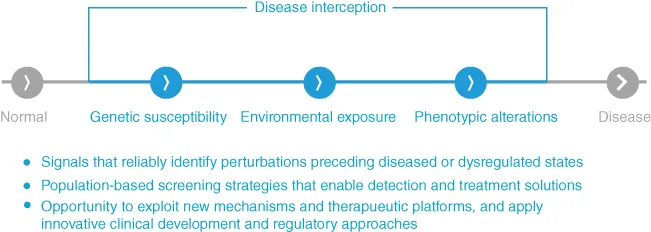
Simply stated, disease interception refers to intervention from the time of the earliest stages of dysregulation in an individual bearing the appropriate genetic and/or environmental risks for a particular disease, until the time the disease is clinically evidenced (Figure 1.1). The temporal period for disease interception precedes any clinically symptomatic stage, hence defining a distinct timeframe for therapeutic intervention. The phenotypic alterations that constitute the early aberrant perturbations should be well‐defined so as to identify the at‐risk or “dysregulated” prospective patients with a high degree of confidence, allowing for implementation of appropriate disease interception strategies to alter the course of, or cease the progression of disease. This concept is particularly powerful since it provides strategic and scientific differentiation from current therapeutic approaches focused on the chronic stages of autoimmune disorders. Since most current therapies are broadly anti‐inflammatory or immune‐suppressive, they may not be an optimal choice for application in disease interception approaches – based from a viewpoint of distinct trigger mechanisms and safety considerations in a population not yet manifesting clinical symptoms. This presents new opportunities for translating scientific understanding of earliest mechanisms of immune dysregulation into novel therapeutics that are likely to offer superior, and perhaps lasting, clinical benefit. In addition, practical application of disease interception strategies to clinical practice will challenge new paradigms in clinical development approaches, regulatory endpoints, and health economics. A perspective on challenges and opportunities for disease interception has been discussed in a recent commentary by Hait and Lebowitz [3]. Some of the key points include challenges with validated targets and surrogate endpoints to demonstrate a beneficial outcome, as well as the positive precedence with current approved drugs that are already applied in an at‐risk patient population in a disease interception setting (e.g. statins and cardiovascular disease). Additional regulatory and commercial perspectives would also need to be factored in when thinking about future markets and opportunity in this space.
Graphical progression of an individual from a normal state toward a diseased state. Some key considerations for successful execution of disease interception strategies are listed below.
Figure 1.1 Graphical progression of an individual from a normal state toward a diseased state. Disease interception refers to the earliest phenotypic alterations that result as a consequence of genetic susceptibility of the individual coupled with an appropriate environmental trigger. Listed below are some key considerations for successful execution of disease interception strategies.

1.2 Disease Interception in Autoimmune Diseases

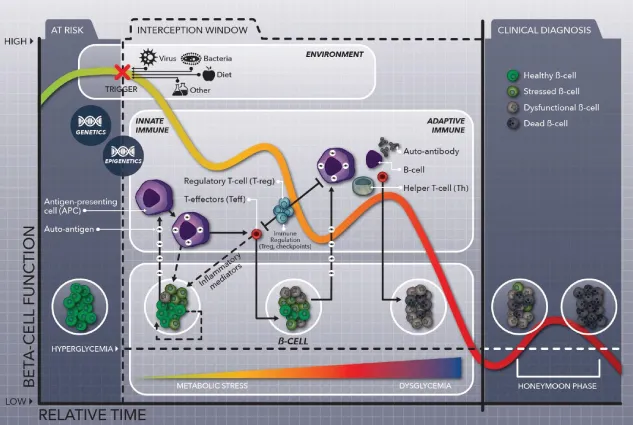
The stages of an autoimmune response can be broken down into phases that span the gamut starting from a predisposed healthy individual that experiences an environmental trigger or insult resulting in early signals of breakdown of tolerance (Figure 1.2); this stage subsequently progresses, via amplification of immune cell activation coupled with compromised regulatory mechanisms, to manifest as clinically evident symptomatic disease, which ultimately results in destruction of target tissue and additional comorbidities [4–7]. While the final effector reactions resulting in chronic inflammation have been the focus of research for many, the understanding of the earliest stages of immune dysregulation offers a novel opportunity for disease interception.
Screenshot depicting the progression of at-risk individuals toward diabetes initiated by a combination of genetic risk coupled with environmental triggers, ultimately resulting in the sensitization of the immune system against islet β-cell antigens.
Figure 1.2 Window for disease interception in type 1 diabetes. Progression of at‐risk individuals toward diabetes is initiated by a combination of genetic risk coupled with environmental triggers, which ultimately result in the sensitization of the immune system against islet β‐cell antigens. Persistent and sustained activation of the autoimmune response ultimately results in destruction of islet β‐cells resulting in hyperglycemia. The interception window, as shown above, provides an opportunity wherein environmental triggers and/or immune components could be selectively targeted to arrest any further progression of the pathogenic state. (See insert for color representation of this figure.)
The single highest genetic susceptibility for many organ‐specific autoimmune diseases (including RA, type 1 diabetes [T1D], multiple sclerosis [MS], ankylosing spondylitis, etc.) maps to the major histocompatibility complex (MHC) molecules, also known as human leukocyte antigens (HLAs) [8,9]. The expression of disease‐associated MHC molecules has a marked impact on the repertoire of effector and regulatory T cells selected in the thymus, as well on the nature of potential antigenic self‐peptides that are selected and displayed in the periphery. In seropositive RA, for example, a notable correlation exists between expression of disease‐associated HLA‐DR molecules (0401, 0404, and 0101) and production of antibodies against modified citrullinated self‐proteins (also known as antibodies to citrullinated protein antigens, ACPAs) [10,11]. Individuals expressing this phenotype are at a high risk of developing RA, and ex...

Table of contents

  1. Cover
  2. Table of Contents
  3. List of Contributors
  4. About the Editors
  5. Foreword
  6. Preface
  7. 1 Disease Interception in Autoimmune Diseases: From a Conceptual Framework to Practical Implementation
  8. 2 The Role of Biomarkers in Treatment Algorithms for Ulcerative Colitis (UC)
  9. 3 Mechanism and Physiologically Based PK/PD Model in Assisting Translation from Preclinical to Clinical: Understanding PK/PD of Therapeutic Proteins at Site‐of‐Action
  10. 4 Application of Minimal Anticipated Biological Effect Level (MABEL) in Human Starting Dose Selection for Immunomodulatory Protein Therapeutics – Principles and Case Studies
  11. 5 5Model‐Based Meta‐Analysis Use in the Development of Therapeutic Proteins
  12. 6 Utility of Joint Population Exposure–Response Modeling Approach to Assess Multiple Continuous and Categorical Endpoints in Immunology Drug Development
  13. 7 Modeling Approaches to Characterize Target‐Mediated Pharmacokinetics and Pharmacodynamics for Therapeutic Proteins
  14. 8 Tutorial: Numerical (NONMEM) Implementation of the Target‐Mediated Drug Disposition Model
  15. 9 Translational Considerations in Developing Bispecific Antibodies: What Can We Learn from Quantitative Pharmacology?
  16. 10 Application of Pharmacometrics and Systems Pharmacology to Current and Emerging Biologics in Inflammatory Bowel Diseases
  17. 11 Pharmacokinetics‐Based Dosing for Therapeutic Monoclonal Antibodies in Inflammatory Bowel Disease
  18. 12 Pharmacokinetics‐Based Dosing Strategies for Therapeutic Proteins in Inflammatory Bowel Disease
  19. 13 Quantitative Pharmacology Approach to Select Optimal Dose and Study the Important Factors in Determining Disposition of Therapeutic Monoclonal Antibody in Pediatric Subjects – Some Considerations
  20. 14 Quantitative Pharmacology Assessment Strategy Therapeutic Proteins in Pediatric Subjects – Challenges and Opportunities
  21. 15 Case Examples of Using Quantitative Pharmacology in Developing Therapeutic Proteins for Plaque Psoriasis – Guselkumab
  22. 16 Vedolizumab—A Case Example of Using Quantitative Pharmacology in Developing Therapeutic Biologics in Inflammatory Bowel Disease
  23. 17 Case Examples of Using Quantitative Pharmacology in Developing Therapeutic Proteins in Systemic Lupus Erythematosus – Belimumab
  24. 18 Case Examples of Using Quantitative Pharmacology in Developing Therapeutic Proteins in Multiple Sclerosis – Peginterferon Beta‐1a, Daclizumab Beta, Natalizumab
  25. Index
  26. End User License Agreement