The first book to explore the potential of tunable functionalities in organic and hybrid nanostructured materials in a unified manner.
The highly experienced editor and a team of leading experts review the promising and enabling aspects of this exciting materials class, covering the design, synthesis and/or fabrication, properties and applications. The broad topical scope includes organic polymers, liquid crystals, gels, stimuli-responsive surfaces, hybrid membranes, metallic, semiconducting and carbon nanomaterials, thermoelectric materials, metal-organic frameworks, luminescent and photochromic materials, and chiral and self-healing materials.
For materials scientists, nanotechnologists as well as organic, inorganic, solid state and polymer chemists.
eBook - ePub
Functional Organic and Hybrid Nanostructured Materials
Fabrication, Properties, and Applications
- English
- ePUB (mobile friendly)
- Available on iOS & Android
eBook - ePub
Functional Organic and Hybrid Nanostructured Materials
Fabrication, Properties, and Applications
About this book
Information
Chapter 1
Controllable Self-Assembly of One-Dimensional Nanocrystals
Shaoyi Zhang, Yang Yang and Zhihong Nie
University of Maryland, Department of Chemistry and Biochemistry, 8051 Regents Drive, College Park, MD, 20742, USA
1.1 Introduction
In the past decades, controlled assembly of nanocrystals (NCs) has been a topic of continuous interest. The tremendous interest in organizing NCs mainly stemmed from the potential applications of NCs in diverse areas, including chemical and biological sensing, energy storage and production, and optoelectronic devices. Recent advances at this frontier are also partially driven by the rapid development in the synthesis of relatively monodispersed NC building blocks with controlled size, shape, and composition [1, 2]. Compared to spherical NCs, one dimensional (1D) NCs, that is, nanorods (NRs) and nanowires (NWs), exhibit unique optical, electronic, and magnetic properties due to their shape anisotropy [3, 4]. Taking Au NRs as an example, they exhibit localized surface plasmon resonance (LSPR) and strong photothermal effect, which enable their broad applications in such areas as cancer imaging and therapy. The LSPR absorption of these NRs can be tailored in the range from visible to near-infrared wavelengths for specific applications by controlling the aspect ratio of NRs. To date, various methods have been developed for the organization of 1D NCs into functional structures. In particular, the bottom-up assembly approach offers a more robust, scalable, and cost-effective way to fabricate arrays of NCs in a controlled manner, compared to top-down techniques such as electron-beam and focused-ion beam lithography [5]. In this chapter, we have classified the current self-assembly methods into four major categories, namely templated assembly, field-driven assembly, assembly at interfaces, and ligand-guided assembly. The following section features the properties and applications of assemblies of 1D NCs. Finally, conclusion and outlook are presented in the last section.
1.2 Assembly Strategies
1.2.1 Templated Assembly
Templated assembly, as the name implies, is the assembly directed by a predesigned template, which governs the anchoring of NCs on (or within) the template. As a straightforward method, the geometry and patterning of templates or the distribution of functional groups on the template dictates the location, orientation, or alignment of NCs as well as the association state of NCs. Typically, the templating effect arises from physical confinement of the template, differential affinity of NCs toward the template surface, or chemical bonding between the ligands on NCs and templates. Recent progress in this frontier has allowed the assembly of 1D NCs into long-range-ordered structures with high yield and well-defined orientation of NCs at single-particle resolution. This largely fulfills the requirement of assemblies on substrates for applications including biosensors, optical devices, metamaterials, and so on [6]. In this section we discuss several categories of assembly systems, classified on the basis of the characteristics of templates.
1.2.1.1 Geometrically Patterned Template
Assembly based on geometrically patterned template utilizes the topographical patterns on a substrate to direct the interaction and shape-selective organization of NCs within the patterns. Representative topographical patterns include periodic polygonal grooves, discrete spherical poles, and parallel channels. These templates are usually fabricated by top-down approaches such as photolithography, chemical vapor deposition, inkjet printing, and focused beam (electrons, ions, laser, etc.) etching [7]. To achieve the desired assembly structures of NCs, the geometric parameters (e.g., size, depth, and geometry of patterns) have to be carefully tuned. By using this method, various types of assemblies have been produced, such as discrete clusters, 1D arrays, 2D monolayers, and 3D supercrystals.
Toward the end of the last century, Blaaderen et al. reported the crystallization of bulk colloidal crystals through the slow sedimentation of silica spheres onto a pole-patterned poly(methyl methacrylate) (PMMA) layer [8]. Xia et al. fabricated a series complex aggregates of polystyrene beads including polygonal or polyhedral clusters, linear or zigzag chains, and circular rings by combing physical templating and capillary forces [9]. Thanks to the developments in pattern design, great progress has been achieved in fabricating diverse arrays of 1D NCs on patterned substrates with high yield, good scalability, and superior morphology control [10]. Bach et al. produced free-standing arrays of hexagonal close-packed Au NRs on predefined locations using a patterned substrate containing square grooves of different wettability on the surface of the substrate [11]. Recently, Brugger et al. realized the capillary assembly of Au NRs into large-area ordered structures on substrates with predetermined surface patterns [12]. In a typical capillary assembly, the colloidal solution is confined between a patterned substrate and a sliding top plate. The receding meniscus directs the colloidal solution to move over the substrate in a controlled manner. Subsequently, NCs assemble from the three-phase contact line at predetermined assembly sites. In order to improve the accuracy and success rate in the placement of NCs, it is crucial to prevent the possible removal of NCs that are inserted in the traps. In this work, the precise control over the organization of Au NRs on the substrate was accomplished by the delicate design of the geometry of the traps. As shown in Figure 1.1, funneled traps with auxiliary sidewalls were fabricated to effectively prevent the removal of NRs after their insertion into the traps. With the introduction of sidewalls, the assembly yield goes up to 100%. The positional control of Au NRs goes down to the nanometer scale. As shown in Figure 1.1b, Au NRs can be selectively placed onto a substrate with arbitrary patterns by using this method.
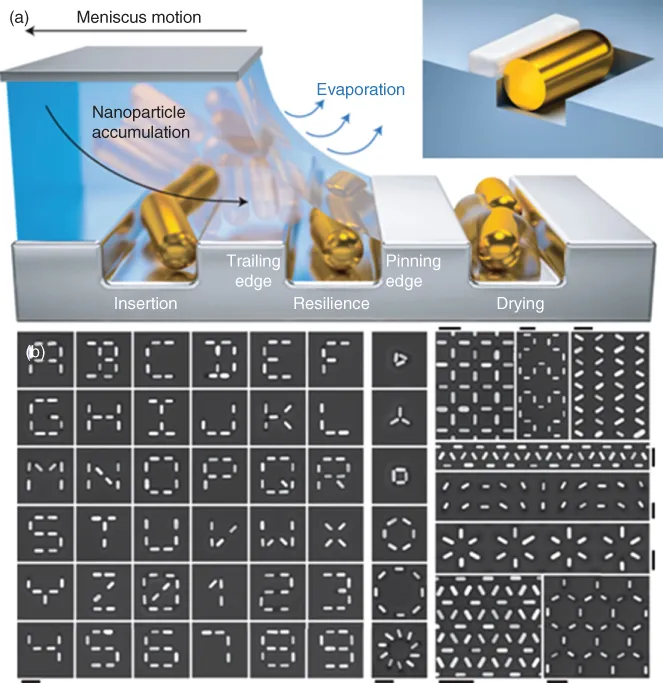
Figure 1.1 Assembly of Au NRs on a patterned solid substrate. (a) Scheme of capillary assembly of Au NRs onto substrates with geometrical patterns. (b) SEM images of Au NRs patterns by topographically templated capillary assembly. Scale bar: 250 nm.
(Flauraud et al. 2016 [12]. Reproduced with permission of Nature Publishing Group.)
Apart from directly modulating the patterns on a substrate, confinement can be used to control the organization of NCs. Typically, a suspension of NCs is confined between a topologically patterned template at the top and a smooth substrate at the bottom. The subsequent evaporation of solvent in a controlled manner drives the formation of an orientated array of NCs. The above templates function as both regulating the solvent evaporation and controlling the deposition of NCs at given locations on the substrate. Typical templates such as the elastomeric poly(dimethyl siloxane) (PDMS) stamp and highly oriented pyrolytic graphite (HOPG) have been employed to provide confinement to facilitate the formation of closely packed arrays of 1D NCs [13]. In this case, the templates can be easily removed and recycled while the assemblies are left on flat substrates. As an example, Ahmed et al. reported the formation of perpendicular superlattices of hexagonally oriented CdS NRs using an HOPG template [14]. A dispersion of CdS NRs in toluene was trapped between a block of HOPG and a smooth silicon wafer. Upon slow evaporation of the solvent, a large-area (∼2 µm2) monolayer of perpendicularly oriented NRs was formed on the substrate. It was found that the monodispersity and hexagonal facets along the c-axis of wurtzite NRs are crucial to the formation of highly ordered lattices. Also, the cleaved surface of the HOPG substrate efficiently trapped the NRs in a narrow capillary, facilitating the slow evaporation of solvents. Later, Liz-Marzan et al. reported a simple assembly method to produce large-area (up to millimeter size) supercrystal arrays of Au NRs using a patterned PDMS mold [15]. The supercrystals with tunable size, shape, and...
Table of contents
- Cover
- Title Page
- Copyright
- Table of Contents
- Preface
- Chapter 1: Controllable Self-Assembly of One-Dimensional Nanocrystals
- Chapter 2: Self-Assembled Graphene Nanostructures and Their Applications
- Chapter 3: Photochromic Organic and Hybrid Self-Organized Nanostructured Materials: From Design to Applications
- Chapter 4: Photoresponsive Host–Guest Nanostructured Supramolecular Systems
- Chapter 5: π-Electronic Ion-Pairing Assemblies Providing Nanostructured Materials
- Chapter 6: Stimuli-Responsive Nanostructured Surfaces for Biomedical Applications
- Chapter 7: Stimuli-Directed Self-Organized One-Dimensional Organic Semiconducting Nanostructures for Optoelectronic Applications
- Chapter 8: Stimuli-Directed Helical Axis Switching in Chiral Liquid Crystal Nanostructures
- Chapter 9: Electrically Driven Self-Organized Chiral Liquid-Crystalline Nanostructures: Organic Molecular Photonic Crystal with Tunable Bandgap
- Chapter 10: Nanostructured Organic–Inorganic Hybrid Membranes for High-Temperature Proton Exchange Membrane Fuel Cells
- Chapter 11: Two-Dimensional Organic and Hybrid Porous Frameworks as Novel Electronic Material Systems: Electronic Properties and Advanced Energy Conversion Functions
- Chapter 12: Organic/Inorganic Hybrid Nanostructured Materials for Thermoelectric Energy Conversion
- Chapter 13: Hybrid Organic–Nitride Semiconductor Nanostructures for Biosensor Applications
- Chapter 14: Polymer–Nanomaterial Composites for Optoacoustic Conversion
- Chapter 15: Functional Nanostructured Conjugated Polymers
- Chapter 16: Nanostructured Self-Organized Heliconical Nematic Liquid Crystals: Twist-Bend Nematic Phase
- Index
- End User License Agreement
Trusted by 375,005 students
Access to over 1.5 million titles for a fair monthly price.
Study more efficiently using our study tools.
Frequently asked questions
Yes, you can cancel anytime from the Subscription tab in your account settings on the Perlego website. Your subscription will stay active until the end of your current billing period. Learn how to cancel your subscription
No, books cannot be downloaded as external files, such as PDFs, for use outside of Perlego. However, you can download books within the Perlego app for offline reading on mobile or tablet. Learn how to download books offline
Perlego offers two plans: Essential and Complete
- Essential is ideal for learners and professionals who enjoy exploring a wide range of subjects. Access the Essential Library with 800,000+ trusted titles and best-sellers across business, personal growth, and the humanities. Includes unlimited reading time and Standard Read Aloud voice.
- Complete: Perfect for advanced learners and researchers needing full, unrestricted access. Unlock 1.5M+ books across hundreds of subjects, including academic and specialized titles. The Complete Plan also includes advanced features like Premium Read Aloud and Research Assistant.
We are an online textbook subscription service, where you can get access to an entire online library for less than the price of a single book per month. With over 1.5 million books across 990+ topics, we’ve got you covered! Learn about our mission
Look out for the read-aloud symbol on your next book to see if you can listen to it. The read-aloud tool reads text aloud for you, highlighting the text as it is being read. You can pause it, speed it up and slow it down. Learn more about Read Aloud
Yes! You can use the Perlego app on both iOS and Android devices to read anytime, anywhere — even offline. Perfect for commutes or when you’re on the go.
Please note we cannot support devices running on iOS 13 and Android 7 or earlier. Learn more about using the app
Please note we cannot support devices running on iOS 13 and Android 7 or earlier. Learn more about using the app
Yes, you can access Functional Organic and Hybrid Nanostructured Materials by Quan Li in PDF and/or ePUB format, as well as other popular books in Technology & Engineering & Materials Science. We have over 1.5 million books available in our catalogue for you to explore.