QoS for Fixed and Mobile Ultra-Broadband
eBook - ePub

QoS for Fixed and Mobile Ultra-Broadband

  1. English
  2. ePUB (mobile friendly)
  3. Available on iOS & Android
eBook - ePub

QoS for Fixed and Mobile Ultra-Broadband

About this book

Provides extensive coverage of standardized QoS technologies for fixed and mobile ultra-broadband networks and services—bringing together technical, regulation, and business aspects

The Quality of Service (QoS) has been mandatory for traditional telecommunication services such as telephony (voice) and television (TV) since the first half of the past century, however, with the convergence of telecommunication networks and services onto Internet technologies, the QoS provision remains a big challenge for all ICT services, not only for traditional ones. This book covers the standardized QoS technologies for fixed and mobile ultra-broadband networks and services, including the business aspects and QoS regulation framework, which all will have high impact on the ICTs in the current and the following decade.

QoS for Fixed and Mobile Ultra-Broadband starts by introducing readers to the telecommunications field and the technology, and the many aspects of both QoS and QoE (Quality of Experience). The next chapter devotes itself to Internet QoS, starting with an overview of numerous technology protocols and finishing with business and regulatory aspects. The next three chapters look at QoS in NGN and Future Networks, QoS for fixed ultra-broadband, and QoS for mobile ultra-broadband. The book also provides readers with in-depth accounts of services in fixed and mobile ultra-broadband; broadband QoS parameters, KPIs, and measurements; network neutrality; and the QoS regulatory framework.

  • Comprehensively covers every aspect of QoS technology for fixed and mobile ultra-broadband networks and services, including the technology, the many regulations, and their applications in business
  • Explains how the QoS is transiting from the traditional telecom world to an all-IP world
  • Presents all the fundamentals of QoS regulation, as well as SLA regulation

QoS for Fixed and Mobile Ultra-Broadband is an excellent resource for managers, engineers, and employees from regulators, ICT government organizations, telecommunication companies (operators, service providers), ICT companies, and industry. It is also a good book for students and professors from academia who are interested in understanding, implementation, and regulation of QoS for fixed and mobile ultra-broadband.
Frequently asked questions

Yes, you can cancel anytime from the Subscription tab in your account settings on the Perlego website. Your subscription will stay active until the end of your current billing period. Learn how to cancel your subscription.
No, books cannot be downloaded as external files, such as PDFs, for use outside of Perlego. However, you can download books within the Perlego app for offline reading on mobile or tablet. Learn more here.
Perlego offers two plans: Essential and Complete
  • Essential is ideal for learners and professionals who enjoy exploring a wide range of subjects. Access the Essential Library with 800,000+ trusted titles and best-sellers across business, personal growth, and the humanities. Includes unlimited reading time and Standard Read Aloud voice.
  • Complete: Perfect for advanced learners and researchers needing full, unrestricted access. Unlock 1.4M+ books across hundreds of subjects, including academic and specialized titles. The Complete Plan also includes advanced features like Premium Read Aloud and Research Assistant.
Both plans are available with monthly, semester, or annual billing cycles.
We are an online textbook subscription service, where you can get access to an entire online library for less than the price of a single book per month. With over 1 million books across 1000+ topics, we’ve got you covered! Learn more here.
Look out for the read-aloud symbol on your next book to see if you can listen to it. The read-aloud tool reads text aloud for you, highlighting the text as it is being read. You can pause it, speed it up and slow it down. Learn more here.
Yes! You can use the Perlego app on both iOS or Android devices to read anytime, anywhere — even offline. Perfect for commutes or when you’re on the go.
Please note we cannot support devices running on iOS 13 and Android 7 or earlier. Learn more about using the app.
Yes, you can access QoS for Fixed and Mobile Ultra-Broadband by Toni Janevski in PDF and/or ePUB format, as well as other popular books in Technology & Engineering & Electrical Engineering & Telecommunications. We have over one million books available in our catalogue for you to explore.

1
Introduction

The telecommunications world has been developing at a rapid pace since the growth of the Internet in the 1990s and 2000s. Nowadays telecommunications is also referred to as information and communication technologies (ICT), as stated by the largest telecommunications agency in the world, the International Telecommunication Union (ITU) [1], a specialized agency of the United Nations. Telecommunications has been around for more than 150 years, starting with telegraphy in the nineteenth century. In fact, the telecommunications world and the ITU have been interrelated since 1865 when the ITU was formed as the International Telegraph Union. Nowadays, telegraphy belongs to history (it has become redundant since the appearance of email and other messaging services available worldwide today). But speaking about the history of telecommunications, after Alexander Graham Bell invented the telephone in 1876 the following century was marked by the development and deployment of telephony, with fixed telephony until the 1980s accompanied by mobile telephony worldwide from the 1990s. Of course, one should not forget to mention television and radio as important telecommunication services during the twentieth century, and they continue to be so in the twenty‐first century.
ICT has created a globally connected world, not only giving people the ability to communicate with each other but also opening up access to information and facilitating the exchange of information. The foundation of such an ICT world (the terms ICT and telecommunications will be used interchangeably in this book) lies in the introduction of digital systems and networks in the 1970s and 1980s, which provided the possibility for all information from different sources and of different types (e.g. voice, video, data, multimedia) to be transferred over the global telecommunications infrastructure by using series of bits and zeros (i.e. in a digital form). When information is coded at the source as series of ones and zeros, all such information can be transferred over the same telecommunications networks and accessed via the same devices – if, of course, the networks are created in such a manner. The Internet has provided the required openness to transfer all different types of information over the same network, which is present and working well in the second decade of the twenty‐first century and is expected to continue in a similar manner in the future. However, telecommunication networks are interconnected on a local, regional, and global scale to be able to transfer the information between any two or more communication endpoints on the Earth, so the telecommunication services are global. Therefore, the quality of telecommunication services which is applied in a single network or in a single country has influence on the end‐to‐end quality of that service. So, the quality cannot be considered only at national or regional level, it needs to be considered globally. Today, citizens around the world rely on ICT to conduct their everyday activities in personal or business life, and that requires having certain quality of services (QoS). Therefore guaranteeing QoS in the socio‐economic environment of users is becoming very important. For that purpose there is a need for technical mechanisms and functions for implementation of the QoS in networks and end‐users' devices, and for its regulation in a harmonized and globally accepted approach. That will enable greater quality of services provided to users as customers or consumers or content generators, irrespective of their location or service provider (the entity that provides access to telecommunications services), where the provider can be a telecom operator (on local or national levels) or global over‐the‐top (OTT) provider (e.g. Google, Amazon, etc.).

1.1 The Telecommunications/ICT Sector in the Twenty‐First Century

The telecommunication/ICT world in the twenty‐first century is characterized by two important developments:
  • It is becoming fully based on Internet technologies, including all networks (with fixed and mobile access) and all services (including all applications working over the Internet).
  • It is becoming broadband, which means that there are enough high bitrates in access networks (and also end‐to‐end) which provide all available applications/services to run smoothly and with satisfactory quality experienced by end‐users (we will define what the quality means later in the chapter).
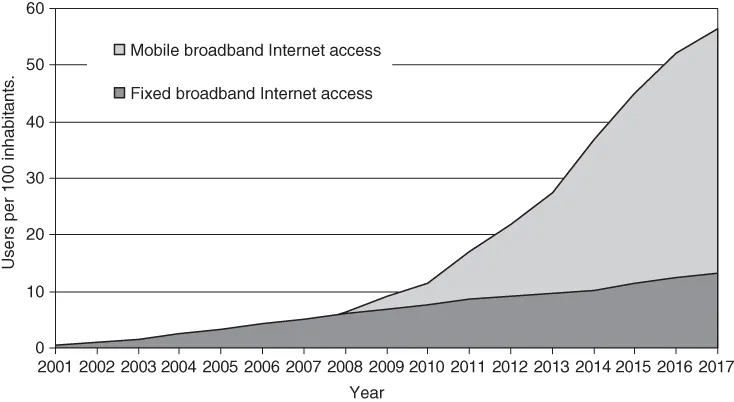
So, the ICT world is becoming all‐IP (Internet protocol) and broadband on a global scale (Figure 1.1) [1]). However, it is even more interesting to note that mobile communications are spreading at a faster pace than fixed communications regarding access networks. One may note that in the 1990s only about 1% of the global population had a mobile cellular subscription and about 11% had a fixed telephone subscription. Nowadays, mobile subscribers' penetration is near saturation, with almost everyone on this planet having a mobile phone/device. Mobile broadband is the most dynamic market segment, surpassing fixed broadband access in the second decade of the twenty‐first century. The number of Internet users is also constantly growing over the entire world population (Figure 1.1).
Graph of users per 100 inhabitants vs. year with 2 shaded areas depicting mobile broadband Internet access (light) and fixed broadband Internet access (dark).
Figure 1.1 Global telecommunication/ICT broadband developments.
What is broadband? One may define broadband as access network bitrates and end‐to‐end network bitrates in both directions (downstream and upstream) which support all available types of services with satisfactory quality. For example, in the first decade of the twenty‐first century broadband access meant offering hundreds of kbit/s, while a decade later it means access with Mbit/s or tens of Mbit/s (as measurement units for data speeds), enabling, for example, the provision of HD (high definition) video and ultra‐HD video streaming (some of the most demanding services).
Broadband can be divided into two main categories (similar to type of access networks):
  • Fixed broadband. Fixed broadband access technologies are provided by copper (twisted pairs) by reusing local loops deployed for fixed telephony for IP‐based access via ADSL (asymmetric digital subscriber line), VDSL (very‐high‐bit‐rate digital subscriber line), or generally x digital subscriber line (xDSL); or by cable access (by reusing coaxial cable networks, primarily developed for TV distribution, and FTTH (fiber to the home) or more general FTTx (fiber to the x), which is a long‐term future for fixed broadband access in all regions. On the other side, almost all transport networks nowadays are fiber‐based (accompanied by satellite networks, where optical transport is not present), so the differences remain mainly in the last mile.
  • Mobile broadband. Mobile broadband access technologies appeared with the 3G (third‐generation) mobile networks in the late 2000s, and they continue with 4G (fourth‐generation) and 5G (fifth‐generation) mobile networks in the second and third decades of the twenty‐first century. The widespread mobile technologies which belong to the mobile broadband world include UMTS/HSPA (universal mobile telecommunication system/high speed packet access) as part of the 3G standards umbrella, Mobile Wi...

Table of contents

  1. Cover
  2. Table of Contents
  3. Dedication
  4. 1 Introduction
  5. 2 Internet QoS
  6. 3 QoS in NGN and Future Networks
  7. 4 QoS for Fixed Ultra‐Broadband
  8. 5 QoS for Mobile Ultra‐Broadband
  9. 6 Services in Fixed and Mobile Ultra‐Broadband
  10. 7 Broadband QoS Parameters, KPIs, and Measurements
  11. 8 Network Neutrality
  12. 9 QoS Regulatory Framework
  13. 10 Conclusions
  14. Index
  15. End User License Agreement