BEST PRACTICES FROM FINLAND'S HIGH-PERFORMING SCHOOL SYSTEM
Empowered Educators in Finland is one volume in a series that explores how high- performing educational systems from around the world achieve strong results. The anchor book, Empowered Educators: How High-Performing Systems Shape Teaching Quality Around the World, is written by Linda Darling-Hammond and colleagues, with contributions from the authors of this volume.
Empowered Educators in Finland explores Finland's unique approach to teacher training that, combined with a national focus on equity and children, has led to strong student results on the OECD PISA and other international tests.
Since the 1930s, every child born in Finland has been provided with a box of clothes, sheets, toys, diapers, and even a small mattress; the box itself can—and often does—serve as a simple crib. Intended to ensure that all Finnish children begin with the essentials, this box also serves as a clear symbol of the nation's emphasis on equality and opportunity.
This book describes how what is commonly thought to be "just a part of Finnish culture" is actually the result of strong support for educators at all levels of government. From the Ministry of Education and Culture, to the Finnish National Board of Education, to regional and local policy makers, Finland has made deliberate choices to create and support a strong educational system. While there are unique political, cultural, and societal features of Finland—as with all countries—there are many lessons to be learned and practical ideas to be implemented across the world.
Upon the occasion of the birth of a new baby in Finland, since the 1930’s, the Finnish government has been providing every new mother with a cardboard box filled with clothes, sheets, toys, diapers, and other essential items. The box even includes a small mattress, and the box can actually (and often does for many newborns) serve as a simple crib.1 The intention of the box is to ensure that all children in Finland have an equal start; but it serves also as a symbol of the centrality of equity and children in Finland (Lee, 2014). This rather simple, straightforward tradition is also illustrative of the Finnish policy context that we explore in this case—one that is focused upon equity and a strong early start, and centered around children.
In this book, we examine the policies and practices that have been deliberately developed to support and contribute to a national policy context that is centered upon children: a policy context that builds capacity for quality teaching. Upon first glance, one might quickly conclude that the strong and equitable student outcomes in Finland are simply the result of recruiting top candidates into teaching. Or, some might wonder whether the small size and relative homogeneity of Finland makes it more likely for all children to achieve at the high levels they do. Similarly, one might hear about the respect and value for the teaching profession in Finland; and respond, “we can’t replicate that here in the United States [or in any other country], it’s just part of Finnish culture.”
However, we tell a story of intentional, considered decision making that has taken place in Finland over just a few decades. We show that the Finnish government, the Ministry of Education and Culture, the Finnish National Board of Education, and other actors at all levels of the educational system have carried out a set of considered, deliberate policy choices and created multiple practical supports that function in concert, which intersect in Finland to create a coherent, strong, and equitable educational context. In turn, these policies function to build capacity (and continue to do so) at multiple levels of the system to produce well-prepared, committed, reflective, and responsible teachers. The deliberate work to focus upon capacity building of the teaching profession is far from the result simply recruiting the cream of the crop into teaching or “just the culture.” Furthermore, it is not true that Finland’s small size (about five and a half million people [Statistics Finland, 2014b]) and relative homogeneity means that we can’t apply what we can learn from Finland. While of course there are cultural, societal, and political features that we cannot replicate, what we can learn from Finland has to do with the intentional and deliberate choice to emphasize the thorough preparation and training of teachers, the development of a high-quality workforce of teachers, and purposeful efforts to eliminate differences in student achievement.
These carefully aligned and consistent policy choices, which include efforts to develop strong academic, research-based teacher preparation, to support and promote the work of teaching, to make high quality teaching and education available to all Finnish children, to address issues of equity and diversity, and to carefully and gradually build a more inclusive school system for all children, have created a coherent context for an educational system that has been successful in producing strong student results on international tests such as OECD’s PISA and IEA’s TIMSS and PIRLS.
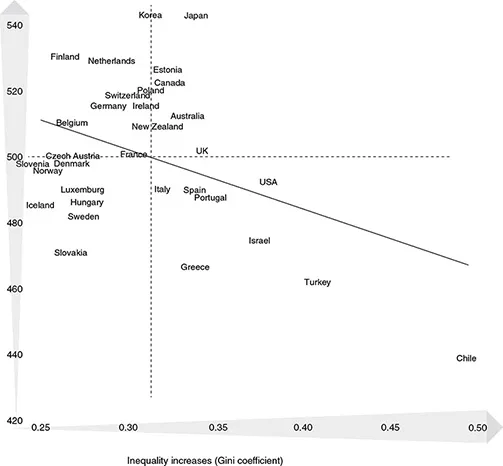
One particularly impressive feature of the strong outcomes is the remarkable equity in achievement in Finland. Indeed, in Finland, the effect of socioeconomic status has far less impact on reading, science, and mathematics achievement than in other countries (interestingly, socioeconomic status also seems to have little relationship to the problem-solving skills of adults in Finland, as well). In their most recent release of findings, the OECD reports that Finland, alongside countries like Australia, Canada, and the Netherlands, “combine high levels of performance with equity in education opportunities (OECD, 2012). It is also important that income inequality in Finland is one of the lowest among OECD countries (OECD, 2012; Sahlberg, 2011). As Figure 1 shows, this income equality may contribute to high achievement in reading, mathematics, and science. However, Finland far out performs several other similarly equitable nations.
Figure 1Income inequality (gini coefficient) and aggregated student achievement (PISA score average of all three domains) in OECD countries in 2012 (OECD, 2013b).
However, it is also critically important to understand that success in Finland means much more than the narrow range of learning outcomes that are captured in high PISA scores. Finland ranks among the top four countries2 on measures of children’s well-being (UNICEF, 2007, 2013). A recent OECD report examining the skills of adults found Finnish adults had excellent literacy and numeracy skills; and Finnish adults were among the top in their ability to solve problems in a technology rich environment (OECD, 2013).3 In a report recently initiated by the United Nations, Finland ranked among the top ten countries in terms of a number of important features identified as central to positive human development—key measures of well-being including safety, physical and mental health, and economic measures. Equity was one of the distinguishing factors that separated countries like Finland and Norway and The Netherlands that scored high on all these measures; while countries that scored lower also had indications of “loss of human potential due to inequity” (United Nations, 2014).
In this climate, teachers are not only respected and valued, but the corps of teachers is effectively—and continually—sustained at a high level of professionalism. Further, such intentional investment in high quality teachers has a positive economic impact, teacher retention is higher across the profession in Finland than in countries like the United States—meaning that school districts and communities do not have to invest in the costly process of recruiting and training new teachers as often as every year. There is no Finnish term for teacher retention (Itkonen & Jahnukainen, 2007). Finnish teachers’ commitment to their profession has been extremely high: a national survey of 4,500 Finnish teachers found that only about 10% of Finnish teachers leave their positions (Jokinen et al. 2013, p. 36). Indeed, that survey suggested that almost three of four teachers were convinced that they would remain in teaching until retirement. In that same survey, only about 20% of teachers reported that they have considered leaving teaching for another profession (ibid, p. 36; see also Heikonen et al., in press). Recent TALIS data may shed some light upon these findings: in Finland, 95% of middle school teachers report that the more positive aspects of their work outweigh any negative elements (OECD, 2013).
We begin with providing some background on the overall context of Finland and Finnish teachers; the policy context that supports and contributes to teacher quality; and then describe in detail the way these policies, supports, and decisions play out to support quality teaching from preparation through to professional practice—reflecting a kind of “continuum of teaching” described by scholars of teaching like Feiman-Nemser (2001).
The Context
Finland is divided into about 300 local municipalities that have the main responsibility to organize education for their citizens according to national regulations and legislation. The challenge Finland has with its decentralized and locally controlled education system is related to the relatively large land area that is inhabited by less than six million people very unevenly. The metropolitan region, including the capital city Helsinki, hosts about one-fifth of Finland’s entire population. Many issues affecting teachers and schools in Finland today, such as increasing immigration, tightening public budgets, and access to professional development for teachers, are therefore not seen in the same ways in different parts of the country.
Education is mostly funded by local municipal taxes in Finland. Because the wealth of Finnish municipalities varies greatly, the proportion of central government’s share of education spending is different from one municipality to another. The Finnish National Board of Education uses an equalizing formula, however, that takes into account specific needs of the region as well as attends to any differences in wealth, so that districts all gain the support they need. Some districts are fully supported by government subsidies while others are able to support their work through some municipal funding. This calculation and effort to equalize funding means that the wealthier districts do not end up with an unequally high proportion of funding. Roughly speaking, two thirds of school education spending in Finland comes from local funds and the rest from the central government’s budget. Government’s subsidies to municipalities are not earmarked—which means that locally elected politicians and school boards in municipalities decide how the overall local budgets will allocate resources to education and other public services.
Finland’s municipalities have also a degree of freedom in terms of education administration and governance. For example, school principals are normally appointed by municipal councils and their politically appointed boards of education. In some cases teachers may also be recruited by the municipalities but in many other situations, teachers apply directly to open vacancies in schools. By law municipalities are required to monitor the quality of education including teachers’ and principals’ performance in schools but without national framework or common procedures.
There are three national institutions that play a normative, regulatory role with locally governed school system in Finland. First, Ministry of Education and Culture (MOEC) is part of Finland’s government that is in charge of all educat...
Table of contents
Cover
Title page
Copyright
FOREWORD
ACKNOWLEDGMENTS
ABOUT THE SPONSORING ORGANIZATIONS
ABOUT THE AUTHORS
ONLINE DOCUMENTS AND VIDEOS
Introduction
Appendix Methodology
REFERENCES
EULA
Trusted by 375,005 students
Access to over 1.5 million titles for a fair monthly price.
Study more efficiently using our study tools.
Frequently asked questions
Yes, you can cancel anytime from the Subscription tab in your account settings on the Perlego website. Your subscription will stay active until the end of your current billing period. Learn how to cancel your subscription
No, books cannot be downloaded as external files, such as PDFs, for use outside of Perlego. However, you can download books within the Perlego app for offline reading on mobile or tablet. Learn how to download books offline
Perlego offers two plans: Essential and Complete
Essential is ideal for learners and professionals who enjoy exploring a wide range of subjects. Access the Essential Library with 800,000+ trusted titles and best-sellers across business, personal growth, and the humanities. Includes unlimited reading time and Standard Read Aloud voice.
Complete: Perfect for advanced learners and researchers needing full, unrestricted access. Unlock 1.5M+ books across hundreds of subjects, including academic and specialized titles. The Complete Plan also includes advanced features like Premium Read Aloud and Research Assistant.
Both plans are available with monthly, semester, or annual billing cycles.
We are an online textbook subscription service, where you can get access to an entire online library for less than the price of a single book per month. With over 1.5 million books across 990+ topics, we’ve got you covered! Learn about our mission
Look out for the read-aloud symbol on your next book to see if you can listen to it. The read-aloud tool reads text aloud for you, highlighting the text as it is being read. You can pause it, speed it up and slow it down. Learn more about Read Aloud
Yes! You can use the Perlego app on both iOS and Android devices to read anytime, anywhere — even offline. Perfect for commutes or when you’re on the go. Please note we cannot support devices running on iOS 13 and Android 7 or earlier. Learn more about using the app
Yes, you can access Empowered Educators in Finland by Karen Hammerness,Raisa Ahtiainen,Pasi Sahlberg in PDF and/or ePUB format, as well as other popular books in Education & Education Administration. We have over 1.5 million books available in our catalogue for you to explore.