Systematically summarizes the current status and recent advances in bimetallic structures, their shape-controlled synthesis, properties, and applications
Intensive researches are currently being carried out on bimetallic nanostructures, focusing on a number of fundamental, physical, and chemical questions regarding their synthesis and properties. This book presents a systematic and comprehensive summary of the current status and recent advances in this field, supporting readers in the synthesis of model bimetallic nanoparticles, and the exploration and interpretation of their properties.
Bimetallic Nanostructures: Shape-Controlled Synthesis for Catalysis, Plasmonics and Sensing Applications is divided into three parts. Part 1 introduces basic chemical and physical knowledge of bimetallic structures, including fundamentals, computational models, and in situ characterization techniques. Part 2 summarizes recent developments in synthetic methods, characterization, and properties of bimetallic structures from the perspective of morphology effect, including zero-dimensional nanomaterials, one-dimensional nanomaterials, and two-dimensional nanomaterials. Part 3 discusses applications in electrocatalysis, heterogeneous catalysis, plasmonics and sensing.
Comprehensive reference for an important multidisciplinary research field
Thoroughly summarizes the present state and latest developments in bimetallic structures
Helps researchers find optimal synthetic methods and explore new phenomena in surface science and synthetic chemistry of bimetallic nanostructures
Bimetallic Nanostructures: Shape-Controlled Synthesis for Catalysis, Plasmonics and Sensing Applications is an excellent source or reference for researchers and advanced students. Academic researchers in nanoscience, nanocatalysis, and surface plasmonics, and those working in industry in areas involving nanotechnology, catalysis and optoelectronics, will find this book of interest.
Part I Fundamentals and Structural Characterization of Shape‐Controlled Bimetallic Nanostructures
1 Introduction of Bimetallic Nanostructures
Zhi‐Ping Zhang and Ya‐Wen Zhang
College of Chemistry and Molecular Engineering, Peking University, Beijing, China
1.1 Metallic Nanoparticles
Nanostructured particles are materials with at least one dimension at the nanoscale level (between 0.1 nm and 100 nm). Their scales are at the transition area between atomic clusters and bulk materials, and their optical, electrical, mechanical, magnetic, and catalytic properties are significantly different from those of bulk materials due to their quantum size effect, small size effect, surface effect, quantum tunneling effect, and dielectric confinement effect. There is no doubt that it is an exciting subject focusing on promising application of nanomaterials in various fields such as functional materials, sophisticated equipment, environmental remediation, and renewable energy processing.
In the elemental periodic table, more than two‐thirds of the elements are metals. Metals are a class of glossy materials with good thermal and electrical conductivity, and are widely applied in architecture, electronic devices, information science, biomedical technology, and catalysis. For example, steel (iron) is often used for building; tungsten wire is applied in photoelectric instrument; ytterbium is applied in laser materials; and germanium is a valuable semiconductor material. Metal is fundamental to industry and life. In 1875, Pt/V2O5 catalysts were applied in the large‐scale production of sulfuric acid. Around 1913, Fe/Al2O3/K2O catalysts were used for ammonia synthesis, which was a significant reaction for the production of chemical fertilizer[1]. In the 1970s and 1980s, Pt, Pd, and Rh were developed for automobile emission control, including CO and HC oxidations and NO reduction[1].
In order to improve their material properties and enhance their atomic utilization efficiency, metallic materials were also manufactured in nanoscales. The preparation of metallic nanoparticles dates from 1850s. In 1857, Faraday synthesized his famous Au colloids through the reduction of Au(III) ions with phosphorous in water[2]. In 1941, Rampino and Nord prepared colloidal dispersion of Pd by reduction with hydrogen[3].
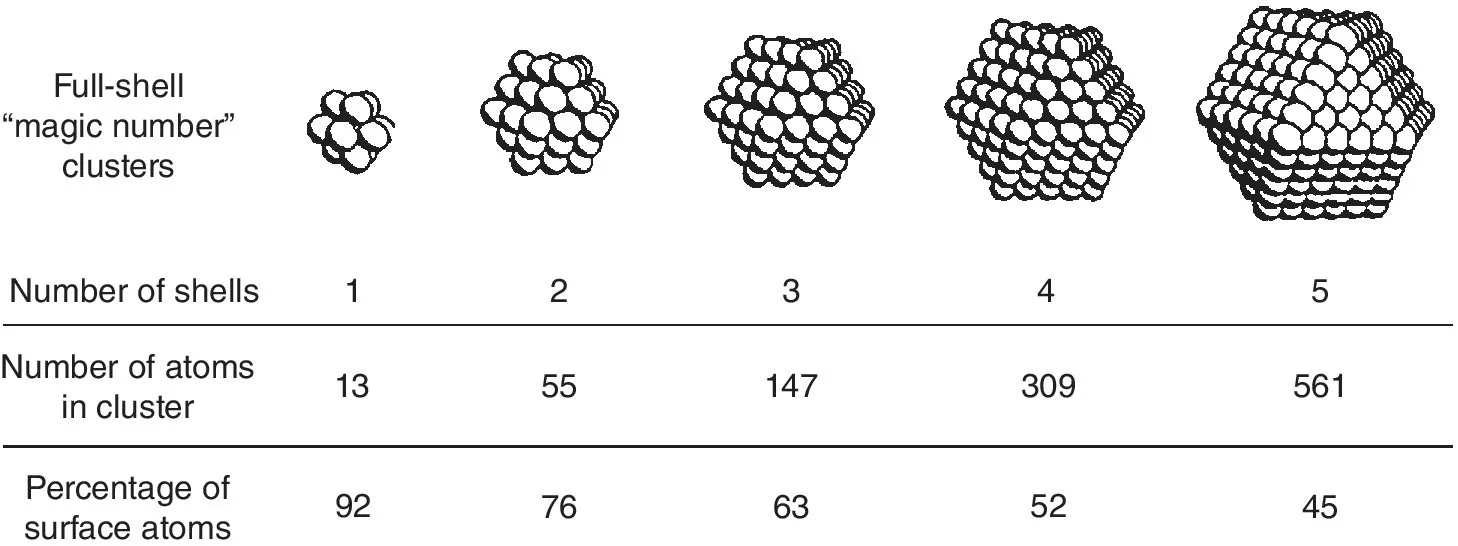
Attributed to the two main factors, unique surface effect and quantum size effect, metallic nanomaterials have exhibited different properties from the corresponding bulk materials and have attracted increasing attention due to their potential application in catalysis, plasmonic, sensing, magnetic recording and other fields. For example, Pt nanoparticles (NPs) are good catalysts for energy storage, Au NPs are candidates for photothermal therapy, Fe NPs are magnetic materials for spintronic devices. The first main factor, surface effect, results in the large surface‐to‐volume ratios of metallic nanoparticles (NPs). As shown in Figure 1.1, the percentage of surface atoms increases dramatically with the decreased size of nanoparticles[4]. So when the sizes of nanoparticles are decreasing, the distributions of low‐coordinated or coordinatively unsaturated atoms, including corner, edge, kink and step sites, on the surface of small particles will be increasing. Unsaturated coordination environment gives rise to the strong trend of active surface atoms to capture other atoms or migrate, and leads to the change of electronic energy band, spin conformation of surface atoms. One example is the large difference of the melting points between bulk gold and 1.5 nm gold nanoparticles[5]. The former is 1064 °C, while the latter is reduced to ca. 500 °C. The lowered melting point of 1.5 nm gold nanoparticles is because the low‐coordinated surface atoms dominate about 80% of the total atoms and are easily mobilized under thermal perturbation.
Figure 1.1 The percentage of surface atoms with the change of the size of nanoparticles.
Modified with permission from ref. [4], copyright 2009 Wiley‐VCH.
The second main factor, the quantum size effect, leads to the shifting electronic energy bands and the change of band gap between the highest occupied molecular orbital (HOMO) and the lowest unoccupied molecular orbital (LUMO). As shown in Figure 1.2, in one bulk metallic material, the effectively continuous energy band is the combination of an infinite number of very similar orbitals; an...
Table of contents
Cover
Table of Contents
Part I: Fundamentals and Structural Characterization of Shape‐Controlled Bimetallic Nanostructures
Part II: Synthesis, Characterization, and Properties of Shape‐Controlled Bimetallic Nanostructures
Part III: Applications of Shape‐Controlled Bimetallic Nanostructures
Index
End User License Agreement
Trusted by 375,005 students
Access to over 1.5 million titles for a fair monthly price.
Study more efficiently using our study tools.
Frequently asked questions
Yes, you can cancel anytime from the Subscription tab in your account settings on the Perlego website. Your subscription will stay active until the end of your current billing period. Learn how to cancel your subscription
No, books cannot be downloaded as external files, such as PDFs, for use outside of Perlego. However, you can download books within the Perlego app for offline reading on mobile or tablet. Learn how to download books offline
Perlego offers two plans: Essential and Complete
Essential is ideal for learners and professionals who enjoy exploring a wide range of subjects. Access the Essential Library with 800,000+ trusted titles and best-sellers across business, personal growth, and the humanities. Includes unlimited reading time and Standard Read Aloud voice.
Complete: Perfect for advanced learners and researchers needing full, unrestricted access. Unlock 1.5M+ books across hundreds of subjects, including academic and specialized titles. The Complete Plan also includes advanced features like Premium Read Aloud and Research Assistant.
Both plans are available with monthly, semester, or annual billing cycles.
We are an online textbook subscription service, where you can get access to an entire online library for less than the price of a single book per month. With over 1.5 million books across 990+ topics, we’ve got you covered! Learn about our mission
Look out for the read-aloud symbol on your next book to see if you can listen to it. The read-aloud tool reads text aloud for you, highlighting the text as it is being read. You can pause it, speed it up and slow it down. Learn more about Read Aloud
Yes! You can use the Perlego app on both iOS and Android devices to read anytime, anywhere — even offline. Perfect for commutes or when you’re on the go. Please note we cannot support devices running on iOS 13 and Android 7 or earlier. Learn more about using the app
Yes, you can access Bimetallic Nanostructures by Ya-Wen Zhang in PDF and/or ePUB format, as well as other popular books in Scienze fisiche & Chimica. We have over 1.5 million books available in our catalogue for you to explore.