Information in all its forms is at the heart of the economic intelligence process. It is also a powerful vector of innovation and, more than ever, a balance between economic and societal forces.
Strategic Intelligence for the Future 1 analyzes the need for the French economic intelligence to mutate in order to develop the economy, strengthen social cohesion and protect vital interests.
This mutation requires a change of attitudes and a new way of thinking, widely open to global change and new technologies. The focus of the French economic intelligence on conventional objectives such as business and the economy does not allow for the integration of its multiple possible fields and thus its global nature. The strategy, foresight and temporal dynamics necessary to the understanding of the world, and the new balance of power and control of complex situations, have thus increased the time needed to put this in place.
Both theoretical and practical, this book provides a basis from which to develop "enhanced economic intelligence" leading to the implementation of global security.
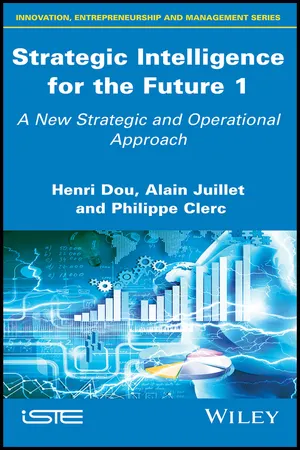
eBook - ePub
Strategic Intelligence for the Future 1
A New Strategic and Operational Approach
- English
- ePUB (mobile friendly)
- Available on iOS & Android
eBook - ePub
Strategic Intelligence for the Future 1
A New Strategic and Operational Approach
About this book
Information
1
For a New Strategic and Competitive Intelligence
We are not only in a changing world; we find ourselves in a world where traditional structures are evolving, in which the power of the state and the relationship with its citizens is beginning to change. Technological breakthroughs are forcing us to rethink traditional models and ways of working. The digital revolution has opened up new, unexplored fields of activity, destroying our traditional notions of discipline demarcation, creating a hybridization of fields and its actors. The loss of cyberspace borders has led to a multipolarization of cultures, meaning that we need to start taking a particular interest in them in order to make sense of our present reality. The primacy of sovereign power has been conquered by the power of some companies and the public/private relations balance due to the mutual interest of both parties. Faced with the radical transformations in which we must take part, pragmatism and realism are essential in the reconstruction of our referents.
1.1. Our assessment
For 500 years, according to the analysis of British historian Paul Kennedy [KEN 10], the most powerful state was the one with the most significant coercive force at the local, regional or international level through military capability, economic leadership or the possession of essential natural resources. Today, we are experiencing a paradigm shift. Joseph Nye [NYE 04] announced in 1990 that power would no longer be based on force, but on the ability of a state to obtain the support of other states based on shared values without the need for coercion, by relying on communication and exchange that the State controls. In response to some criticism, in his latest book, he adds to the outdated hard power, which is favored by George W. Bush, and the emerging soft power, advocated by Barack Obama, as well as an intermediate stage: smart power [NYE 09] advocated by Hillary Clinton. In these three scenarios, the overall strategy is at the heart of the approach and its practice, drawing on the deepest possible knowledge of all facets of the environment and its likely evolution.
Within states, we are witnessing the same phenomenon at the corporate level with a direct impact on the practice of capitalism or liberalism and the expectations of users. After 30 years of creating value for the shareholder, we rediscover that the company is at the heart of community life and has a societal role, as the presidents of Danone and Veolia have recently reminded us [POS 09]. In order for it to be effective, a company can no longer stay in a closed circuit where it is only interested in its own competitors and customers. Profit must benefit investments, research, employees and, of course, shareholders. It cannot rely solely on this practice, however, like some financial practices of investment funds that have largely contributed to the current difficulties of the industrial world. The behavior of GAFAM [WIK 18a] (Google, Apple, Facebook, Amazon, Microsoft) is very revealing here in terms of a new vision of the world and its environment. To emerge from or to stay in the current competition, a company must understand and integrate the geopolitical context, the evolution of ideas, the expectations of the users, the declarations of values and the changes of practices. This complementary knowledge involves in-depth studies that are constantly updated to decode the true reality hidden behind perceived reality [JUS 17] to create effective and efficient strategies.
The strategic errors of large public institutions and private groups have led to industrial and financial disasters, which are often resolved through the use of public funds, without any responsibility being seriously sought by those in power. Despite the collective refusal to study the objective reasons, giving in to the temptation of the scapegoat or fatality, Areva business, Alstom, Technip, Lafarge and how many others show a real strategic weakness. Beyond management and the market, this weakness can only be explained by the lack of information on the competitive and industrial reality of their environments. Those young elites who are straight out of school and thus protected from the harsh reality of the market, and who live in small circles, understand failure as just a sure step in the normal progression of their careers, without understanding the current evolution of the field. This denial, crossed with the mediatization of the methods and practices that led to these situations, contributes to a climate of unhealthy doubt in civil society that distances it from politics and the State [GAV 03]. Yet the analysis of reality and of what is happening in the world shows that the future passes through a very close public/private network in which everyone contributes to the common cause. The state can no longer assume all its missions alone and large and medium-sized companies cannot survive in isolation. Today, everything is connected. Similarly, at the regional level, as for SMEs, this situation becomes a necessity, as shown by the result of the referral “territorial intelligence” of the CESER of the Alpes Provence Côte d’Azur region [CES 17].
Widespread political correctness, imposed by the ruling classes to circumvent the pitfall of democracy and reduce the range of thought and capacity for exchange, is eliminating this contradiction. Unlike Greek philosophical rhetoric or the disputatio of Renaissance humanists, only sophist rhetoric is validated, preventing the opponent from expressing themself outside a defined framework that becomes the limits of thought. Since this contradiction has become impossible, it leaves the field open to media, political or social pressure groups to manipulate the information in order to make it compatible with the agreed thought [MON 10]. In this context, the perceived reality is based on a virtual base built on a set of imposed values that reject or eliminate all that is wrong with the path to transformation. It is therefore very difficult for the analyst to find the elements of a true reality or at least of what is closest to it [FRI 04] to technically escape from this single line of thinking [DEM 00] and to make heard other possibilities. This involves the introduction of artificial intelligence to improve strategic foresight by facilitating the collection, processing and analysis of all data available in Big Data, including those from open, digital, electronic or social sources. We therefore enter the field of smart economy [MED 17].
In this complex environment, the individual evolves by becoming a proactive and cooperative player who benefits from a level of knowledge that is out of step with previous generations and thus benefits from an extensive social network. Immersed in cyberspace, these individuals know how to use the necessary tools and can integrate the permanent evolution into their work, thus setting them apart from the older generations. Their openness to international travel and media opens them up to a whole new set of opportunities. Acting autonomously through an ability to acquire information and form an idiosyncratic opinion, the chain of command is disrupted by an expectation of decentralization of decision-making processes and a willingness to assume one’s share in the operational process.
1.2. The present day
In 1999, Richard Heuer [HEU 99] had already shown the cognitive challenges that would be faced by intelligence analysts; be they scientists, economic or military because of the complexity of the problems, the variable reliability of the data, the growing volume of available information and the multiplicity of actors. Confronted with a double uncertainty by the intersection of complex and indeterminate intelligence problems, linked to the totally artificial denial and influence operations, at each step of the process, they tend to use cognitive biases derived from filters of their own. The problem is therefore analyzing the data and drawing useful conclusions by going beyond the limits of the human mind. This leads to applying artificial intelligence, but also the use of the theory of deterrence games which allow a fairly simple way of classifying, selecting or eliminating competing hypotheses relating to a set of data such as those shown by Michel Rudnianski [RUD 16].
Making this kind of claim leads to questions surrounding how competitive intelligence is practiced in France. The Martre and Carayon reports [DEL 06] and the formation of the Académie d’intelligence économique (academy of competitive intelligence) by Robert Guillaumot [SAL 15] were greatly useful in opening France’s eyes to the positive effects of these methods founded across the Atlantic; the lack of knowledge of which had had a negative impact on progress in France. Founded in the United States in the 1980s by Michael Porter, competitive, and later, strategic intelligence rapidly developed and was an integral part of the federal budget of every president, responding to computer and digital evolutions. The system was built around the Advocacy Center (1993) [EXP 18] which builds on the National Economic Council [WIK 18b] created the same year. The group has been gradually reinforced by a legal, defensive and offensive system, including the Omnibus Trade and Competitiveness Act (1988) [WIK 18c], the Toricelli Act (1992) [CUB 92], the Statement of Administrative Action (Uruguay Round Agreement Act 1994) [URU 18], the Helms-Burton Act (strengthening the embargo on Cuba 1996) [WIK 18d], the Amato-Kennedy Act [COS 96] against rogue states (1996), then the Patriot Act (2001) [DOU 15]. We might also mention the anti-corruption scheme with its 2010 Dodd-Frank [USC 10] and FATCA [FAT 17] extraterritorial legislation, which is based on the 1997 FCPA [USD 97] Act and was mobilized by its implementation by elected officials and all US administrations. All have understood that the preservation of world leadership in the face of Chinese methodical growth and the fierce emergence of other countries should center around the centralization of information, public action to support all American companies and the permanence of efficient economic and technical intelligence at the service of the public and private sectors.
The work carried out in France since 1994 and especially in 2002 has allowed us to model the competitive intelligence approach, at both the levels of development and of practice. This popularized the required state of mind, as defined in Philippe Lemercier’s 5V grid [LEM 14]. It led to the discovery of the usefulness of monitoring and analysis, the importance of security and the practice of influence. It made it possible to draw up a territorial network with the local councils and chambers of commerce. It also opened the field of international standards and practice and inspired policy implementations of competitive intelligence in countries in Europe and Africa, as well as in China. On the other hand, they showed that France had a lot of useful information for the companies that remained in their ministries due to a strict partition that goes against the necessary transversality of the approach. They also showed th...
Table of contents
- Cover
- Table of Contents
- Preface
- Introduction
- 1 For a New Strategic and Competitive Intelligence
- 2 Geopolitics and Strategic Intelligence
- 3 Competitive Intelligence Schools Across the World: Foundations, Influence and Perspectives
- 4 Competitive Intelligence as a Vehicle for International Collaboration
- 5 Regional Competitive Intelligence
- 6 Influence
- 7 Sphere of Influence
- 8 Organizational Intelligence
- 9 From Military Intelligence to Competitive Intelligence
- Conclusion
- Index
- Summary of Volume 2
- End User License Agreement
Trusted by 375,005 students
Access to over 1.5 million titles for a fair monthly price.
Study more efficiently using our study tools.
Frequently asked questions
Yes, you can cancel anytime from the Subscription tab in your account settings on the Perlego website. Your subscription will stay active until the end of your current billing period. Learn how to cancel your subscription
No, books cannot be downloaded as external files, such as PDFs, for use outside of Perlego. However, you can download books within the Perlego app for offline reading on mobile or tablet. Learn how to download books offline
Perlego offers two plans: Essential and Complete
- Essential is ideal for learners and professionals who enjoy exploring a wide range of subjects. Access the Essential Library with 800,000+ trusted titles and best-sellers across business, personal growth, and the humanities. Includes unlimited reading time and Standard Read Aloud voice.
- Complete: Perfect for advanced learners and researchers needing full, unrestricted access. Unlock 1.5M+ books across hundreds of subjects, including academic and specialized titles. The Complete Plan also includes advanced features like Premium Read Aloud and Research Assistant.
We are an online textbook subscription service, where you can get access to an entire online library for less than the price of a single book per month. With over 1.5 million books across 990+ topics, we’ve got you covered! Learn about our mission
Look out for the read-aloud symbol on your next book to see if you can listen to it. The read-aloud tool reads text aloud for you, highlighting the text as it is being read. You can pause it, speed it up and slow it down. Learn more about Read Aloud
Yes! You can use the Perlego app on both iOS and Android devices to read anytime, anywhere — even offline. Perfect for commutes or when you’re on the go.
Please note we cannot support devices running on iOS 13 and Android 7 or earlier. Learn more about using the app
Please note we cannot support devices running on iOS 13 and Android 7 or earlier. Learn more about using the app
Yes, you can access Strategic Intelligence for the Future 1 by Henri Dou,Alain Juillet,Philippe Clerc in PDF and/or ePUB format, as well as other popular books in Business & Decision Making. We have over 1.5 million books available in our catalogue for you to explore.