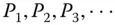
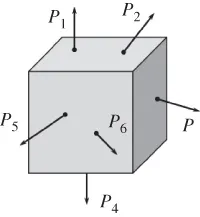
acts on a deformable material element (see Figure 1.1) and remains balanced without causing a displacement and/or rotation, a set of balanced internal stresses must be generated because of the deformation taking place in the material element. Generally, if stress components distribute uniformly on a plane, the stress unit is equal to the force per unit area. Despite an inherent relation that exists between the stress and the acting force, the stress and the force are entirely different in their physical concepts that we could not confuse.
Figure 1.1 Directional forces acting on a unit element.
In analyzing displacement and rotation of a rigid body, all acting forces are vectors and can be converted into a single one. For example, the forces
shown in Figure 1.1 can be turned into a single vector P:
1.1
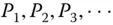
Equation (1.1) means that if
, this loaded body must move and if P does not pass the body's center, the body must rotate simultaneously.
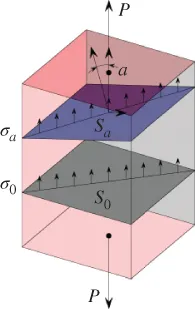
However, it is incorrect to use the force P resulted from vector addition to analyze the elastic or plastic changes in shape of the material element. Different sets of directional forces will respond to different stress distribution on a plane cut out of this material element even if they have the same vector composition. Figure 1.2 illustrates the case of a simple uniaxial tension.
Figure 1.2 Relationship between forces and stresses on a plane cut out of a loaded body under uniaxial tension.
Stress components on different planes of this loaded material element are different. For example, the stress component on the plane vertical to the axis in Figure 1.2 can be expressed by
1.2
where P is the axial force, and S0 is the cross section.
If this material element is a unit body with each edge equal to 1 unit, Equation (1.2) becomes
1.3
Equation (1.3) builds up a relationship between the force and the stre...
Table of contents
Cover
Title Page
Copyright
Table of Contents
Preface
Chapter 1: Fundamentals of Classical Plasticity
Chapter 2: Experimental Research on Material Mechanical Properties under Uniaxial Tension
Chapter 3: Experimental Research on Mechanical Properties of Materials under Non-Uniaxial Loading Condition
Chapter 4: Yield Criteria of Different Materials
Chapter 5: Plastic Constitutive Relations of Materials
Chapter 6: Description of Material Hardenability with Different Models
Chapter 7: Sequential Correspondence Law between Stress and Strain Components and Its Application in Plastic Deformation Process
Chapter 8: Stress and Strain Analysis and Experimental Research on Typical Axisymmetric Plane Stress-Forming Process
Chapter 9: Shell and Tube Hydroforming
Chapter 10: Bulk Forming
Chapter 11: Sheet Forming
Index
End User License Agreement
Trusted by 375,005 students
Access to over 1.5 million titles for a fair monthly price.
Study more efficiently using our study tools.
Frequently asked questions
Yes, you can cancel anytime from the Subscription tab in your account settings on the Perlego website. Your subscription will stay active until the end of your current billing period. Learn how to cancel your subscription
No, books cannot be downloaded as external files, such as PDFs, for use outside of Perlego. However, you can download books within the Perlego app for offline reading on mobile or tablet. Learn how to download books offline
Perlego offers two plans: Essential and Complete
Essential is ideal for learners and professionals who enjoy exploring a wide range of subjects. Access the Essential Library with 800,000+ trusted titles and best-sellers across business, personal growth, and the humanities. Includes unlimited reading time and Standard Read Aloud voice.
Complete: Perfect for advanced learners and researchers needing full, unrestricted access. Unlock 1.5M+ books across hundreds of subjects, including academic and specialized titles. The Complete Plan also includes advanced features like Premium Read Aloud and Research Assistant.
Both plans are available with monthly, semester, or annual billing cycles.
We are an online textbook subscription service, where you can get access to an entire online library for less than the price of a single book per month. With over 1.5 million books across 990+ topics, we’ve got you covered! Learn about our mission
Look out for the read-aloud symbol on your next book to see if you can listen to it. The read-aloud tool reads text aloud for you, highlighting the text as it is being read. You can pause it, speed it up and slow it down. Learn more about Read Aloud
Yes! You can use the Perlego app on both iOS and Android devices to read anytime, anywhere — even offline. Perfect for commutes or when you’re on the go. Please note we cannot support devices running on iOS 13 and Android 7 or earlier. Learn more about using the app
Yes, you can access Engineering Plasticity by Z. R. Wang,Weilong Hu,S. J. Yuan,Xiaosong Wang in PDF and/or ePUB format, as well as other popular books in Technology & Engineering & Materials Science. We have over 1.5 million books available in our catalogue for you to explore.