Materials and Processes for CO2 Capture, Conversion, and Sequestration
eBook - ePub

Materials and Processes for CO2 Capture, Conversion, and Sequestration

  1. English
  2. ePUB (mobile friendly)
  3. Available on iOS & Android
eBook - ePub

Materials and Processes for CO2 Capture, Conversion, and Sequestration

About this book

Addresses materials, technology, and products that could help solve the global environmental crisis once commercialized

This multidisciplinary book encompasses state-of-the-art research on the topics of Carbon Capture and Storage (CCS), and complements existing CCS technique publications with the newest research and reviews. It discusses key challenges involved in the CCS materials design, processing, and modeling and provides in-depth coverage of solvent-based carbon capture, sorbent-based carbon capture, membrane-based carbon capture, novel carbon capture methods, computational modeling, carbon capture materials including metal organic frameworks (MOF), electrochemical capture and conversion, membranes and solvents, and geological sequestration.

Materials and Processes for CO 2 Capture, Conversion and Sequestration offers chapters on: Carbon Capture in Metal-Organic Frameworks; Metal Organic Frameworks Materials for Post-Combustion CO 2 Capture; New Progress of Microporous Metal-Organic Frameworks in CO 2 Capture and Separation; In Situ Diffraction Studies of Selected Metal-Organic Framework (MOF) Materials for Guest Capture Applications; Electrochemical CO 2 Capture and Conversion; Electrochemical Valorization of Carbon Dioxide in Molten Salts; Microstructural and Structural Characterization of Materials for CO 2 Storage using Multi-Scale X-Ray Scattering Methods; Contribution of Density Functional Theory to Microporous Materials for Carbon Capture; and Computational Modeling Study of MnO 2 Octahedral Molecular Sieves for Carbon Dioxide Capture Applications.

  • Addresses one of the most pressing concerns of society—that of environmental damage caused by the greenhouse gases emitted as we use fossil fuels
  • Covers cutting-edge capture technology with a focus on materials and technology rather than regulation and cost
  • Highlights the common and novel CCS materials that are of greatest interest to industrial researchers
  • Provides insight into CCS materials design, processing characterization, and computer modeling

Materials and Processes for CO 2 Capture, Conversion and Sequestration is ideal for materials scientists and engineers, energy scientists and engineers, inorganic chemists, environmental scientists, pollution control scientists, and carbon chemists.
Frequently asked questions

Yes, you can cancel anytime from the Subscription tab in your account settings on the Perlego website. Your subscription will stay active until the end of your current billing period. Learn how to cancel your subscription.
No, books cannot be downloaded as external files, such as PDFs, for use outside of Perlego. However, you can download books within the Perlego app for offline reading on mobile or tablet. Learn more here.
Perlego offers two plans: Essential and Complete
  • Essential is ideal for learners and professionals who enjoy exploring a wide range of subjects. Access the Essential Library with 800,000+ trusted titles and best-sellers across business, personal growth, and the humanities. Includes unlimited reading time and Standard Read Aloud voice.
  • Complete: Perfect for advanced learners and researchers needing full, unrestricted access. Unlock 1.4M+ books across hundreds of subjects, including academic and specialized titles. The Complete Plan also includes advanced features like Premium Read Aloud and Research Assistant.
Both plans are available with monthly, semester, or annual billing cycles.
We are an online textbook subscription service, where you can get access to an entire online library for less than the price of a single book per month. With over 1 million books across 1000+ topics, we’ve got you covered! Learn more here.
Look out for the read-aloud symbol on your next book to see if you can listen to it. The read-aloud tool reads text aloud for you, highlighting the text as it is being read. You can pause it, speed it up and slow it down. Learn more here.
Yes! You can use the Perlego app on both iOS or Android devices to read anytime, anywhere — even offline. Perfect for commutes or when you’re on the go.
Please note we cannot support devices running on iOS 13 and Android 7 or earlier. Learn more about using the app.
Yes, you can access Materials and Processes for CO2 Capture, Conversion, and Sequestration by Lan Li, Winnie Wong-Ng, Kevin Huang, Lawrence P. Cook, Lan Li,Winnie Wong-Ng,Kevin Huang,Lawrence P. Cook in PDF and/or ePUB format, as well as other popular books in Technology & Engineering & Energy. We have over one million books available in our catalogue for you to explore.

1
CARBON CAPTURE IN METAL–ORGANIC FRAMEWORKS

Mehrdad Asgari and Wendy L. Queen
Laboratory of Functional Inorganic Materials,Ecole Polytechnique Federale de Lausanne,, Sion, Switzerland

1.1 INTRODUCTION

1.1.1 The Importance of Carbon Dioxide Capture

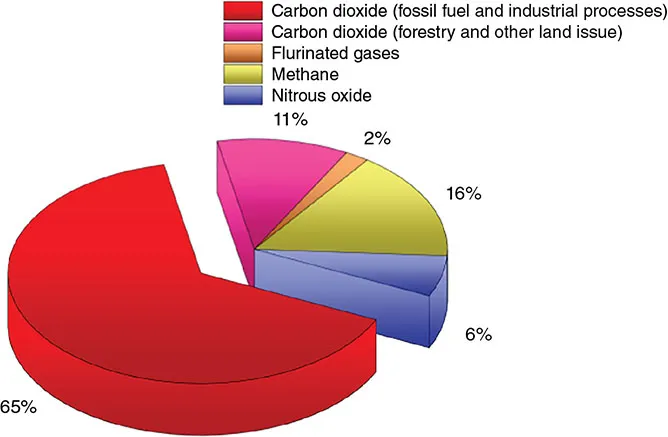
Carbon dioxide, an important chemical gas found in the atmosphere, is critical for the continuation of life on earth. This molecule is required for photosynthesis that fuels plants, which serve as the main source of food for all humans and animals and further produce oxygen that is essential for human respiration [1]. Studies have shown that a small accumulation of CO2 in the atmosphere is necessary to warm earth to a level where glaciation is inhibited, producing an environment where plant and animal life can thrive [2]. However, there is recent evidence that human activity related to energy production is generating an abundance of CO2 in the atmosphere that can no longer be balanced by earth’s natural cycles, an act that is expected to confront mankind with serious environmental problems in the future. Since CO2 is the most abundantly produced greenhouse gas (Figure 1.1) [3], it is directly implemented in global warming. It is predicted that if the negligent release of CO2 persists, it could have detrimental effects on our environment that include melting ice caps, rising sea levels, strong changes in weather patterns, ocean acidification, ozone layer depletion, poor air quality, and desertification; all of these things could lead to the potential demise of the human, plant, and animal life, making CO2 mitigation an urgent need [4, 5].
Pie chart shows percentage share of carbon dioxide from fossil fuels and industrial processes as 65, carbon dioxide from forestry and other land use as 11, flurinated gases as 2, methane as 16, and nitrous oxide as 6.
Figure 1.1 The contribution of different constituent in the greenhouse gas emission. Source: Victor et al. 2014 [3].
Eighty percent of the world’s energy is currently supplied by the combustion of carbon-based fossil fuels [6], an anthropogenic activity that has led to steady increase in atmospheric CO2 levels. Since the beginning of the industrial revolution in the 1750s, atmospheric CO2 concentration has increased from 280 ppm [7] to above 400 ppm in March 2015 [8, 9]. While the best remediation method is to transition from traditional carbon-based fuels to clean energy sources, like wind and solar, energy transitions are historically slow [9]. As such, it is projected that the use of fossil fuels will continue for years to come, requiring the development of materials that can remediate the effects of CO2 through direct carbon capture and sequestration (CCS) and/or conversion of this greenhouse gas into value-added chemicals and fuels. While CO2 capture directly from air is considered to be an unfeasible task, carbon capture from large point sources, such as coal- or gas-fired power plants, could be realized. Currently, 42% of the world’s CO2 emissions come from production of electricity and heat [10] and it is anticipated that approximately 80–90% of these emissions could be eliminated with the implementation of adequate CCS technology [11]. CCS is a multi-step process that includes the capture of CO2 and its transport to sites where it is subsequently stored. While the processes of storage and transport are well-developed technologies, the actual implementation of capture process on a global scale is still constrained by the development of an adequate gas separation technology. Thus, the discovery of new materials with high separation ability is a pertinent obstacle that must be overcome.

1.1.2 Conventional Industrial Process of Carbon Capture and Limitations: Liquid Amines

The most mature capture technology, which has been around since the 1930s, includes aqueous alkanolamine-based scrubbers [12]. These chemical absorbents feature an amine functionality that undergoes a nucleophilic attack on the carbon of the CO2 molecule (Figure 1.2) to form either a carbamate (in the case of primary or secondary amines) or a bicarbonate species (in the case of tertiary amines) [13]. While amine scrubbers are highly selective in the capture of CO2 relative to other components in a gas stream, operate well at low partial pressures, and can be readily included into existing infrastructure at power plants, they have several limitations that inhibit their implementation on scales large enough for post-combustion carbon capture [14]. The materials are quite corrosive to sources of containment requiring their dilution with water to concentrations ranging from 20 to 40 wt% of the amine [15]. The high heat capacities of the aqueous amine solutions combined with high adsorption enthalpies of CO2, approaching āˆ’100 kJ molāˆ’1, creates a large parasitic energy cost for the subsequent release of CO2. While the strength of CO2 binding can be tuned to some degree with amine substitution (1° > 2° > 3°, i.e., monoethanolamine, diethanolamine, or triethanolamine) [13], the regeneration process typically requires temperatures that range from 120°C to 150°C [16–18]. The instability of the materials at these temperatures leads to a slow decomposition and hence a decrease in the materials’ performance with subsequent absorption cycles. Given all of these problems, this technology, which has already been employed in hundreds of plants worldwide for CO2 removal from natural gas, hydrogen, and other gases, requires that approximately 30% of the energy produced from a power plant be put back into the carbon-capture process [12]. It is projected that solid adsorbent materials with lower heat capacities might cut the energy consumption assumed from the current carbon-capture technology considerably [19]. For this to be realized, much further work is required to design porous solid adsorbents that show (i) high stability in the presence of various components in the gas stream, ...

Table of contents

  1. Cover
  2. Title Page
  3. Copyright
  4. Preface
  5. List of Contributors
  6. 1 Carbon Capture in Metal–Organic Frameworks
  7. 2 Metal–Organic Frameworks Materials for Post-Combustion CO2 Capture
  8. 3 New Progress of Microporous Metal–Organic Frameworks in CO2 Capture and Separation
  9. 4 In Situ Diffraction Studies of Selected Metal–Organic Framework Materials for Guest Capture/Exchange Applications
  10. 5 Electrochemical CO2 Capture and Conversion
  11. 6 Electrochemical Valorization of Carbon Dioxide in Molten Salts
  12. 7 Microstructural and Structural Characterization of Materials for CO2 Storage Using Multi-Scale X-Ray Scattering Methods
  13. 8 Contribution of Density Functional Theory to Microporous Materials for Carbon Capture
  14. 9 Computational Modeling Study of MnO2 Octahedral Molecular Sieves for Carbon Dioxide–Capture Applications
  15. Index
  16. End User License Agreement