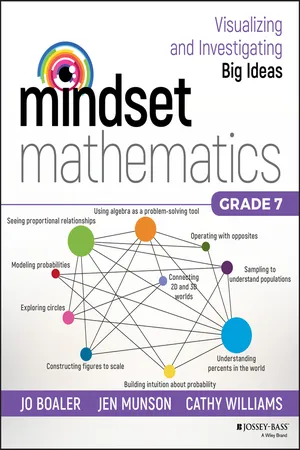
Mindset Mathematics: Visualizing and Investigating Big Ideas, Grade 7
eBook - ePub

Mindset Mathematics: Visualizing and Investigating Big Ideas, Grade 7

  1. English
  2. ePUB (mobile friendly)
  3. Available on iOS & Android
eBook - ePub

Mindset Mathematics: Visualizing and Investigating Big Ideas, Grade 7

About this book

Engage students in mathematics using growth mindset techniques

The most challenging parts of teaching mathematics are engaging students and helping them understand the connections between mathematics concepts. In this volume, you'll find a collection of low floor, high ceiling tasks that will help you do just that, by looking at the big ideas at the seventh-grade level through visualization, play, and investigation.

During their work with tens of thousands of teachers, authors Jo Boaler, Jen Munson, and Cathy Williams heard the same messageโ€”that they want to incorporate more brain science into their math instruction, but they need guidance in the techniques that work best to get across the concepts they needed to teach. So the authors designed Mindset Mathematics around the principle of active student engagement, with tasks that reflect the latest brain science on learning. Open, creative, and visual math tasks have been shown to improve student test scores, and more importantly change their relationship with mathematics and start believing in their own potential. The tasks in Mindset Mathematics reflect the lessons from brain science that:

  • There is no such thing as a math person - anyone can learn mathematics to high levels.
  • Mistakes, struggle and challenge are the most important times for brain growth.
  • Speed is unimportant in mathematics.
  • Mathematics is a visual and beautiful subject, and our brains want to think visually about mathematics.

With engaging questions, open-ended tasks, and four-color visuals that will help kids get excited about mathematics, Mindset Mathematics is organized around nine big ideas which emphasize the connections within the Common Core State Standards (CCSS) and can be used with any current curriculum.

Frequently asked questions

Yes, you can cancel anytime from the Subscription tab in your account settings on the Perlego website. Your subscription will stay active until the end of your current billing period. Learn how to cancel your subscription.
No, books cannot be downloaded as external files, such as PDFs, for use outside of Perlego. However, you can download books within the Perlego app for offline reading on mobile or tablet. Learn more here.
Perlego offers two plans: Essential and Complete
  • Essential is ideal for learners and professionals who enjoy exploring a wide range of subjects. Access the Essential Library with 800,000+ trusted titles and best-sellers across business, personal growth, and the humanities. Includes unlimited reading time and Standard Read Aloud voice.
  • Complete: Perfect for advanced learners and researchers needing full, unrestricted access. Unlock 1.4M+ books across hundreds of subjects, including academic and specialized titles. The Complete Plan also includes advanced features like Premium Read Aloud and Research Assistant.
Both plans are available with monthly, semester, or annual billing cycles.
We are an online textbook subscription service, where you can get access to an entire online library for less than the price of a single book per month. With over 1 million books across 1000+ topics, weโ€™ve got you covered! Learn more here.
Look out for the read-aloud symbol on your next book to see if you can listen to it. The read-aloud tool reads text aloud for you, highlighting the text as it is being read. You can pause it, speed it up and slow it down. Learn more here.
Yes! You can use the Perlego app on both iOS or Android devices to read anytime, anywhere โ€” even offline. Perfect for commutes or when youโ€™re on the go.
Please note we cannot support devices running on iOS 13 and Android 7 or earlier. Learn more about using the app.
Yes, you can access Mindset Mathematics: Visualizing and Investigating Big Ideas, Grade 7 by Jo Boaler,Jen Munson,Cathy Williams in PDF and/or ePUB format, as well as other popular books in Education & Teaching Mathematics. We have over one million books available in our catalogue for you to explore.

Information

Publisher
Jossey-Bass
Year
2019
Print ISBN
9781119357919
eBook ISBN
9781119358015
Edition
1

BIG IDEA 1
Connecting 2D and 3D Worlds

Researchers have recently shown that when we work on a mathematics problem, five areas of the brain are involved, and two of them are visual pathways (Menon, 2015) (as I explained in the introduction to this book). Our brains are helped when we work visually; and when we connect visuals with numbers, important brain connections occur. In addition, other brain areas are involved when we touch, move things, and interact physically with mathematical ideas. The area of research concerning physical touch and movement is known as โ€œembodied cognition,โ€ and researchers in this field point out the importance of students' holding mathematical ideas in the motor and perceptual areas of the brain (Nemirovsky, Rasmussen, Sweeney, & Wawro, 2012), which comes about when they learn mathematical ideas through touch and movement. In this big idea, students are learning about the features of 3D shapes. This is an area that is particularly important to experience physically, as students will not develop a complete understanding of the mathematical features of shapes if they only see them in two-dimensional pictures in textbooks.
When we taught 83 middle school students a few summers ago, we invited them to build larger cubes out of sugar cubes. A year later, one of the students told me that he still remembers the meaning of โ€œ1 cubedโ€ by recalling the feel and the features of the small cube he held in his hands. He told me that it was continuing to help him as he learned geometry. The three activities in this big idea give students a physical opportunity to hold objects in their hands and experience their different features.
In the Visualize activity, students are invited to slice 3D objects to make different two-dimensional shapes. Students will enjoy working with clay, and they will learn about the three-dimensional objects they hold in their hands as they touch and feel the dimensions. As they form the shapes and then sketch them, they will be able to make connections between areas of the brain that deal with physical touch and with drawing.
In the Play activity, students will get the opportunity to explore further with the objects they build out of clay. This activity also includes an element we design into tasks wherever possibleโ€”giving students choice. This is something that will increase their interest, which, in turn, will increase their learning and achievement.
Our Investigate activity poses questions that we hope will enable students to struggle, as that causes positive brain activity, and to extend their ideas to high levels. The questions have an openness that is rare in textbooks but that is important, as this openness enables students to develop their own ideas and to develop mathematical thinking in response to ill-defined problems of the type they will meet in the world outside school. We pose the following questions:
  • How could you slice this solid so that the face that is made has the same area as the base?
  • How could you slice it so that the shape has an area bigger than the base?
Both questions will give students opportunities to think deeply, to wonder about relationships, and to connect ideas.
Jo Boaler

References

  1. Menon, V. (2015). Salience network. In A. W. Toga (Ed.), Brain mapping: An encyclopedic reference (Vol. 2, pp. 597โ€“611). San Diego, CA: Academic Press.
  2. Nemirovsky, R., Rasmussen, C., Sweeney, G., & Wawro, M. (2012). When the classroom floor becomes the complex plane: Addition and multiplication as ways of bodily navigation. Journal of the Learning Sciences, 21(2), 287โ€“323. doi:10.1080/10508406.2011.611445

Seeing Slices

Image depicting the lens of a camera made by slicing a rectangular solid to explore two-dimensional figures.

Snapshot

Students visualize and explore the two-dimensional shapes that can be made by slicing a rectangular solid.
Connection to CCSS
7.G.3

Agenda

Activity Time Description/ Prompt Materials
Launch 10โ€“15 min Show students a rectangular solid made of clay, and then slice that solid on an angle. Without separating the pieces, ask student to predict what shape the face of the slice is. Discuss students' predictions, then reveal and discuss the shape of the face.
  • Rectangular solid made of clay
  • Cutting tool (dental floss or a wire cutter)
Explore 25โ€“30 min Small groups explore the question, What different two-dimensional shapes can you make by slicing a rectangular prism? Groups create a rectangular solid from clay and a net to match. Then groups use a cutting tool to slice and re-form the solid repeatedly to explore the shapes of the sliced faces. Students sketch the solid, how it was sliced, and the resulting face shape.
  • Clay, enough for each group to form a rectangular solid
  • Cutting tool (dental floss or a wire cutter), for each group
  • Regular and isometric dot paper (see appendix), multiple sheets per group
Discuss 15 min Discuss the two-dimensional shapes students created by slicing their rectangular solids. Discuss patterns for creating rectangles, other quadrilaterals, or triangles. Ask, What shapes cannot be made? Why? Optional: chart and markers

To the Teacher

For this activity and the others in this big idea, we want students to have the chance to physically interact with three-dimensional figures and have the opportunity to slice them. To accomplish this, we recommend the use of clay to make the solids and dental floss for cutting. If you have an art department that has wire cutters for clay, those are even better. You may also try plastic knives, if you have those available. We like clay because it is stiff, and if you use a thin cutting tool, clay will maintain the shape of the slice better than play dough or other softer modelin...

Table of contents

  1. Cover
  2. Table of Contents
  3. Introduction
  4. Note on Materials
  5. Activities for Building Norms
  6. BIG IDEA 1: Connecting 2D and 3D Worlds
  7. BIG IDEA 2: Constructing Figures to Scale
  8. BIG IDEA 3: Seeing Proportional Relationships
  9. BIG IDEA 4: Understanding Percents in the World
  10. BIG IDEA 5: Building Intuition about Probability
  11. BIG IDEA 6: Modeling Probabilities
  12. BIG IDEA 7: Sampling to Understand Populations
  13. BIG IDEA 8: Operating with Opposites
  14. BIG IDEA 9: Using Algebra as a Problem-Solving Tool
  15. BIG IDEA 10: Exploring Circles
  16. Appendix
  17. About the Authors
  18. Acknowledgments
  19. Index
  20. End User License Agreement