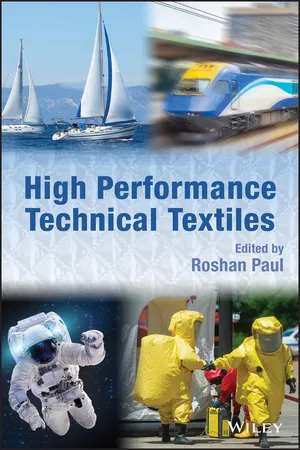
High Performance Technical Textiles
eBook - ePub

High Performance Technical Textiles

  1. English
  2. ePUB (mobile friendly)
  3. Available on iOS & Android
eBook - ePub

High Performance Technical Textiles

About this book

An authentic resource for the fundamentals, applied techniques, applications and recent advancements of all the main areas of technical textiles

Created to be a comprehensive reference, High Performance Technical Textiles includes the review of a wide range of technical textiles from household to space textiles. The contributors—noted experts in the field from all the continents—offer in-depth coverage on the fibre materials, manufacturing processes and techniques, applications, current developments, sustainability and future trends.

The contributors include discussions on synthetic versus natural fibres, various textile manufacturing techniques, textile composites and finishing approaches that are involved in the manufacturing of textiles for a specific high performance application. Whilst the book provides the basic knowledge required for an understanding of technical textiles, it can serve as a springboard for inspiring new inventions in hi-tech fibres and textiles. This important book:

  • Contains a unique approach that offers a comprehensive understanding of the manufacturing and applications of technical textiles
  • Includes a general overview to the fundamentals, current techniques, end use applications as well as the most recent advancements
  • Explores the current standards in the industry and the ongoing research in the field
  • Offers a comprehensive and single source reference on the topic

Written for academics, researchers and professionals working in textile and related industries, High Performance Technical Textiles offers a systematic, structured, logical and updated source of information for understanding technical textiles.

Tools to learn more effectively

Saving Books

Saving Books

Keyword Search

Keyword Search

Annotating Text

Annotating Text

Listen to it instead

Listen to it instead

Information

1
High Performance Technical Textiles: An Overview

Roshan Paul
University of Beira Interior, Covilhã, Portugal

1.1 Introduction

Technical textiles provide technical, functional, and performance properties, unlike textiles used in the fashion, artistic, or decorative sectors. These include textiles for households, packaging, sports, medical, protection, military, filtration, geotextiles, agriculture, construction, automotive, marine, aeronautic, and other smart applications. Synthetic as well as nanofibres – like aramid, polyolefin, polyamide, polyester (PES), viscose, glass, and ceramic fibres – are widely used for the manufacture of technical textiles. Nanofibre nonwovens can also improve the properties of textiles designed for technical applications.
Natural and bast fibres like jute, flax, hemp, coir, ramie, kenaf, and abaca are also finding applications as technical textiles for environmental reasons. They are gaining increasing importance particularly as fibre reinforced composites in automotive, construction, aerospace, and packaging industries. This is mainly due to the fact that bast fibres offer good tensile strength and stiffness compared to synthetic fibres such as polyamide, carbon, and aramid. Besides, they originate from renewable natural resources and are environmentally friendly.

1.2 Application Areas of Technical Textiles

In general, application areas of technical textiles are classified as:
  • Hometech. Carpet components, furniture components, consumer and industrial wipes, air and water filtration, interior design, drapes, covers, ticking, composites, etc.
  • Packtech. Bulk packaging with a predefined three‐dimensional (3D) structure, scrap and disposable, spacer and tying, absorbent food pads, etc.
  • Sporttech. Luggage components, sports equipment, sportswear, wipes, covers, disposable, and camping equipment, etc.
  • Medtech. Drapes and gowns, sterile wrap, swabs and dressing, cleaning products, cover stock, wound care, protective apparel, bedding and sheets and masks, etc.
  • Protech. Chemical and biological protection, particulate protection, flame retardant, cut resistant, shields and gowns worn in emergency situations, chemical handling, hazardous waste control, cleaning, filtration, etc.
  • Clothtech. Cleanroom garments, shoe components, insulation and structure, sewing products, interlining, leather goods applications, etc.
  • Indutech. Electrical components, filtration and separation, satellite dishes, clothing surfacing tissues/veils, conveyor belts, reinforced plastics, polyvinyl chloride (PVC) substrates, flame barriers, noise absorbents, battery separators, antislip matting, lifting and pulling, etc.
  • Geotech. Asphalt overlay, soil stabilization, drainage, sedimentation and erosion control, pond liner, impregnation base, drainage channel liners, separation, reinforcement, filtration, offshore land reclamation, roadside, railside, river and canal banks, reservoirs, etc.
  • Oekotech. Environmental protection, exhaust air and waste water filtration, dust collection, oil and fuel absorbent, gas and odour removal, etc.
  • Agrotech. Crop covers, seed blankets, weed control fabrics, greenhouse shading, root bags, biodegradable plant pots, capillary matting cover, protection and collection, fishing, etc.
  • Buildtech. Roofing and tile underlay, underslating, thermal and noise insulation, house wrap, facings for plaster board, pipe wrap, concrete moulding layers, foundations and ground stabilization, vertical drainage, protection and display, textile construction, building components, reinforcements, high quality wallpapers, etc.
  • Mobiltech. Boot liners, parcel shelves, heat shields, shelf trim, moulded bonnet liners, boot floor covering, fuel/oil filters, headliners, rear parcel shelves, airbags, cabin air filters, engine intake and exhaust air filters, silencer pads, insulation materials, car covers, under padding, car mats, tapes, backing for tufted carpets, seat covers, door trim and insulation, floor coverings, protection, composites, etc.

1.3 Technical Textiles by Functional Finishing

It is a general concept that technical textiles are manufactured using technical fibres, with inherent technical properties. But innovative functional finishes are creating possibilities for developing functional technical textiles by a simple finish application at the end of the textile manufacturing process. The modification of commodity fibre and fabric properties by innovative finishes can be a cheaper route to high performance than by using high cost fibres with inherent built in performance properties. In a textile industry, finishing is usually done in the final stage of textile processing. A wide variety of functional properties can be created on textiles by means of chemical or bio finishing and also it is possible to develop multifunctional textiles.
With the advent of nanotechnology, a new area has developed in the realm of textile finishing. Nanotechnology is opening new avenues in chemical finishing, resulting either in improved processes or in helping to achieve new functional properties, which were not possible with conventional finishes. Thus, the application of nanotechnology creates an expanded array of functional properties enabling textiles to be used in novel materials and products. Unlike in conventional finishing, the nanometric size of the coating will not affect negatively the hand and feel of the finished fabric. The low temperature sol–gel techniques, as well as the new generation of polymeric resins, are offering new possibilities in textile chemical finishing.
Another important development is the plasma enhanced chemical vapour deposition (PECVD) technique. It is a finishing process which can be used to deposit thin solid polymeric films from a gas state to a solid state on a textile substrate to achieve the desired properties. The advantage of such plasma treatments is that the modification turns out to be restricted to the uppermost layers of the substrate, thus not affecting the overall bulk properties. In general, plasma treatment can be considered as a dry alternative to the wet chemical treatments and so they are environmentally friendly. Layer by layer (LbL) assembly method is another new finishing technique by which ultrathin composite films can be developed on solid surfaces like textiles. It involves an LbL adsorption of polycations and polyanions to build a multilayer ultrathin polyelectrolyte coating on a textile substrate.

1.4 High Performance Technical Textiles

This book on high performance technical textiles covers almost all the important areas of technical textiles. The book starts with household and packaging textiles, hi‐tech sports textiles, and medical textiles. Further, it focuses on the protective aspects, with chapters on protective textiles, personal protective clothing, and military textiles. Industrial and filtration textiles, geotextiles, and agrotextiles are dealt with in the subsequent chapters. Important application areas like construction, automotive, marine, aeronautic, and space are covered in the following chapters. The last chapter talks exclusively about smart and responsive textiles.

1.4.1 Household and Packaging Textiles

Textiles have become an integral part of the home, both in daily use and in household installations. Household textiles include carpets, sheets, pillow cases, pillows, blankets and quilts, bedspreads, table linens, bathroom and kitchen towels, bathmats, shower curtains, readymade and custom made curtains, draperies, slipcovers, and other furniture protectors. They make life more comfortable and give home interiors a defined aesthetic characteristic.
Technological innovations have converted conventional household textiles into high performance textiles by improving their durability and by adding multiple functionalities, thus allowing them to follow trends in line with e‐textiles, combining sustainable materials for easier disposal and reuse, and incorporating nanotechnology into everyday personal items. Hollow fibres with good insulation properties are broadly employed in bedding and sleeping bags. Other categories of fibre are increasingly being utilized to substitute foams in furniture because of the fear of fire and of health hazards created by such materials.
Packaging textiles include all textile packing material for industrial, agricultural, and other goods. Lightweight nonwoven and knitted materials are widely used for various wrapping and protection purposes, particularly in foodstuff industries. Growing environmental concern over reusable packages and containers is opening new opportunities for textile products in this area. Textiles have helped high performance packaging to advance as they can be engineered to have very strong weaving structures while being lightweight and more sustainable than conventional packaging materials. High performance textiles along with modern materials handling methods have permitted the innovation of more proficient handling, storing, and distribution of various powdered and granular merchandise varying from fertilizers, sand, cement, sugar, and flour to dyes and pigments. Packaging textiles have also entered a new era of active and intelligent systems which interact with their content and inform the consumer about spoilage risks or products' nonconformity.

1.4.2 Sports Textiles

Traditional applications of sports textiles are in high activity outdoor athletics, team sports, as well in less active games, for example golf. Further, they are also used in highly visible applications, including textiles for balloons, parachutes, paragliders, and sailcloth. Sportswear has also become leisure and casual clothing. High performance sports textiles are widely used in shoes, sports equipment, winter and summer sports, flying and sailing sports, climbing, angling, and cycling.
Functional sportswear has a new look as lifestyle wear, and accordingly sportswear is functionally modified and fashion elements are added to meet these new requirements. High performance sports textiles are manufactured using sophisticated raw materials and technology. The performance fibres, yarns, fabrics, and functional finishes developed for the sports sector are increasingly transferring the sportswear to the mass market in the high street. Sports textiles are also specially designed to take moisture away from the body, and attached with sensors to identify high impact stresses on joints, heart rate, temperature, and other physiological data. All these developments have made the choice of materials more pronounced and selection of them more complicated. This leads to balancing properties and functionalities with user and maintenance friendliness.

1.4.3 Medical Textiles

Medical textiles are one of the important areas within technical textiles and the use of textile materials for medical and healthcare products ranges from simple uniforms or gauze or bandage materials to scaffolds for tissue culturing and a large variety of prostheses for permanent body implants. It should provi...

Table of contents

  1. Cover
  2. Table of Contents
  3. List of Contributors
  4. 1 High Performance Technical Textiles: An Overview
  5. 2 Household and Packaging Textiles
  6. 3 Sports Textiles and Comfort Aspects
  7. 4 Medical and Healthcare Textiles
  8. 5 Textile Materials for Protective Textiles
  9. 6 Personal Protective Textiles and Clothing
  10. 7 Textiles for Military and Law Enforcement Personnel
  11. 8 Industrial and Filtration Textiles
  12. 9 Geotextiles and Environmental Protection Textiles
  13. 10 Agrotextiles and Crop Protection Textiles
  14. 11 Building and Construction Textiles
  15. 12 Automotive Textiles and Composites
  16. 13 Marine Textiles and Composites
  17. 14 Aeronautical and Space Textiles
  18. 15 Wearable and Smart Responsive Textiles
  19. Index
  20. End User License Agreement

Frequently asked questions

Yes, you can cancel anytime from the Subscription tab in your account settings on the Perlego website. Your subscription will stay active until the end of your current billing period. Learn how to cancel your subscription
No, books cannot be downloaded as external files, such as PDFs, for use outside of Perlego. However, you can download books within the Perlego app for offline reading on mobile or tablet. Learn how to download books offline
Perlego offers two plans: Essential and Complete
  • Essential is ideal for learners and professionals who enjoy exploring a wide range of subjects. Access the Essential Library with 800,000+ trusted titles and best-sellers across business, personal growth, and the humanities. Includes unlimited reading time and Standard Read Aloud voice.
  • Complete: Perfect for advanced learners and researchers needing full, unrestricted access. Unlock 1.4M+ books across hundreds of subjects, including academic and specialized titles. The Complete Plan also includes advanced features like Premium Read Aloud and Research Assistant.
Both plans are available with monthly, semester, or annual billing cycles.
We are an online textbook subscription service, where you can get access to an entire online library for less than the price of a single book per month. With over 1 million books across 990+ topics, we’ve got you covered! Learn about our mission
Look out for the read-aloud symbol on your next book to see if you can listen to it. The read-aloud tool reads text aloud for you, highlighting the text as it is being read. You can pause it, speed it up and slow it down. Learn more about Read Aloud
Yes! You can use the Perlego app on both iOS and Android devices to read anytime, anywhere — even offline. Perfect for commutes or when you’re on the go.
Please note we cannot support devices running on iOS 13 and Android 7 or earlier. Learn more about using the app
Yes, you can access High Performance Technical Textiles by Roshan Paul in PDF and/or ePUB format, as well as other popular books in Technology & Engineering & Materials Science. We have over one million books available in our catalogue for you to explore.