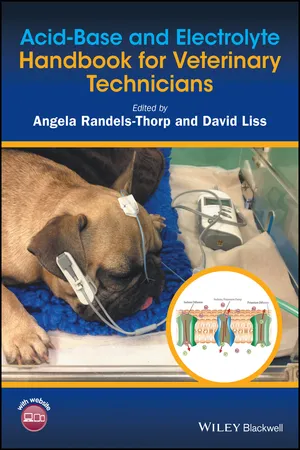
Acid-Base and Electrolyte Handbook for Veterinary Technicians provides an easy to understand yet comprehensive approach to acid-base and electrolyte balance.
Covers the physiology of fluids and their effect on acid-base and electrolyte balance
Offers detailed information on managing acid-base and electrolyte derangements in disease
Includes access to a companion website with case studies and multiple choice questions
CHAPTER 1 Introduction to Acid‐Base and Electrolytes
Angela Randels‐Thorp, CVT, VTS (ECC, SAIM) and David Liss, RVT, VTS (ECC, SAIM)
Understanding of acid‐base and electrolyte chemistry and physiology is both an important and valuable knowledge base for all veterinary technicians, and especially those in emergency and critical care or specialty practice. These very topics, however, are frequently thought of as boring at best or utterly confusing at worst. In actuality neither is true. These topics are often approached in a piecemeal or qualitative way, which lends itself to confusion. It is the goal of this text to provide a useful, easy‐to‐learn, and practical approach to the concepts regarding acid‐base and electrolytes.
Introduction to acid‐base
Assessment of acid‐base status provides insight into three physiologic processes: alveolar ventilation, acid‐base status, and oxygenation. Evaluating acid‐base status has become an integral part of the emergent/critical care patient workup and should be performed as a baseline on all emergent patients. Deviation from normal acid‐base balances is indicative of clinical disease processes and can aid the clinician in identifying underlying causes of illness in the patient. Venous samples can provide most of the information needed regarding acid‐base status and even alveolar ventilation. Arterial samples are required, however, in order to provide oxygenation status (Sorrell‐Raschi 2009). It is ever more important for the emergency and critical care (ECC) technician to be familiar in his/her understanding of acid‐base values and what they mean.
What is acidity?
In the simplest of terms, the acidity or alkalinity of a solution is based on how many hydrogen (H+) ions, or molecules of carbon dioxide (CO2), are present. Hydrogen ions are produced daily as a normal part of metabolism of protein and phospholipids, and are considered a fixed, non‐volatile acid. Carbon dioxide is a byproduct of the metabolism of fat and carbohydrates in the body, and is considered a volatile acid (volatile = readily vaporized). Gaseous CO2 is soluble in water. CO2 is considered an acid because it readily combines with H2O in the presence of carbonic anhydrase (enzyme/catalyst) to form carbonic acid (H2CO3). Without the catalyst, this change occurs very slowly. CO2 is continually removed by ventilation and thereby kept at a stable partial pressure (pCO2) in the body. The change in dissolved CO2 in body fluids is proportional to pCO2 in the gas phase. Elimination of these acids is dependent on the function of the lung, kidney, and liver.
Bronsted and Lowry state an acid is a proton donor (H+) and a base is a proton acceptor (A–) (DiBartola 2006: 229). The H+ concentration ([H+]) of body fluids must be kept at a constant level to prevent detrimental changes in enzyme function and cellular structure. Levels compatible with life are between 16 and 160 nEq/L. Excessive hydrogen ions in the blood result in acidemia. Decreased hydrogen ions in the blood result in alkalemia (Kovacic 2009). Hydrogen ions are not typically measured or tested in clinical practice. Therefore, Sorenson developed pH notation in order to provide simpler notation of the wide range of [H+] (DiBartola 2006: 229). There is an inverse relationship between pH and [H+] (Ex: ↑[H+] → ↓pH). Normal pH ranges between 7.35 and 7.45, approximately. The processes which lead to changes in production, retention, or excretion of acids or bases, which may or may not result in a change in pH, are called acidosis or alkalosis.
Buffering systems
The body contains several mechanisms in order to maintain the desired “normal” pH level, which is called buffering. A buffer is a compound that can accept or donate protons (H+) and minimize a change in pH. Buffers consist of a weak acid and its conjugate salt (Sorrell‐Raschi 2009). If a strong acid is added to a buffer, the protons from the acid dissociate to the salt of the buffer and the change of pH is therefore minimized. With these buffers the body is continually converting CO2, H2O, H+, and
to maintain pH within normal ranges. The following equation represents this constant interaction:
There are several compounds that serve as buffers in the body. The primary buffer of extracellular fluid (ECF) is bicarbonate (
). Non‐bicarbonate buffers consist of proteins and inorganic and organic phosphates, which are primarily intracellular fluid (ICF) buffers. Bone is a prominent source of buffer (calcium carbonate and calcium phosphate). Up to 40% of buffering can be done from resources found in bone. Upon treatment/administration of sodium bicarbonate (
), carbonate that has been released to buffer can then be deposited back into the bone. In the blood, proteins, including hemoglobin and plasma, serve as buffers. Hemoglobin constitutes 80% of the buffering capacity of blood, whereas plasma proteins only account for 20% of buffering in the blood.
The body’s buffering system is considered an open buffering system, with both bicarbonate and carbonic acid systems. In a closed system the exchanges would have to occur in a reciprocal manner. Since the body eliminates the majority of CO2 through ventilation, keeping ...
Table of contents
Cover
Title Page
Table of Contents
List of Contributors
Foreword
About the Companion Website
CHAPTER 1: Introduction to Acid‐Base and Electrolytes
CHAPTER 2: Disorders of Sodium
CHAPTER 3: Disorders of Chloride
CHAPTER 4: Disorders of Potassium
CHAPTER 5: Disorders of Magnesium
CHAPTER 6: Disorders of Phosphorus
CHAPTER 7: Disorders of Calcium
CHAPTER 8: Traditional Acid‐Base Physiology and Approach to Blood Gas
CHAPTER 9: Metabolic Blood Gas Disorders
CHAPTER 10: Respiratory Acid‐Base Disorders
CHAPTER 11: Mixed Acid‐Base Disorders
CHAPTER 12: Strong Ion Approach to Acid‐Base
CHAPTER 13: Companion Exotic Animal Electrolyte and Acid‐Base
Index
End User License Agreement
Trusted by 375,005 students
Access to over 1.5 million titles for a fair monthly price.
Study more efficiently using our study tools.
Frequently asked questions
Yes, you can cancel anytime from the Subscription tab in your account settings on the Perlego website. Your subscription will stay active until the end of your current billing period. Learn how to cancel your subscription
No, books cannot be downloaded as external files, such as PDFs, for use outside of Perlego. However, you can download books within the Perlego app for offline reading on mobile or tablet. Learn how to download books offline
Perlego offers two plans: Essential and Complete
Essential is ideal for learners and professionals who enjoy exploring a wide range of subjects. Access the Essential Library with 800,000+ trusted titles and best-sellers across business, personal growth, and the humanities. Includes unlimited reading time and Standard Read Aloud voice.
Complete: Perfect for advanced learners and researchers needing full, unrestricted access. Unlock 1.5M+ books across hundreds of subjects, including academic and specialized titles. The Complete Plan also includes advanced features like Premium Read Aloud and Research Assistant.
Both plans are available with monthly, semester, or annual billing cycles.
We are an online textbook subscription service, where you can get access to an entire online library for less than the price of a single book per month. With over 1.5 million books across 990+ topics, we’ve got you covered! Learn about our mission
Look out for the read-aloud symbol on your next book to see if you can listen to it. The read-aloud tool reads text aloud for you, highlighting the text as it is being read. You can pause it, speed it up and slow it down. Learn more about Read Aloud
Yes! You can use the Perlego app on both iOS and Android devices to read anytime, anywhere — even offline. Perfect for commutes or when you’re on the go. Please note we cannot support devices running on iOS 13 and Android 7 or earlier. Learn more about using the app
Yes, you can access Acid-Base and Electrolyte Handbook for Veterinary Technicians by Angela Randels-Thorp, David Liss, Angela Randels-Thorp,David Liss in PDF and/or ePUB format, as well as other popular books in Medicine & Veterinary Medicine. We have over 1.5 million books available in our catalogue for you to explore.