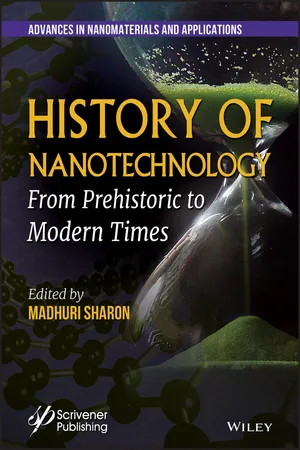
The scientific knowledge of nanoscience and nanotechnology is regarded to be a modern sciencethat evolved after Feynman's concept was formulated in the 1950s. However, Faraday and other scientists in the 19th century showed the science behind the small and its relation to optical properties. And it is now accepted that knowledge of using nanoparticles prevailed during the medieval period as well.
This book takes the readers on a fascinating journey writing the history of nanotechnology based on the evidence of existence from the prehistoric period right up to the contemporary times. Nature utilized nanotechnology during the origin and expansion of the universe and especially in the evolution of living beings on our planet. Early civilizations in different parts of globe fabricated and used materials without having perception of their actual size.
This unique historical view systematically evaluates the development of various applications of nanotechnology through the ages and the science behind it. Some of the issues covered include:
• How old is nanotechnology? • Pre-historic evidence of knowledge of nanotechnology • Nanotechnology in ancient India • Ayurvedic Bhasma as nanomedicine • Mayan's knowledge of nanotechnology • Nanotechnology during the Roman empire and medieval period • European knowledge in the 19th century • Modern and contemporary history of nanotechnology
This book is compilation of existence of scientific knowledge even of the people who existed before there were schools, universities and organized teaching. The author has scoured literature dating back to Mayan … as well as historical observations
A systematic evaluation of development of various applications of nanotechnology and the science behind it is presented in this book under following headings
-How old is Nanotechnology -Pre-historic Evidence of Knowledge of Nanotechnology -Nanotechnology in Ancient India -Ayurvedic Bhasma as Nanomedicine, its use prevails even today -Mayan's Knowledge of Nanotechnology -Nanotechnologists Flourished During Roman Empire and medieval period -European Nano knowledge That Led to Faraday Understands of Gold Nanoparticles -Contemporary History of Nanotechnology
Walchand College of Arts and Science, Solapur University, Solapur, Maharashtra, India
I want to know why the universe exists, why there is something greater than nothing. Stephen Hawking
Preamble
When we sat down to write this chapter, the first thing that came to mind was whether there are nanoparticles existing in nature which are not man-made or fabricated. Both biotic and abiotic natural nanoparticles came to mind. The next question was, “Since when?” Nanoparticles by definition are particles of any shape with an equivalent diameter of 1–100 nm, i.e., specifically those particles that are intermediate in size between bulk materials and atomic/molecular structures or quantum dots. These nano-size particles exhibit unique physical and chemical properties due to their distinctive novel properties related to a high surface area to volume ratio and/or quantum effects.
A quick glance at various scales of measurement (Table 1.1) gives an idea of how small a nanometer is. A nanometer (nm) is one thousand-millionth of a meter. For comparison, a red blood cell is approximately 7,000 nm wide and a water molecule is almost 0.3 nm across. People are interested in the nanoscale (which is defined to be from 100 nm down to the size of atoms (approximately 0.2 nm) because it is at this scale that the properties of materials can be very different from those at a larger scale. Nanoscience is defined as the study of phenomena and manipulation of materials at atomic, molecular and macromolecular scales, where properties differ significantly from those at a larger scale; and nanotechnologies as the design, characterization, production and application of structures, devices and systems by controlling shape and size at the nm scale.
Table 1.1 Scales of Measurement.
Factor
Symbol
Prefix
Factor
Symbol
Prefix
10–18
A
Atto
101
Da
Dekka
10–15
F
Femto
102
H
Hector
10–12
P
Pico
103
K
Kilo
10–9
N
Nano
106
M
Mega
10–6
μ
Micro
109
G
Giga
10–3
M
Milli
1012
T
Tera
10–2
C
Centi
1015
P
Peta
10–1
D
Deci
1018
E
Exa
Let us look at some of the known naturally occurring nanoparticles. Depending on the origin, a distinction is made between three types of nano-size particles: (i) natural, (ii) incidental and (iii) engineered. Natural nanoparticles from volcanic dust, lunar dust, mineral composites, etc., have existed since the beginning of the Earth. Some such nanoparticles still occur in the environment and are termed incidental nanoparticles, also defined as waste or anthropogenic particles, which take place as the result of man-made industrial processes such as diesel exhaust, coal combustion, welding fumes, etc.
1.1 Introduction
Our present awareness of nanotechnology (materials of a size between 1–100 nm, having novel properties that are not found in their bulk counterpart) started in the 1980s, caused by the convergence of experimental advances such as the invention of the scanning tunneling microscope in 1981 and the discovery of fullerenes in 1985, with the elucidation of a conceptual framework for the goals of nanotechnology. Nanotechnology became popularized as a result of the Nobel Prize being awarded for many nanoparticle discoveries; i.e., Nobel Prizes were awarded to Heinrich Rohrer in 1986 for the invention of the scanning tunneling microscope, to Kroto et al., in 1985 for the discovery of fullerene, and to Geim and Novoselov in 2010 for graphene. The ideas and concepts behind nanoscience and nanotechnology started with a talk entitled “There’s Plenty of Room at the Bottom” by physicist Richard Feynman at an American Physical Society meeting at the California Institute of Technology (Caltech) on December 29, 1959, long before the term nanotechnology was coined in 1974 by Taniguchi.
Our concern in this chapter is to address the questions of “How old is nanotechnology?” and “Are there naturally occurring nanoparticles; if so, since when?” To know the existence of nanoparticles on Earth, which is part of this universe, we realize that their origin plays a great role in the existence of any matter.
There was a time when scientists thought Earth was at the center of the universe. As late as the 1920s, we did not realize that our galaxy was just one of many in a vast universe. Only later did we recognize that the other galaxies were running away from us—in every direction—at ever greater speeds. Our universe is both ancient and vast, and expanding out farther and faster every day. This accelerating universe, the dark energy that seems to be behind it and other puzzles, like the exact nature of the Big Bang and the early evolution of the universe, are among the great puzzles of cosmology.
About 11 to 15 billion years ago all of the matter and energy in the universe was concentrated into an area the size of an atom. At that moment, matter, energy, space and time did not exist. Then suddenly, the universe began to expand at an incredible rate and matter, energy, space and time came into being (the Big Bang). As the universe expanded, matter began to coalesce into gas clouds, and then stars and planets. Our solar system formed about 5 billion years ago when the universe was about 65% of its present size. Today, the universe continues to expand along with the existence of nanoparticles.
Though the chemical properties of a bulk material depend on its molecular structure, when they assemble at the nano level they exhibit other unique and novel physicochemical properties. That may be why nature decided to naturally synthesize particles at the nano level to contribute to the evolution of our Earth or perhaps other planets also.
Prehistoric events date back to the time before the invention of writing—roughly 5,000 years ago. Without access to written records, scientists investigating the lives of prehistoric people face special challenges. A lot of knowledge has been lost due to man-made activities like wars, as well as natural calamities such as earthquakes, tsunamis, floods, volcanic eruptions and meteor showers, which have caused tremendous adverse effects.
What are natural nanomaterials? As the name suggests, natural nanoparticles are synthesized by natur...
Table of contents
Cover
Title page
Copyright page
Preface
Foreword
Chapter 1: How Old is Nanotechnology?
Chapter 2: Prehistoric Evidence of Nanotechnology
Chapter 3: Nanotechnology in Ancient India
Chapter 4: Are Bhasma Nanomedicine of Ancient Times
Chapter 5: The Maya’s Knowledge of Nanotechnology
Chapter 6: Did Nanotechnology Flourish During the Roman Empire and Medieval Periods?
Chapter 7: European Nano Knowledge That Led to Faraday’s Understanding of Gold Nanoparticles
Chapter 8: Contemporary History of Nanotechnology
Index
End User License Agreement
Trusted by 375,005 students
Access to over 1.5 million titles for a fair monthly price.
Study more efficiently using our study tools.
Frequently asked questions
Yes, you can cancel anytime from the Subscription tab in your account settings on the Perlego website. Your subscription will stay active until the end of your current billing period. Learn how to cancel your subscription
No, books cannot be downloaded as external files, such as PDFs, for use outside of Perlego. However, you can download books within the Perlego app for offline reading on mobile or tablet. Learn how to download books offline
Perlego offers two plans: Essential and Complete
Essential is ideal for learners and professionals who enjoy exploring a wide range of subjects. Access the Essential Library with 800,000+ trusted titles and best-sellers across business, personal growth, and the humanities. Includes unlimited reading time and Standard Read Aloud voice.
Complete: Perfect for advanced learners and researchers needing full, unrestricted access. Unlock 1.5M+ books across hundreds of subjects, including academic and specialized titles. The Complete Plan also includes advanced features like Premium Read Aloud and Research Assistant.
Both plans are available with monthly, semester, or annual billing cycles.
We are an online textbook subscription service, where you can get access to an entire online library for less than the price of a single book per month. With over 1.5 million books across 990+ topics, we’ve got you covered! Learn about our mission
Look out for the read-aloud symbol on your next book to see if you can listen to it. The read-aloud tool reads text aloud for you, highlighting the text as it is being read. You can pause it, speed it up and slow it down. Learn more about Read Aloud
Yes! You can use the Perlego app on both iOS and Android devices to read anytime, anywhere — even offline. Perfect for commutes or when you’re on the go. Please note we cannot support devices running on iOS 13 and Android 7 or earlier. Learn more about using the app
Yes, you can access History of Nanotechnology by Madhuri Sharon in PDF and/or ePUB format, as well as other popular books in Technology & Engineering & Materials Science. We have over 1.5 million books available in our catalogue for you to explore.