Medical Student Survival Skills
eBook - ePub

Medical Student Survival Skills

Procedural Skills

  1. English
  2. ePUB (mobile friendly)
  3. Available on iOS & Android
eBook - ePub

Medical Student Survival Skills

Procedural Skills

About this book

Medical students encounter many challenges on their path to success, from managing their time, applying theory to practice, and passing exams. The Medical Student Survival Skills series helps medical students navigate core subjects of the curriculum, providing accessible, short reference guides for OSCE preparation and hospital placements. These guides are the perfect tool for achieving clinical success.

Medical Student Survival Skills: Procedural Skills is the ideal guide for medical students tasked with performing a core set of clinical procedures. A vital part of any medical training, these procedures range from basic body temperature and blood pressure measurements to more advanced arterial blood gas sampling and ophthalmoscopic techniques. This indispensable guide enables students to quickly lookup relevant information on the go, carry out clinical procedures with minimal supervision and apply procedural knowledge to their OSCE exams.
Frequently asked questions

Yes, you can cancel anytime from the Subscription tab in your account settings on the Perlego website. Your subscription will stay active until the end of your current billing period. Learn how to cancel your subscription.
No, books cannot be downloaded as external files, such as PDFs, for use outside of Perlego. However, you can download books within the Perlego app for offline reading on mobile or tablet. Learn more here.
Perlego offers two plans: Essential and Complete
  • Essential is ideal for learners and professionals who enjoy exploring a wide range of subjects. Access the Essential Library with 800,000+ trusted titles and best-sellers across business, personal growth, and the humanities. Includes unlimited reading time and Standard Read Aloud voice.
  • Complete: Perfect for advanced learners and researchers needing full, unrestricted access. Unlock 1.4M+ books across hundreds of subjects, including academic and specialized titles. The Complete Plan also includes advanced features like Premium Read Aloud and Research Assistant.
Both plans are available with monthly, semester, or annual billing cycles.
We are an online textbook subscription service, where you can get access to an entire online library for less than the price of a single book per month. With over 1 million books across 1000+ topics, we’ve got you covered! Learn more here.
Look out for the read-aloud symbol on your next book to see if you can listen to it. The read-aloud tool reads text aloud for you, highlighting the text as it is being read. You can pause it, speed it up and slow it down. Learn more here.
Yes! You can use the Perlego app on both iOS or Android devices to read anytime, anywhere — even offline. Perfect for commutes or when you’re on the go.
Please note we cannot support devices running on iOS 13 and Android 7 or earlier. Learn more about using the app.
Yes, you can access Medical Student Survival Skills by Philip Jevon,Ruchi Joshi in PDF and/or ePUB format, as well as other popular books in Medicine & Medical Education. We have over one million books available in our catalogue for you to explore.

Information

Year
2019
Print ISBN
9781118870570
eBook ISBN
9781118870549
Edition
1

1
Measuring body temperature

Introduction

  • Normal body temperature ranges between 35.8 °C and 37.2 °C (depending on circadian variation and from which part of the body it is measured)
  • Core temperature represents the balance between the heat generated by body tissues during metabolic activity, especially of the liver and muscles, and heat lost during various mechanisms
  • Taken orally, temperature has been found to be 0.5–1 °C lower than when measured from the rectum
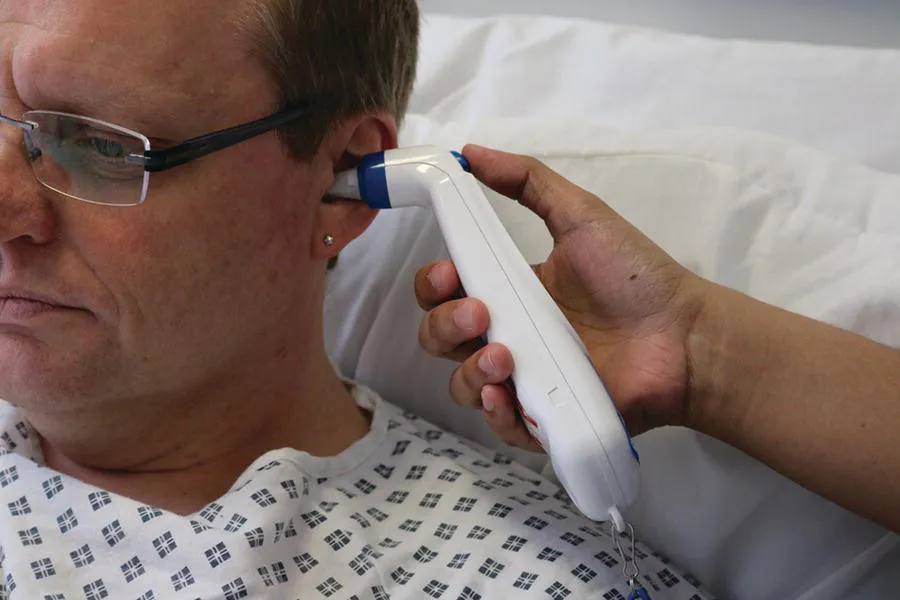
  • The most widely used device to measure temperature is the infrared tympanic thermometer (Figure 1.1). This is inserted into the external acoustic meatus and measures the infrared radiation emitted from the tympanic membrane
  • Temperature is regulated by the thermoregulatory centre in the hypothalamus through various physiological mechanisms, e.g. sweating, dilation/constriction of peripheral blood vessels and shivering
An electronic tympanic thermometer inserted into the left ear of a male patient.
Figure 1.1 Electronic tympanic thermometer.

Indications

  • Acute illness – part of the ABCDE approach
  • Routine observations

Methods for measuring body temperature

  • Tympanic thermometer (most commonly used method)
  • Rectal thermometer (particularly in hypothermia)
  • Oesophageal/nasopharangeal probes
  • Bladder probe
  • Pulmonary artery catheter
icon1
NB Important definitions:
  • Hypothermia: <35 °C
  • Hyperthemia: >37.5 °C

Procedure using an electronic tympanic thermometer

  • Assemble equipment: electronic tympanic thermometer, new hygiene probe, and waste bag
  • Identify correct patient
  • Introduce yourself to the patient
  • Explain procedure to the patient and gain consent
  • Ascertain which ear was used for previous readings
  • Wash hands
  • Turn on electronic thermometer and attach new hygienic probe cover following manufacturer’s recommendations
  • Gently pull back the pinna upwards and backwards and insert the thermometer in the external acoustic meatus (Figure 1.2)
  • Press the button on the device to measure the temperature and a reading should appear
  • Remove the thermometer from the ear canal and then dispose of the hygiene probe into the waste bag
  • Wash hands
  • Document information on temperature chart of correctly identified patient including time and date taken
  • Clear away equipment and ensure that the electronic tympanic thermometer is stored following the manufacturer's guidelines
A woman standing beside a male patient (lying in bed) while inserting an electronic tympanic thermometer into the left ear of the patient.
Figure 1.2 Inserting an electronic tympanic thermometer.

icon2
OSCE Key Learning Points

Good practice
  • Wash and dry hands
  • Use the same ear for consecu...

Table of contents

  1. Cover
  2. Table of Contents
  3. About the companion website
  4. 1 Measuring body temperature
  5. 2 Measuring pulse and blood pressure
  6. 3 Transcutaneous monitoring of oxygen saturations
  7. 4 Peak expiratory flow
  8. 5 Venepuncture
  9. 6 Managing blood samples correctly
  10. 7 Taking blood cultures
  11. 8 Measuring capillary blood glucose
  12. 9 ECG monitoring
  13. 10 Recording a 12 lead ECG
  14. 11 Basic respiratory function tests
  15. 12 Urine multi-dipstick test
  16. 13 Advising patients on how to collect a mid-stream urine specimen
  17. 14 Taking nose, throat, and skin swabs
  18. 15 Performing a pregnancy test
  19. 16 Administering oxygen
  20. 17 Airway management
  21. 18 Ventilation
  22. 19 Defibrillation (manual and automated)
  23. 20 Cardiopulmonary resuscitation
  24. 21 Establishing peripheral intravenous access
  25. 22 Use of infusion devices
  26. 23 Making up drugs for parenteral administration
  27. 24 Dosage and administration of insulin and use of sliding scales
  28. 25 Administering a subcutaneous injection
  29. 26 Intravenous injections
  30. 27 Administration of blood transfusion
  31. 28 Male and female urinary catheterisation
  32. 29 Instructing patients in the use of devices for inhaled medication
  33. 30 Skin suturing
  34. 31 Application of a sling
  35. 32 Safe disposal of clinical waste, needles, and other ‘sharps’
  36. 33 Arterial blood gas sampling
  37. 34 Examination of the ear
  38. 35 Ophthalmoscopy
  39. 36 Relieving foreign body airway obstruction
  40. Index
  41. End User License Agreement