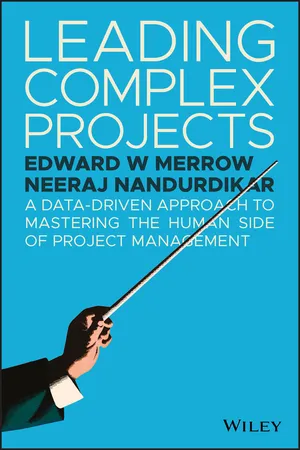
Leading Complex Projects
eBook - ePub

Leading Complex Projects

A Data-Driven Approach to Mastering the Human Side of Project Management

  1. English
  2. ePUB (mobile friendly)
  3. Available on iOS & Android
eBook - ePub

Leading Complex Projects

A Data-Driven Approach to Mastering the Human Side of Project Management

About this book

Quantitative analysis of outcomes vs PMs at the individual level

Leading Complex Projects takes a unique approach to post-mortem analysis to provide project managers with invaluable insight. For the first time, individual PM characteristics are quantitatively linked to project outcomes through a major study investigating the role of project leadership in the success and failure of complex industrial projects; hard data on the backgrounds, education, and personality characteristics of over 100 directors of complex projects is analyzed against the backdrop of project performance to provide insight into controllable determinants of outcomes. By placing these analyses alongside their own data, PMs will gain greater insight into areas of weakness and strength, locate recurring obstacles, and identify project components in need of greater planning, oversight, or control.

The role of leadership is to deliver results; in project management, this means taking responsibility for project outcomes. PMs are driven by continuous improvement, and this book provides a wealth of insight to help you achieve the next step forward.

  • Understand why small, simple projects consistently outperform larger, more complex projects
  • Delve into the project manager's role in generating successful outcomes
  • Examine the data from over 100 PMs of complex industrial projects
  • Link PM characteristics to project outcome to find areas for improvement

Complex industrial projects from around the world provide a solid basis for quantitative analysis of outcomes—and the PMs who drive them. Although the majority of the data is taken from projects in the petroleum industry, the insights gleaned from analysis are widely applicable across industry lines for PMs who lead complex projects of any stripe. Leading Complex Projects provides clear, data-backed improvement guidance for anyone in a project management role.

Trusted by 375,005 students

Access to over 1.5 million titles for a fair monthly price.

Study more efficiently using our study tools.

Information

Publisher
Wiley
Year
2018
Print ISBN
9781119382195
Edition
1
eBook ISBN
9781119382263
Subtopic
Management

CHAPTER 1
GETTING GROUNDED

There are literally thousands of books about project management and how it should be done for all manner of projects, large and small. But, ironically, there are almost no books about project managers, the people who actually organize and lead projects and get the work done. In this book we explore the makeup of a particular subset of project managers: those who lead major complex projects for the sponsors (owners) of the projects.1 The leaders of large complex projects usually carry the title of project director rather than project manager. We will use that term or simply project leader to differentiate them from the managers of simpler projects or of the subprojects that usually accompany a large, complex capital venture.
Management is all about the efficient organization of tasks in a project, making rational assignments to team members and contractors based on their strengths, monitoring performance of individuals and teams, and getting work accomplished. All projects require management or they will fail. But not all projects require leadership.
Leadership is rather different from management even if exercised by the same person. Leadership is all about inducing people to cooperate in pursuing a goal (a vision if you prefer) that the leader has articulated. The notion of leadership implies followership. The notion of followership implies a degree of volition. We contend that smaller, simpler projects can usually be managed without much true leadership, but large complex projects must always be led. We understand, of course, that this is a matter of degree and situation. For example, a small project staffed entirely by volunteers may require leadership as well as management because the staff can walk away if they are unhappy or even bored. Those who sponsor and invest in projects must come to understand which projects require leaders and what characteristics of those leaders help predict which candidate will most likely be successful. Providing that knowledge is the primary goal of this book.
We have known for some time that the fate of difficult projects seems to hinge more on the project leaders than the results of simpler projects.2 In complex projects, the loss of continuity in project leadership at any point from the start of project execution planning forward results in much worse outcomes with the failure rate more than doubling. The effect is present in simpler projects too, but the effect on outcomes is much larger in complex projects. Our goal in undertaking the research that led to this book was to understand the personalities, prior experience, and habits of mind that make some complex project leaders successful while others fail. The reason that this book is needed is that far too many large complex projects fail. We have become convinced through the course of this research that one of the major reasons why so many complex projects fail is because the leader was miscast in his or her role.

THE SELECTION PROCESS FOR COMPLEX PROJECT LEADERS IS NOT WORKING

We conclude from the analysis described in Chapters 4 and 5 of this book that the process that industrial companies are using to select leaders for their most important projects is broken. Before we dive into what leads us to that conclusion, we describe how the current selection process actually works.
To better understand how leaders are actually selected for complex projects, we surveyed 13 industrial companies, all in the petroleum industry, that have numerous complex megaprojects in their portfolios. All of the companies will typically have multiple multibillion-dollar projects underway at any point so their need for complex project leaders is sustained. We asked representatives of the companies how project leaders are selected, by whom, and at what point in time in the project's evolution. We were fortunate to have multiple responses from most companies because the multiple responses indicated the extent to which the selection process is consistent and understood. At least one representative from each company was a senior manager within the project's organization. Forty-nine people completed the survey, giving us an average of almost four responses per company.

Who Selects the Leaders?

Eight of the 13 companies reported that complex project leaders are selected by senior management within the projects organization, although one of those eight indicated that a “functional professional development committee” within the project organization made the assignment. In three cases a senior business executive selected the project leader, and in two cases the selection is made jointly by the business and projects. While one might guess that selection by a business executive would be more common in smaller companies where the business professionals are more likely to know the project leaders personally, there is actually no pattern at all. Rather, sole selection by the business appears to reflect weakness in the project's organization. In the cases of joint selection, one company is a very large, nationally owned company and the other a much smaller independent.

What Are the Selection Criteria?

While the selection criteria are not exactly random, there is not much hint of scientific method. Experience – undefined – was the most commonly cited criterion followed by availability, and then by “politics or favoritism.”3 Of our total of 49 respondents, only two claimed that any personality characteristics were included in the selection criteria, although one indicated that language skills and cultural understanding were important. Two respondents indicated that familiarity with the technology to be used on the project was important.
The picture that emerges from our survey is of selection processes that are largely ad hoc. Experience, which we take to mean prior track record of success, is important but relatively little else. There are several problems with this approach. First, at any point in time, a significant fraction of all complex project leaders will be doing their first complex project. This is because most project managers who graduate to complex project leadership have already spent 20 years in project management and therefore have only one or two megaprojects left in their careers.4 Only in the most unusual cases do we see more than two or three complex projects in a career. This means that the experience measure that companies are using is often based on performance on less complex projects. Unfortunately, there is no evidence to support the notion that successful experience on less complex projects is a good predictor of success in difficult projects. The great majority of those selected to lead their first complex projects were successful simpler-project managers. Success in one's first complex project is a good predictor of success in a second. But it is not even clear that a long career progression in smaller, less complex projects is of any substantial value to the complex project leader at all. A few of our most successful leaders were assigned – usually out of necessity – to their first complex project at an earlier (inexperienced) point in their careers. A few more of our most successful leaders had never actually managed any capital project prior to their first megaproject, although they had been in positions that were closely aligned with projects, such as disciplinary heads of engineering. If an effective selection process were in place to identify effective project leader candidates earlier in their careers, it would significantly increase the supply of these critical human resources.

When Are Project Directors Usually Installed?

There is an ongoing debate within the industrial megaprojects community about what constitutes the ideal time to appoint and install the leader for projects. The point of contention is whether leaders who are adept at developing the right scope for a project also have the right skills (and perhaps temperament) to execute a project. Those who believe that the temperaments and skillsets are necessarily different argue to bring the project leader on at the beginning of FEL 35 or even at the start of detailed engineering rather than earlier in front-end loading. Those who believe that a single project leader can lead the entire process want the project leader involved as early as reasonably practical so that the project leader deeply understands the scope.
We asked our survey respondents when project directors are usually appointed for their projects and in those cases in which they were installed at the start of scope development whether they actually controlled the scope development process or acted more in an observer role. The results are shown in Figure 1.1. One of the 13 companies represented in the survey brings the leader on at the beginning of FEL 1 and makes that leader accountable for scope development.6 Six companies bring the leader onto the projects at the start of scope development and five of those six make the project leader responsible for scope development. Two companies bring the leader on after the basic scope is developed but still during the FEL 2 (scope development) phase of the project. None of the 13 companies routinely wait until the beginning of FEED7 (FEL 3) to bring the leader onto the project. Four of the companies, including some of the largest, have no established policy around the timing of project leader installation; they sometimes bring the leader on at the start of FEL 2 and others at FEL 2A and still others at the start of FEED. In no case did any respondent suggest that start of execution was ever intended to be the start of the project director's tenure.
...

Table of contents

  1. Cover
  2. Title Page
  3. Copyright
  4. Foreword
  5. Acknowledgments
  6. About the Authors
  7. Introduction Executive Summary
  8. Chapter 1 Getting Grounded
  9. Part One
  10. Part Two
  11. Index
  12. EULA

Frequently asked questions

Yes, you can cancel anytime from the Subscription tab in your account settings on the Perlego website. Your subscription will stay active until the end of your current billing period. Learn how to cancel your subscription
No, books cannot be downloaded as external files, such as PDFs, for use outside of Perlego. However, you can download books within the Perlego app for offline reading on mobile or tablet. Learn how to download books offline
Perlego offers two plans: Essential and Complete
  • Essential is ideal for learners and professionals who enjoy exploring a wide range of subjects. Access the Essential Library with 800,000+ trusted titles and best-sellers across business, personal growth, and the humanities. Includes unlimited reading time and Standard Read Aloud voice.
  • Complete: Perfect for advanced learners and researchers needing full, unrestricted access. Unlock 1.5M+ books across hundreds of subjects, including academic and specialized titles. The Complete Plan also includes advanced features like Premium Read Aloud and Research Assistant.
Both plans are available with monthly, semester, or annual billing cycles.
We are an online textbook subscription service, where you can get access to an entire online library for less than the price of a single book per month. With over 1.5 million books across 990+ topics, we’ve got you covered! Learn about our mission
Look out for the read-aloud symbol on your next book to see if you can listen to it. The read-aloud tool reads text aloud for you, highlighting the text as it is being read. You can pause it, speed it up and slow it down. Learn more about Read Aloud
Yes! You can use the Perlego app on both iOS and Android devices to read anytime, anywhere — even offline. Perfect for commutes or when you’re on the go.
Please note we cannot support devices running on iOS 13 and Android 7 or earlier. Learn more about using the app
Yes, you can access Leading Complex Projects by Edward W. Merrow,Neeraj Nandurdikar in PDF and/or ePUB format, as well as other popular books in Business & Management. We have over 1.5 million books available in our catalogue for you to explore.