Advanced Materials for Electromagnetic Shielding
eBook - ePub

Advanced Materials for Electromagnetic Shielding

Fundamentals, Properties, and Applications

  1. English
  2. ePUB (mobile friendly)
  3. Available on iOS & Android
eBook - ePub

Advanced Materials for Electromagnetic Shielding

Fundamentals, Properties, and Applications

About this book

A comprehensive review of the field of materials that shield people and sensitive electronic devices from electromagnetic fields

Advanced Materials for Electromagnetic Shielding offers a thorough review of the most recent advances in the processing and characterization of the electromagnetic shielding materials. In this groundbreaking book, the authors—noted experts in the field—discuss the fundamentals of shielding theory as well as the practice of electromagnetic field measuring techniques and systems. They also explore applications of shielding materials used as absorbers of electromagnetic radiation, or as magnetic shields and explore coverage of new advancedmaterials for EMI shielding in aerospace applications. In addition, the text contains methods of preparation and applicability of metal foams.

This comprehensive text examines the influence of technology on the micro-and macrostructure of polymers enabling their use in screening technology, technologies of shielding materials based on textiles, and analyses of its effectiveness in screening. The book also details the method of producing nanowires and their applications in EM shielding. This important resource:

  • Explores the burgeoning market of electromagnetic shielding materials as we create, depend upon, and are exposed to more electronic devices than ever
  • Addresses the most comprehensive issues relating to electromagnetic fields
  • Contains information on the manufacturing, characterization methods, and properties of materials used to protect against them
  • Discusses the important characterization techniques compared with one another, thus allowing scientists to select the best approach to a problem

Written for materials scientists, electrical and electronics engineers, physicists, and industrial researchers, Advanced Materials for Electromagnetic Shielding explores all aspects in the area of electromagnetic shielding materials and examines the current state-of-the-art and new challenges in this rapidly growing area.
Frequently asked questions

Yes, you can cancel anytime from the Subscription tab in your account settings on the Perlego website. Your subscription will stay active until the end of your current billing period. Learn how to cancel your subscription.
At the moment all of our mobile-responsive ePub books are available to download via the app. Most of our PDFs are also available to download and we're working on making the final remaining ones downloadable now. Learn more here.
Perlego offers two plans: Essential and Complete
  • Essential is ideal for learners and professionals who enjoy exploring a wide range of subjects. Access the Essential Library with 800,000+ trusted titles and best-sellers across business, personal growth, and the humanities. Includes unlimited reading time and Standard Read Aloud voice.
  • Complete: Perfect for advanced learners and researchers needing full, unrestricted access. Unlock 1.4M+ books across hundreds of subjects, including academic and specialized titles. The Complete Plan also includes advanced features like Premium Read Aloud and Research Assistant.
Both plans are available with monthly, semester, or annual billing cycles.
We are an online textbook subscription service, where you can get access to an entire online library for less than the price of a single book per month. With over 1 million books across 1000+ topics, we’ve got you covered! Learn more here.
Look out for the read-aloud symbol on your next book to see if you can listen to it. The read-aloud tool reads text aloud for you, highlighting the text as it is being read. You can pause it, speed it up and slow it down. Learn more here.
Yes! You can use the Perlego app on both iOS or Android devices to read anytime, anywhere — even offline. Perfect for commutes or when you’re on the go.
Please note we cannot support devices running on iOS 13 and Android 7 or earlier. Learn more about using the app.
Yes, you can access Advanced Materials for Electromagnetic Shielding by Maciej Jaroszewski, Sabu Thomas, Ajay V. Rane, Maciej Jaroszewski,Sabu Thomas,Ajay V. Rane in PDF and/or ePUB format, as well as other popular books in Technology & Engineering & Materials Science. We have over one million books available in our catalogue for you to explore.

Information

1
EMI Shielding Fundamentals

M. K. Aswathi1, Ajay V. Rane1,2, A. R. Ajitha1, Sabu Thomas1,3, and Maciej Jaroszewski4
1 International and Inter University Centre for Nanoscience and Nanotechnology, Mahatma Gandhi University, Kottayam, Kerala, India
2 Composite Research Group, Department of Mechanical Engineering, Durban University of Technology, Durban, South Africa
3 School of Chemical Sciences, Mahatma Gandhi University, Kottayam, Kerala, India
4 Faculty of Electrical Engineering, Wrocław University of Science and Technology, Wrocław, Poland

1.1 Fundamentals of EMI Shielding Theory

Electromagnetic shielding is process of reducing the dispersion of electromagnetic waves into a desired space by hindering the waves with a shield made of conductive material. The effective performance of electrical instruments or the working of electrical instruments is interrupted, degraded, obstructed, or limited due to the electromagnetic interference (EMI). In a material the main mechanisms for EMI attenuation are reflection, absorption, and multiple reflection [1, 2]. Reflection is the primary mechanism of EMI shielding. For reflection the material must possess mobile charge carriers such as electrons or holes that interact with the electromagnetic radiation. Metals are the most common material for EMI shielding and the available free electrons in metals interact with the electromagnetic waves [3]. If the material is highly conductive the shielding against EM (electromagnetic) waves will occur through the reflection mechanism. However, conductivity is not a condition for EMI shielding but it does enhance the reflection mechanism of an EMI shielding material.
The secondary mechanism for EMI shielding is absorption, which requires the existence of electric or magnetic dipoles to interact with the electromagnetic radiation. It changes with the thickness of the material. Materials that have a high dielectric constant provide electric dipoles and materials with high magnetic permeability provide magnetic dipoles for the EMI shielding by absorption [1].
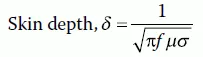
The third mechanism is multiple reflections, which is the reflections at different surfaces or at the interface of the material. Materials that have large specific internal surfaces or composites with fillers show a multiple reflection mechanism. Generally, multiple‐reflection decreases the total shielding value if the material is thinner than the skin depth and the value can be neglected if the material has a higher thickness than the skin depth. At higher frequencies electromagnetic radiation penetrates only to the near surface region of the electrical conductor. This is known as the skin effect. The intensity of penetration of an electromagnetic wave decreases exponentially with increasing depth of the conductor [4]. The skin depth is the depth of the conductor at which the intensity of the incident field drops in to 1/e of the incident value and is denoted by δ [5]:
equation
Here f is the frequency, μ is the magnetic permeability, and σ the electrical conductivity in Ω−1 m−1. Skin depth is not directly proportional to frequency, magnetic permeability, and conductivity, i.e. skin depth decreases with increase in frequency, magnetic permeability, or electrical conductivity. Owing to this skin effect, a material that contains a conductive filler with a small unit size of filler is more effective for shielding than a filler with a large unit size. The complete cross section of the filler unit can be used only when the unit size of the filler is less than or comparable with the skin depth.
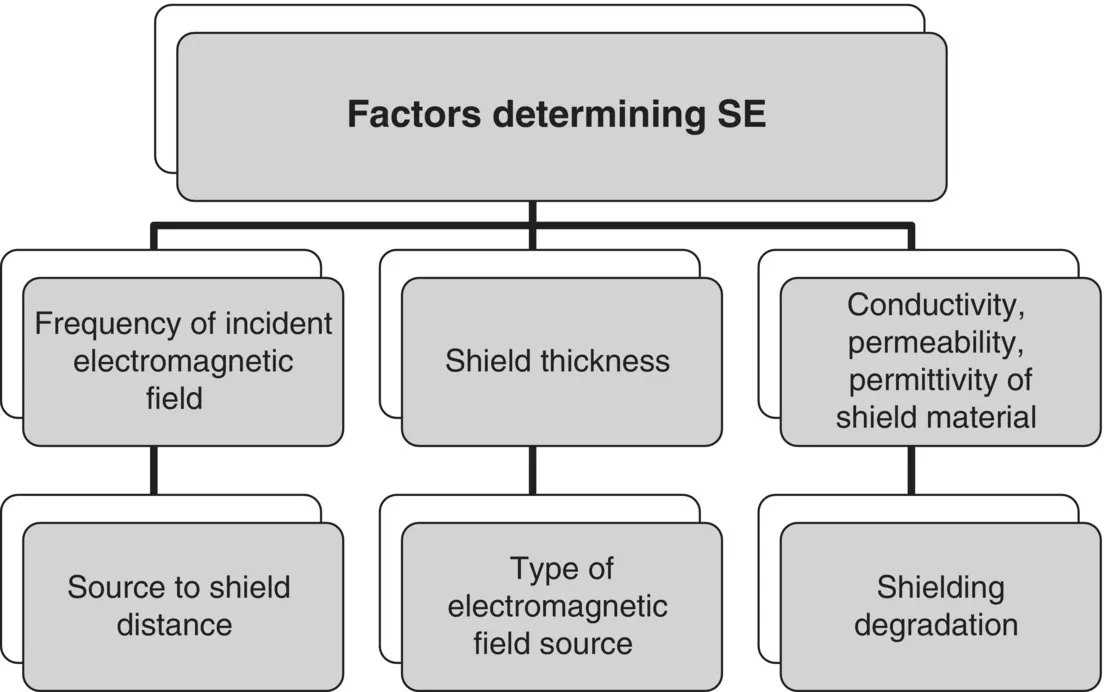
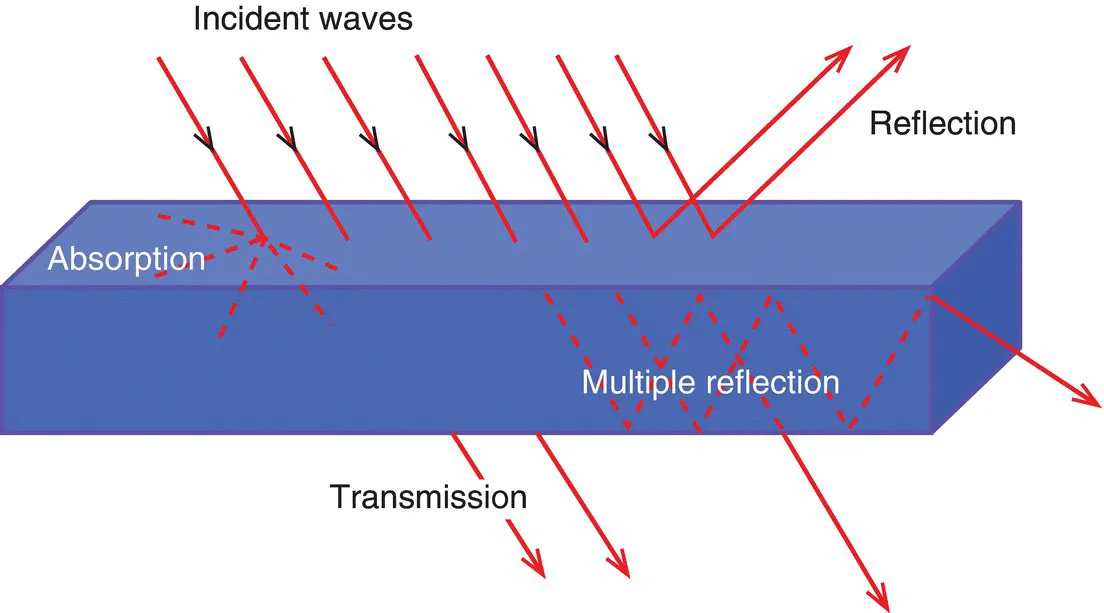
Shielding effectiveness, which is expressed in dB, is the sum of reflection loss, absorption loss, and multiple reflections [6]. When electromagnetic waves strike the surface of an object they undergo reflection, multiple reflection, absorption, and transmission as shown in Figure 1.1. To be a shield against the EM wave, the material should reflect or absorb the electromagnetic wave. Factors determining shielding effectiveness (SE) are classified in Figure 1.2.
Image described by caption and surrounding text.
Figure 1.1 Schematic representation showing mechanism of electromagnetic shielding.
Hierarchy diagram of factors determining shielding effectiveness, including frequency of incident electromagnetic field; shield thickness; and conductivity, permeability, permittivity of shield material.
Figure 1.2 Factors determining shielding effectiveness [7].
Source: Adapted from Gooch 2007.

1.2 Materials for EMI Shielding

Owing to the increasing use of electronic equipment the shielding of other instruments and of human beings from electromagnetic waves is a very serious issue in the present scenario, which is detailed in Chapter 2. The EM waves harmfully affect both the device performance and human beings. Nowadays, a reduction in the use of electronic equipment is not always practical. What we are able to do is to reduce the penetration of EM waves produced from electronic instruments. To decrease the penetration we must use a shield or block the EM waves from the desired surface.
Metals are common...

Table of contents

  1. Cover
  2. Table of Contents
  3. 1 EMI Shielding Fundamentals
  4. 2 EM Noise and Its Impact on Human Health and Safety
  5. 3 Electromagnetic Field Sensors
  6. 4 Shielding Efficiency Measuring Methods and Systems
  7. 5 Electrical Characterization of Shielding Materials
  8. 6 Magnetic Field Shielding
  9. 7 Recent Progress in Electromagnetic Absorbing Materials
  10. 8 Flexible and Transparent EMI Shielding Materials
  11. 9 Polymer‐Based EMI Shielding Materials
  12. 10 Textile Based Shielding Materials
  13. 11 Graphene and CNT Based EMI Shielding Materials
  14. 12 Nanocomposites Based EMI Shielding Materials
  15. 13 Silver Nanowires as Shielding Materials
  16. 14 Advanced Carbon Based Foam Materials for EMI Shielding
  17. 15 Electromagnetic Interference Shielding Materials for Aerospace Application
  18. 16 Metamaterials as Shielding Materials
  19. 17 Double Percolating EMI Shielding Materials Based on Polymer Blend Nanocomposites
  20. 18 Mechanical Performance Characterization of EMI Shielding Materials Using Optical Experimental Techniques
  21. Index
  22. End User License Agreement