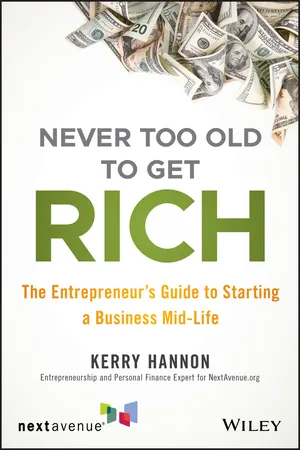
When you think of someone launching a start-up, the image of a twenty-something techie probably springs to mind. However, Gen Xers and Baby Boomers are just as likely to start businesses and reinvent themselves later in life. Never Too Old to Get Rich is an exciting roadmap for anyone age 50+ looking to be their own boss and launch their dream business.
This book provides up-to-date resources and guidance for launching a business when you're 50+. There are snappy profiles of more than a dozen successful older entrepreneurs, describing their inspirational journeys launching businesses and nonprofits, followed by Q&A conversations, and pull-out boxes containing action steps. The author walks you through her three-part fitness program: guidelines for becoming financially fit, physically fit, and spiritually fit, before delving more deeply into how would-be entrepreneurs over 50 can succeed.
• Describes how you can find capital to start your own business • Offers encouraging stories of real people who have become their own bosses and succeeded as entrepreneurs • Written by PBS Next Avenue's entrepreneur expert, Kerry Hannon • Teaches you how to start your own business
Never Too Old to Get Rich is the ideal book for older readers looking to pursue new business ventures later in life.
Transforming a passion into paying work can do a number on your desire for it, so you need to plan ahead and test the waters with care.
Before you step out on this path, be clear about the role that this passion, or hobby, plays in your life right now. For many of us, the things that stir up the most passion – and we always wish we could just have more time to do them – are not anchored in the world of commerce. In fact, the time spent devoted to them is quite frankly our respite from our hectic working lives and family demands. It’s where we go to clear our minds and quiet anxiety.
Tapping into that well of renewal to produce an income can turn it upside down. I’m wildly passionate about horses, for example. I fantasize about what it would be like to truly devote all my time and energy to this world. When someone asks, “What would you do if you didn’t need the money?” I would say, spend my time riding and surround myself with horses and dogs.
But I know in my heart that a career training and working with horses would never be a good fit for me. It’s my special place to escape and breathe, far away from world of deadlines and travel, and yes, people. If the barn became my office, I would lose that enchanted world that has bewitched me since the age of six.
Another example is a friend of mine who is a talented gardener. She decided to open a landscape design business when she took an early retirement package from her law firm. But she soon realized when her garden time was every day and the long hours were mostly spent alone, she had made a big mistake. She was lonely and miserable. You see, her garden was her respite from her hectic life. When it was her life, she missed the people connection – the energy she got from interacting with her social work – and it lost its magic.
So, beware of ruining your hobby. To take this route, you must be absolutely certain you do have the talent and the willingness to shift your mindset to make it succeed.
In the following eight chapters, you will meet entrepreneurs who have taken that calculated risk and blend earning a paycheck with their passion – and they’ll share their lessons learned along the way.
CHAPTER 1 Lights, Camera, Action
Mike Kravinsky, Nextnik Films, LLC
Courtesy of Sali Dimond.
When Mike Kravinsky went to work as a video editor at ABC News in 1981, he figured he would spend a year there and then head out to Los Angeles to become a filmmaker.
Well, it didn’t quite work out that way. Over the course of 29 years, he worked as an editor and technical director for news broadcasts like World News Tonight and Good Morning America, and news magazine shows like 20/20 and Primetime Live.
“ABC turned out to be a great place to work,” Kravinsky says. “They gave me great opportunities and experiences and one thing led to another.” But then the day came when the jig was up. He accepted a buyout. “I was ready,” he says. “It had become routine.”
After retiring in 2010, the 65-year-old is now following his dream to be a filmmaker once again, although he’s not in Hollywood, but Arlington, Virginia. His independent film company: Nextnik Films, LLC.
From the start of his transition, Kravinsky had his wife, Liza, a composer, urging him to “do what makes you happy.” And the couple, who have no children, has a knack for living frugally. “We’re not living on peanut butter and jelly sandwiches, but we do drive a 12-year old car, and we don’t buy expensive clothes and furniture. It’s just our lifestyle,” he says.
Nonetheless, one of his first moves was to tap an adviser at a no-load mutual fund company for some guidance. He wanted to be sure he was making good choices with the funds he had accumulated in his former employer’s retirement plan, and, of course, to sort out how to manage his buyout monies.
And since he was not exactly certain of his new direction initially, Kravinsky spent time working on his website, which was focused on articles about change and transition, that he had launched before he took the buyout. “I had wanted an outlet to do some writing and videos, and talk to people who had taken professional leaps of faith,” he recalls.
Once on his own, and with the website up and running, he started a blog. Kravinsky soon realized, however, that he was doing the same thing he had always done. His magazine-style video and online stories about career changers were all newsy.
“I should get out of my comfort zone here,” he told himself. “Why don’t I create a character, based on what I am experiencing, as well as what those people who I had done stories about had gone through. So that’s where the first film was born,” he says.
It began in stages. First, a 30-minute Web series. Then Kravinsky got the urge to push beyond. He spent two months adding and rewriting scenes, and went back and filmed to build his series into the 77-minute feature film.
That film, The Nextnik, is the story of a worker who has been downsized after 25 years without warning and must reinvent himself. It sounds a tad autobiographical, and, of course, it is in a way. The story revolves around him searching for something new and experimenting with different careers.
Kravinsky has now completed three feature films and is writing his fourth. His films, The Nextnik (2013), Geographically Desirable (2015), and Nothing to Do (2017), have won accolades at independent film festivals across the country and are steadily sending income his way through streaming fees when viewed on Amazon Prime.
The first film cost $25,000 to make, “which is like nothing,” says Kravinsky. Those funds were mostly earmarked for actors and crew salaries. “These films are at the low-end of ultra-low budgets,” he says with a laugh.
The financing for the first two films came from an inheritance of $90,000. The last one, Nothing To Do, was financed by a combination of savings and money earned from Geographically Desirable. His second and third films are both available on Amazon. “Amazon is now doing for small independent filmmakers what they originally did for authors who self-publish,” Kravinsky says. “It’s treated as any other film on their platform. The goal, like books, is to develop an audience for your work.”
Does he make money? “Yes,” he says. Will he profit from his films? “I don’t know,” he says. “I get thousands of daily watched minutes on Amazon Prime with Geo Desire, and it’s making a decent return. Nothing To Do is gaining traction.”
Building a successful film business takes passion and a smattering of pixie dust. “Filmmaking is art,” Kravinsky says. “Like music, books, paintings, photography, et cetera. I hope to pay off the investment and get into the black, but it’s art. It’s speculative. If I make a lot of money, excellent. If I don’t, that’s the business. That’s where I’m at.”
Kravinsky is realistic. “I have a set amount of money to spend. If I spend it and don’t get enough of a return, I hope the experience will get me jobs on the creative work of others in the future. I don’t jeopardize my retirement saving,” he says.
One cost-saving advantage he has is that he is willing to tap his own sweat equity for his films. He auditions and hires actors. He hires technical people – a director of photography and a makeup artist – but the rest he does himself: the writing, producing, directing, and postproduction. He secures the locations to shoot in the Washington, D.C. area: Arlington, Fairfax, and Leesburg in Virginia, and Rehoboth Beach, Delaware. “I’m the one directing people and ordering food at the same time,” Kravinsky laughs.
As for his Hollywood dream? “Of course, it would be great to be nominated for an Academy Award down the road, but you know what, if I can just make movies and make a little money doing it, I am going to be really happy,” he says. That’s rich.
Making It Work
I asked Mike to look back and share his thoughts on his shift to starting his own independent film company.
Kerry: What did starting your own business mean to you personally?
Mike: Freedom. There’s something nice about routine, but routine can really start wearing on you when there’s really nothing left to accomplish. I now have the freedom to take on projects and execute them in my own vision – essentially being my own boss in a creative venture. Each film that I do is like starting a new business. It is like a new crew, new actors, new locations. I really enjoyed my career in TV news, but it was time. For me, making my own fictional films seemed like the right thing.
Were you confident that you were doing the right thing? Any second-guessing?
I was absolutely confident that I was doing the right thing. Not necessarily the website and blog, but I knew I was doing the right thing by moving on. It really felt good when I was initially doing the blog after I left ABC. But there was something gnawing that I wasn’t accomplishing everything that I wanted to do. Basically I have been living something that I thought I would do in...
Table of contents
Cover
Title Page
Copyright
Dedication
Foreword
Acknowledgments
About the Author
Introduction
Also by Kerry Hannon
Part I Turning a Passion into a Business
Part II Building a Winning Senior–Junior Partnership
Part III The Path to Social Entrepreneurship
Part IV Winning Strategies of Female Entrepreneurs
Afterword
Index
End User License Agreement
Trusted by 375,005 students
Access to over 1.5 million titles for a fair monthly price.
Study more efficiently using our study tools.
Frequently asked questions
Yes, you can cancel anytime from the Subscription tab in your account settings on the Perlego website. Your subscription will stay active until the end of your current billing period. Learn how to cancel your subscription
No, books cannot be downloaded as external files, such as PDFs, for use outside of Perlego. However, you can download books within the Perlego app for offline reading on mobile or tablet. Learn how to download books offline
Perlego offers two plans: Essential and Complete
Essential is ideal for learners and professionals who enjoy exploring a wide range of subjects. Access the Essential Library with 800,000+ trusted titles and best-sellers across business, personal growth, and the humanities. Includes unlimited reading time and Standard Read Aloud voice.
Complete: Perfect for advanced learners and researchers needing full, unrestricted access. Unlock 1.5M+ books across hundreds of subjects, including academic and specialized titles. The Complete Plan also includes advanced features like Premium Read Aloud and Research Assistant.
Both plans are available with monthly, semester, or annual billing cycles.
We are an online textbook subscription service, where you can get access to an entire online library for less than the price of a single book per month. With over 1.5 million books across 990+ topics, we’ve got you covered! Learn about our mission
Look out for the read-aloud symbol on your next book to see if you can listen to it. The read-aloud tool reads text aloud for you, highlighting the text as it is being read. You can pause it, speed it up and slow it down. Learn more about Read Aloud
Yes! You can use the Perlego app on both iOS and Android devices to read anytime, anywhere — even offline. Perfect for commutes or when you’re on the go. Please note we cannot support devices running on iOS 13 and Android 7 or earlier. Learn more about using the app
Yes, you can access Never Too Old to Get Rich by Kerry E. Hannon in PDF and/or ePUB format, as well as other popular books in Business & Entrepreneurship. We have over 1.5 million books available in our catalogue for you to explore.