Haematology
  1. English
  2. ePUB (mobile friendly)
  3. Available on iOS & Android
eBook - ePub

About this book

As the science and practice of haematology continues to advance at a considerable rate, Haematology Lecture Notes remains a comprehensive guide to this diverse subject, and provides support in understanding the pathogenesis and management of haematological disorders.

Successfully integrating the physiological, pathological, and clinical aspects of haematology, this new edition includes new material on molecular and cellular diagnostics, expanded coverage on haemostasis, malignant haematology and transplant, and features self-assessment questions at the end of each chapter.

Thoroughly revised and updated, Haematology Lecture Notes provides the core subject knowledge required by students and junior doctors to excel in this specialty.ย 

Frequently asked questions

Yes, you can cancel anytime from the Subscription tab in your account settings on the Perlego website. Your subscription will stay active until the end of your current billing period. Learn how to cancel your subscription.
No, books cannot be downloaded as external files, such as PDFs, for use outside of Perlego. However, you can download books within the Perlego app for offline reading on mobile or tablet. Learn more here.
Perlego offers two plans: Essential and Complete
  • Essential is ideal for learners and professionals who enjoy exploring a wide range of subjects. Access the Essential Library with 800,000+ trusted titles and best-sellers across business, personal growth, and the humanities. Includes unlimited reading time and Standard Read Aloud voice.
  • Complete: Perfect for advanced learners and researchers needing full, unrestricted access. Unlock 1.4M+ books across hundreds of subjects, including academic and specialized titles. The Complete Plan also includes advanced features like Premium Read Aloud and Research Assistant.
Both plans are available with monthly, semester, or annual billing cycles.
We are an online textbook subscription service, where you can get access to an entire online library for less than the price of a single book per month. With over 1 million books across 1000+ topics, weโ€™ve got you covered! Learn more here.
Look out for the read-aloud symbol on your next book to see if you can listen to it. The read-aloud tool reads text aloud for you, highlighting the text as it is being read. You can pause it, speed it up and slow it down. Learn more here.
Yes! You can use the Perlego app on both iOS or Android devices to read anytime, anywhere โ€” even offline. Perfect for commutes or when youโ€™re on the go.
Please note we cannot support devices running on iOS 13 and Android 7 or earlier. Learn more about using the app.
Yes, you can access Haematology by Christian S. R. Hatton,Deborah Hay,David M. Keeling in PDF and/or ePUB format, as well as other popular books in Medicine & Medical Theory, Practice & Reference. We have over one million books available in our catalogue for you to explore.

Information

Chapter 1
An introduction to haematopoiesis

Learning objectives

  • c01f001
    To understand the process of formation of blood cells
  • c01f001
    To understand the concept of a stem cell
  • c01f001
    To appreciate the processes of lineage specification of blood cells
  • c01f001
    To recognize the different types of mature blood cell
  • c01f001
    To understand the normal role of each mature cell type in the blood

Where is blood formed?

As the developing embryo grows, it starts to require a means of delivering oxygen to tissues for respiration. The circulation and blood develop at the same time, from around 3 weeks' gestation, and there are close links between the cellular origins of the first blood cells and the vasculature. Haematopoietic stem cells originate in the para-aortic mesoderm of the embryo. Primitive red blood cells, platelet precursors and macrophages are initially formed in the vasculature of the extra-embryonic yolk sac, before the principal site of haematopoiesis shifts to the fetal liver at around 5โ€“8 weeks' gestation. The liver remains the main source of blood in the fetus until shortly before birth, although the bone marrow starts to develop haematopoietic activity from as early as 10 weeks' gestation.
After birth, the marrow is the sole site of haematopoiesis in healthy individuals. During the first few years of life, nearly all the marrow cavities contain red haematopoietic marrow, but this recedes such that by adulthood haematopoiesis is limited to marrow in the vertebrae, pelvis, sternum and the proximal ends of the femora and humeri, with minor contributions from the skull bones, ribs and scapulae.
Although the sites of haematopoiesis in the adult are therefore relatively limited, other sites retain their capacity to produce blood cells if needed. In conditions in which there is an increased haematopoietic drive (such as chronic haemolytic anaemias and chronic myeloproliferative disorders), haematopoietic tissue will expand and may extend into marrow cavities that do not normally support haematopoiesis in the adult. Foci of haematopoietic tissue may also appear in the adult liver and spleen and other tissues (known as extramedullary haematopoiesis).

Haematopoietic stem cells

The process of haematopoiesis involves both the specification of individual blood cell lineages and cellular proliferation to maintain adequate circulating numbers of cells throughout life. This is accomplished using the unique properties of haematopoietic stem cells.
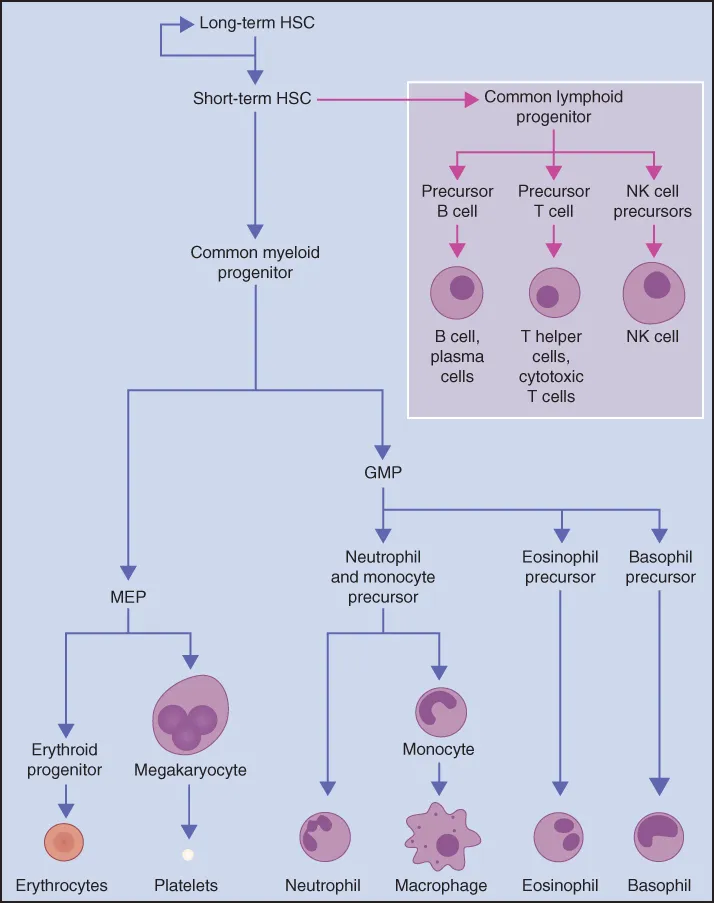
Long-term haematopoietic stem cells (HSCs) in the bone marrow are capable of both self-renewal and differentiation into the progenitors of individual blood cell lineages. The progenitor cells of individual lineages then undergo many rounds of division and further differentiation in order to yield populations of mature blood cells. This process can be represented as a hierarchy of cells, with HSCs giving rise to populations of precursor cells, which in turn give rise to cells increasingly committed to producing a single type of mature blood cell (Figure 1.1). Thus, the immediate progeny of HSCs are the multipotent progenitor cells, which have limited self-renewal capacity but retain the ability to differentiate into all blood cell lineages. Although there is still debate about exactly how lineage-restricted subsequent precursors are, the concept of sequential and irreversible differentiation is widely accepted. In Figure 1.1, the HSC is seen giving rise to two major lineages: the lymphoid lineage, in which a common lymphoid progenitor gives rise to B cells, T cells and natural killer (NK) cells; and a myeloid lineage, with a common myeloid progenitor giving rise to red cells, granulocytes and platelets. The division of haematopoiesis into myeloid and lymphoid compartments is fundamental to an understanding of haematological disease.
Image described by caption and surrounding text.
Figure 1.1 A schematic representation of the process of haematopoiesis. Multipotent stem cells give rise to lymphoid (pink) and myeloid (blue) lineages. The myeloid lineage further divides into granulocytic, erythroid and megakaryocytic (platelet) lineages. As cells progress through this process of differentiation, they accrue more functional specialization and lose their multipotency. GMP, granulocyte macrophage progenitor; HSC, haematopoietic stem cell; MEP, megakaryocyte/erythroid progenitor; NK, natural killer.
The process of haematopoiesis outlined above has several advantages. First...

Table of contents

  1. Cover
  2. Title Page
  3. Copyright
  4. Table of Contents
  5. Preface
  6. About the companion website
  7. Chapter 1: An introduction to haematopoiesis
  8. Chapter 2: Anaemia: General principles
  9. Chapter 3: Haemolytic anaemias
  10. Chapter 4: Disorders of globin synthesis
  11. Chapter 5: Conditions associated with white cell abnormalities
  12. Chapter 6: Structure and function of lymphoid tissue
  13. Chapter 7: Lymphomas: General principles
  14. Chapter 8: Classification of lymphoma
  15. Chapter 9: Neoplastic disorders of lymphoid cells
  16. Chapter 10: Plasma cell myeloma and other paraproteinaemias
  17. Chapter 11: Neoplastic disorders of myeloid cells
  18. Chapter 12: Bone marrow transplantation
  19. Chapter 13: Aplastic anaemia and pure red cell aplasia
  20. Chapter 14: Haemostasis, abnormal bleeding and anticoagulant therapy
  21. Chapter 15: Blood groups and blood transfusion
  22. Chapter 16: Cellular and molecular investigations in haematology
  23. Index
  24. End User License Agreement