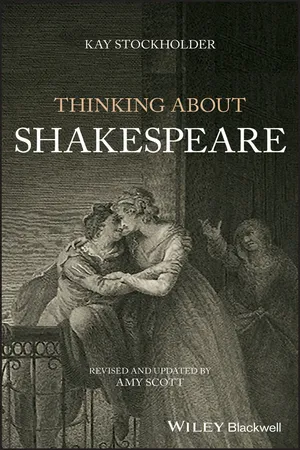
Thinking About Shakespeare
eBook - ePub

Thinking About Shakespeare

  1. English
  2. ePUB (mobile friendly)
  3. Available on iOS & Android
eBook - ePub

Thinking About Shakespeare

About this book

Explores the challenges of maintaining bonds, living up to ideals, and fulfilling desire in Shakespeare's plays

In Thinking About Shakespeare, Kay Stockholder reveals the rich inner lives of some of Shakespeare's most enigmatic characters and the ways in which their emotions and actions shape and are shaped by the social and political world around them. In addressing all genres in the Shakespeare canon, the authors explore the possibility of people being constant to each other in many different kinds of relationships: those of lovers, kings and subjects, friends, and business partners. While some bonds are irrevocably broken, many are reaffirmed. In all cases, the authors offer insight into what drives Shakespeare's characters to do what they do, what draws them together or pulls them apart, and the extent to which bonds can ever be eternal. Ultimately, the most durable bond may be between the playwright and the audience, whereby the playwright pleases and the audience approves.

The book takes an in-depth look at a dozen of The Bard's best-loved works, including: A Midsummer Night's Dream; Romeo and Juliet; The Merchant of Venice; Richard II; Henry IV, Part I; Hamlet; Troilus and Cressida; Othello; Macbeth; King Lear; Antony and Cleopatra; and The Tempest. It also provides an epilogue titled: Prospero and Shakespeare.

  • Written in a style accessible for all levels
  • Discusses 12 plays, making it a comprehensive study of Shakespeare's work
  • Covers every genre of The Bard's work, giving readers a full sense of Shakespeare's art/thought over the course of his oeuvre
  • Provides a solid overall sense of each play and the major characters/plot lines in them

Providing new and sometimes unconventional and provocative ways to think about characters that have had a long critical heritage, Thinking About Shakespeare is an enlightening read that is perfect for scholars, and ideal for any level of student studying one of history's greatest storytellers.

Frequently asked questions

Yes, you can cancel anytime from the Subscription tab in your account settings on the Perlego website. Your subscription will stay active until the end of your current billing period. Learn how to cancel your subscription.
No, books cannot be downloaded as external files, such as PDFs, for use outside of Perlego. However, you can download books within the Perlego app for offline reading on mobile or tablet. Learn more here.
Perlego offers two plans: Essential and Complete
  • Essential is ideal for learners and professionals who enjoy exploring a wide range of subjects. Access the Essential Library with 800,000+ trusted titles and best-sellers across business, personal growth, and the humanities. Includes unlimited reading time and Standard Read Aloud voice.
  • Complete: Perfect for advanced learners and researchers needing full, unrestricted access. Unlock 1.4M+ books across hundreds of subjects, including academic and specialized titles. The Complete Plan also includes advanced features like Premium Read Aloud and Research Assistant.
Both plans are available with monthly, semester, or annual billing cycles.
We are an online textbook subscription service, where you can get access to an entire online library for less than the price of a single book per month. With over 1 million books across 1000+ topics, we’ve got you covered! Learn more here.
Look out for the read-aloud symbol on your next book to see if you can listen to it. The read-aloud tool reads text aloud for you, highlighting the text as it is being read. You can pause it, speed it up and slow it down. Learn more here.
Yes! You can use the Perlego app on both iOS or Android devices to read anytime, anywhere — even offline. Perfect for commutes or when you’re on the go.
Please note we cannot support devices running on iOS 13 and Android 7 or earlier. Learn more about using the app.
Yes, you can access Thinking About Shakespeare by Kay Stockholder, Amy Scott in PDF and/or ePUB format, as well as other popular books in Letteratura & Critica letteraria di Shakespeare. We have over one million books available in our catalogue for you to explore.

Information

1
A Midsummer Night’s Dream

High spirits, romance, and magic, as well as earthy humor, have made A Midsummer Night’s Dream one of the most frequently performed of Shakespeare’s plays. The essence of the play is so generous and embracing that even clumsy performances have the power to delight. Since the action is not dependent upon a particular historical moment, Dream lends itself to being staged in a variety of settings and periods. Indeed, the fairy world conveys such a sense of timelessness that it has been performed in settings all the way from ancient Athens to the outer‐space world of the distant future. But for all the staging possibilities, there are really only two possible dramatic interpretations of the fairies. The fairies can be benign and gossamer presences, and their woodland world can be a thrilling but ultimately safe place to explore the joys of acting on and fulfilling desire, something like an amusement park ride. Or they can be truly frightening creatures, and the woodland can be an alien, dangerous space, where the supernatural threats to human well‐being suggest that desire can be a dark force and emotional commitments in the play are impacted by its unpredictability.1 In his influential work Shakespeare Our Contemporary, Jan Kott makes a darker reading of the play, writing that aside from Troilus and Cressida, nowhere else in the Shakespeare canon “is the eroticism expressed so brutally” (175).2 Love, he observes, “falls down like a hawk” in its “suddenness” (175). Similarly, Louis Adrian Montrose acknowledges in the play traces of “sexual and familial violence […] acts of bestiality and incest […] sexual fears and urges” that emerge from “cycles of violent desire” (75).3 These traces linger as bonds are made and re‐made in the play, even when the lovers find their love reciprocated.4 The vulnerability of relationships to desire’s dark forces renders particularly absurd the laws and powers of Athenian “civilization,” especially Athenian attempts to regulate romantic love.
Even if the “suddenness” of love might be violent, as Kott says, the play’s comic structure and magical tone suggest there might well be something liberating about giving oneself entirely to the experience of desire. The fairies, however dark their power proves to be, also exemplify the risky and revivifying power of the imagination, its ability to create lasting bonds against all odds. The imagination is especially crucial when one is coping with the “real” world in which love and marriage, shaped by forces of social repression and passing feelings, do not always lead to a happy, harmonious ending.
Near the beginning of the play, Shakespeare focuses on different kinds of desire and love in the context of the wild woods of the fairy world. The king and queen of the fairies, Titania and Oberon, meet to discuss an unresolved conflict – Titania’s refusal to give Oberon her “changeling boy.” Aside from wanting the boy for a squire, Oberon offers no other reason for his deep desire to take custody of the child; his insistence, which seems like a whim, therefore, signals the play’s larger interest in interrogating the differences between relationships forged by mere fancies and relationships of greater depth and breadth.
Oberon’s seemingly unaccountable fancy seems designed simply to force Titania to relent more than express the value of the boy to him. When Oberon realizes Titania will not willingly give up the child, he says outside of her hearing “[t]hou shalt not from this grove / Till I torment thee for this injury” (2.1.146–7). As Montrose notes, “Oberon’s preoccupation is to gain possession, not only of the boy but of the woman’s desire and obedience” (71).5 Oberon’s desire is to contain Titania, keeping her within the confines of the “grove,” so that he can exact some sort of punishment for her resistance. His characterization of Titania’s refusal as an “injury” to him tells us something of his experience. Oberon’s desire for the boy is not articulated as an emotional connection to either Titania or the boy, but he reveals himself as a vulnerable subject to Titania’s physical punishment of him, perhaps pointing to a fear that Titania loves someone else more than she loves him. Montrose explains Oberon’s tactics as a means of sundering “an intimate bond between women,” which is “rooted in an experience of female fecundity (71) and prompts men to seek “mercantile compensation” since they can never share in that bond (72).6 Conversely, Titania describes to Oberon her desire to keep the boy as part of an emotional bond, and she eloquently recalls her intimate friendship with the boy’s mother:
Set your heart at rest.
The fairy land buys not the child of me.
Her mother was a vot’ress of my order,
And, in the spiced Indian air, by night
Full often hath she gossip'd by my side,
And sat with me on Neptune's yellow sands,
Marking th’ embarke`d traders on the flood,
When we have laugh'd to see the sails conceive
And grow big‐bellied with the wanton wind;
Which she, with pretty and with swimming gait
Following—her womb then rich with my young squire—
Would imitate, and sail upon the land,
To fetch me trifles, and return again
As from a voyage, rich with merchandise.
But she, being mortal, of that boy did die;
And for her sake do I rear up her boy,
And for her sake I will not part with him. (2.1.121–37)
The speech is touching and complex. Each remembered activity suggests a companionate love despite the difference in their status.7 Yet the passage also focuses on the idea of financial exchange and wealth in a way that would seem to degrade the sweet sentimentality of her words. Titania initially tells Oberon he cannot “buy” the boy, and further plays upon the idea of the votaress and her child as part of economic circulation with the prevalence of ship imagery in the memory. To what extent are the votaress and her son part of an authentic emotional bond with Titania? Mario DiGangi says that the votaress “functions as a kind of exotic commodity through which Titania justifies her possession of the boy” (82). In making this point, DiGangi focuses on Titania’s image of the votaress as “rich with merchandise” when she carries “trifles” to Titania. The trifles, he says, indicate Titania’s vanity and her willingness to exploit the votaress’s service to indulge it. He calls the votaress Titania’s “beloved domestic pet” (82) rather than a friend. While Titania certainly recalls the votaress as a ship laden with goods that are brought to her, the language of commerce is also in service of a tenderness that equals if not exceeds the financial terms of the relationship: if the votaress is like a ship, then the ships are like the votaress, with the votaress’s pregnant belly mimicked in the ships’ sails. Though Titania indeed likens her friend to a rich ship carrying “trifles,” to this she adds a different idea of wealth when she terms her friend’s womb “rich with my young squire.” Titania sees her friend writ large in her surroundings, so enormously valuable is she to Titania. The passage cannot be affecting if we do not see that Titania contrasts the boy to mere trifles in order to suggest his intrinsic, emotional value to her. If the changeling boy is a kind of “mercantile compensation” to Oberon, Titania adopts the language of commodity to underline the boy’s emotional value to her.
The memory begins with Titania telling Oberon, “set your heart at rest” on the matter, but it is clear Oberon’s heart is not engaged, at least not with the boy, and that Titania says this because her heart has been touched by the votaress and her child. After her affecting decree that she will not “part with” the boy, Oberon simply asks “[h]ow long within this wood intend you stay?” (2.1.138). With what we are given, we can feel the strength of Titania’s bond to the boy. Oberon feels not for the boy but feels only the “injury” Titania has done to him, and his wish to then “torment” Titania for withholding the boy paints a much darker picture of the nature of his desire and the qualities of his love.
The devastating effects of Oberon’s whim on marital harmony are detailed in Titania's “wasteland” speech, which occurs immediately before Oberon requests the changeling boy and in which the images of destruction go well beyond what seems called for by the dramatic action but which indicate the depth of Titania’s emotional investment in both Oberon and the changeling boy. Addressing Oberon’s claim that Titania loves Theseus, Titania says:
These are the forgeries of jealousy;
And never, since the middle summer’s spring,
Met we on hill, in dale, forest, or mead,
By pavèd fountain or by rushy brook,
Or in the beachèd margent of the sea,
To dance our ringlets to the whistling wind,
But with thy brawls thou hast disturbed our sport.
Therefore the winds, piping to us in vain,
As in revenge, have sucked up from the sea
Contagious fogs which, falling in the land,
Hath every pelting river made so proud
That they have overborne their continents.
The ox hath therefore stretched his yoke in vain,
The ploughman lost his sweat, and the green corn
Hath rotted ere his youth attained a beard;
The fold stands empty in the drownèd field,
And crows are fatted with the murrion flock;
The nine‐men’s morris is filled up with mud,
And the quaint mazes in the wanton green
For lack of tread are undistinguishable.
The human mortals want their winter here;
No night is now with hymn or carol blessed.
Therefore the moon, the governess of floods,
Pale in her anger, washes all the air,
That rheumatic diseases do abound.
And thorough this distemperature we see
The seasons alter: hoary‐headed frosts
Fall in the fresh lap of the crimson rose,
And on old Hiems’ thin and icy crown
An odorous chaplet of sweet summer buds
Is, as in mockery, set. The spring, the summer,
The childing autumn, angry winter, change
Their wonted liveries, and the mazèd world,
By their increase now knows not which is which.
And this same progeny of evils comes
From our debate, from our dissension.
We are the parents and original. (2.1.81–117)
Their quarrel assumes cosmic proportions. Titania tells us how the winds, angered by the fairies’ failure to dance, have brought floods and sickness. Indeed, the fairies merge with the winds, becoming as much a cause of natural events as their victim. The dance, an image of joy and harmony, keeps the cosmos benign, and in its absence “contagious fogs” sweep in from the sea, bringing an evil rain that spreads disease and perverts the ordinary course of agricultural fertility: “the green corn hath rotted / Ere his youth attained a beard.” By the using the image of a beardless youth, Sh...

Table of contents

  1. Cover
  2. Table of Contents
  3. Foreword
  4. Introduction: True Minds
  5. 1 A Midsummer Night’s Dream
  6. 2 Romeo and Juliet
  7. 3 The Merchant of Venice
  8. 4 Richard II
  9. 5 The Henry IV Plays
  10. 6 Hamlet
  11. 7 Troilus and Cressida
  12. 8 Othello
  13. 9 Macbeth
  14. 10 King Lear
  15. 11 Antony and Cleopatra
  16. 12 The Tempest
  17. Epilogue
  18. Index
  19. End User License Agreement