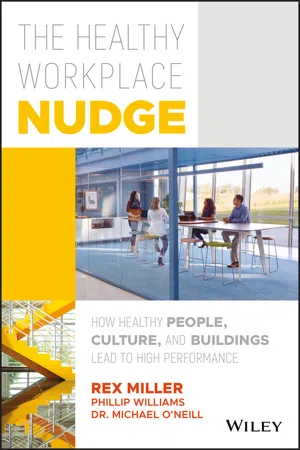
Discover how healthy buildings, culture, and people lead to high profits
Organizations and employees now spend an average of $18,000 per year per employee for health costs, a 61% increase in 10 years. Every indicator projects these costs will double before 2030. This is an unsustainable path. These costs are the tip to an even bigger iceberg, the hidden costs of time out of the office, distraction, disengagement, and turnover. The Healthy Workplace Nudge explains the findings of research on 100 large organizations that have tackled the problems of employee health costs and disengagement in five fresh ways:
Well-being leads to health and high performance
Wake up to the fact that 95% of traditional wellness programs fail to improve health or lower costs
Behavioral economics has become a new powerful tool to nudge healthy behavior
Healthy buildings are now cost effective and produce your strongest ROI to improving health
Leaders who develop healthy cultures achieve sustainable high performance and employee wellbeing
In addition to proving highly effective, these approaches represent a fraction of the cost sunk into traditional wellness and engagement programs. The book explains how to create a workplace that is good for people, releases them to what they do best and enjoy most, and produces great and profitable work.
• Find actionable strategies and tactics you can put into use today
• Retain happy, productive talent
• Cut unnecessary spending and boost your bottom line
• Benefit from real-world research and proven practice
If you're a leader who cares about the health and happiness of your employees, a human resource professional, or a professional who develops, designs, builds, or outfits workplace environments to improve employee health and wellbeing, this is one book you'll want to have on hand.
Part I Slow-Moving Storm: A History of Warnings and Apathy
Chapter 1 A Slow-Moving Storm: The Existential Threat to Business and the Economy
Sound managerial decisions are at the very root of their impending fall from industry leadership.
—Clayton Christensen, The Innovator's Dilemma
In the beginning, I thought our team came together to write a book. But, in fact, we were like those once described in a Cormac McCarthy novel: “They grouped in the road at the top of a rise and looked back. The storm front towered above them and the wind was cool on their sweating faces. They slumped bleary-eyed in their saddles and looked at one another. Shrouded in the black thunderheads the distant lightning glowed mutely like welding seen through foundry smoke.”1
Like that band of cowboys, our troupe stopped in the road when we saw the distant storm. We knew what it meant; our original purpose and destination no longer mattered. I saw the first flashes of lightning and heard the faraway muffled thunder when I met Dr. Michael Roizen at the Cleveland Clinic. Although it was distant, I could tell the storm carried deadly ferocity. For the first time in my life, I saw a true existential crisis. Before I give you a peek into that slow-moving storm, let me explain why and how we came to write this book.
A writer friend of mine was once embedded with a gaggle of reporters for a seven-day papal visit to a Middle Eastern country. In his first experience of being one of “the boys on the bus,” my friend's biggest surprise was what seemed like a total absence of press curiosity. He told me, “I expected to meet people who assumed nothing and probed everything. Surely, they would listen and ask questions thoughtfully and carefully. Instead, I saw journalists ignoring the subject of their coverage. They conducted loud cell phone calls, talked, ate, spilled drinks, swore, and stepped on people to get better positions, often as the pope was speaking!”
Let me assure you, that does not describe our approach. Curiosity drives MindShift.
We distrust the scripts and official announcements. We prefer to excavate the who, what, when, where, why, and how without the help of the authorities and their jackhammers. We agree with Steve Jobs: “It's more fun to be a pirate than to join the Navy.”2
That approach took us through three books; you hold the fourth. Our battle plan gathers 50 to 100 dissimilar, knowledgeable, strong, and gifted thought leaders. Then we move around the United States together, visiting innovative and sometimes radical outliers. We call those gatherings “summits,” but they're more like scavenger hunts. We grab relics, stories, honest research, and other artifacts and rush back to the cave for further analysis. Then we do it all over again a few weeks later.
We lead with our weakness.
Inexperience is our strongest asset. Because we know nothing, we have to be curious. So, we wear camo, distract the gatekeepers, build illusions, slip cash to the night security people, “borrow” reports, and hang out with insiders as well as outsiders. Think of us as the guys in Oceans 11. We embrace audacious goals, build daring plans, have a grand time, and knock over the Bellagio. Or something like that.
In the beginning, we called this project “Wellness.” That word meant something then; it means something totally different now. At its core, this book is really about a set of problems: the systems, ideas, habits, and walls that prevent people from attaining what they do best and enjoy most in America's workplaces.
Others saw that problem long before we did. Since they carried credentials and presented official authorizations at the guard shacks, they entered America's offices and factories and built an industry around their solutions. They issued lots of scripts, press releases, programs, and marketing plans. The problem was, their bold brilliance made the problem worse.
Then we arrived with nothing. Except curiosity and another great (my second and final) quote from Steve Jobs:
When you first start off trying to solve a problem, the first solutions you come up with are very complex, and most people stop there. But if you keep going, and live with the problem and peel more layers of the onion off, you can often times arrive at some very elegant and simple solutions.3
That's where our story began.
Looking back, my unfamiliarity with workplace wellness was a benefit. Because I was a novice about the subject, I had to get educated quickly. That meant digging deep. So, I immersed myself in the relevant areas of architecture, design, medicine, psychology, human resources, and health. It seemed like I read every book, watched every video, scoured every website, and interviewed every authority within the various realms of applicable knowledge.
I knew that Delos had started new collaborations, connecting building science with medical science, with the Cleveland Clinic and the Mayo Clinic. So, I thought a few conversations on the medical side of the wellness topic would help connect some dots and clarify how buildings influence the mind and body. I reached out to Paul Scialla, founder and chief executive officer of Delos. And he built a bridge to Dr. Michael Roizen, chief wellness officer for the Cleveland Clinic.
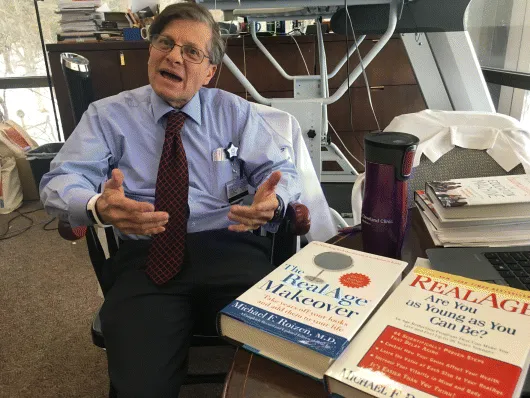
Dr. Roizen, the first chief wellness officer for any medical institution, holds numerous patents, has written several best-selling books, appeared multiple times on Oprah and is a partner, colleague, and co-columnist with Dr. Mehmet Oz. Roizen is a very young 71. In fact, his “RealAge”4 score is 51.2 years old. His dark hair, impeccable dress, and commanding voice help him to fill any room. He moves and talks quickly, drawing from his encyclopedic knowledge in conversation, interviews, and speeches. He doesn't stand before audiences; he prowls like a cat. Roizen is the pragmatic fanatic of wellness.
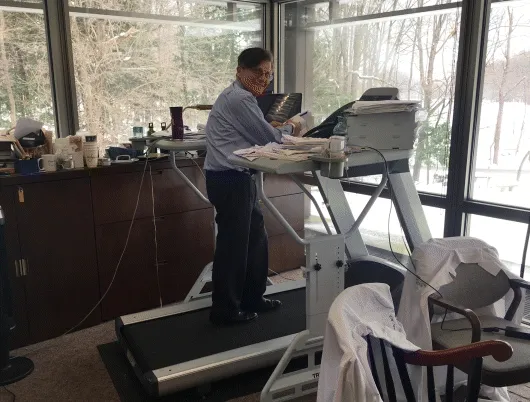
Figure 1.1Meeting Dr. Roizen.
He and the Cleveland Clinic have many critics. That is true of every outlier we met. They attract sharpshooters from the ridges. But our MindShift approach likes projects that provoke critics. We like them for the same reason that musicians create tension with chord progressions that feel incomplete or chords that clash. That dynamic stimulates interest, engagement, and a sense of motion.
When I first entered Dr. Roizen's office, he was walking on a treadmill, talking on his cell phone, and shuffling papers on his standing desk. He waved me to a chair at a table piled with reports. My quick glance around the office took in stacks of paper, boxes of reports, awards, photos, and books. His corner office gave a sweeping view of the grounds of the Cleveland Clinic's Wellness Institute.
Figure 1.2Dr. Michael Roizen, chief wellness officer for the Cleveland Clinic.
The interview started with his brief history of the deadly perils encountered on the road to career prosperity and convenience. It seemed that he too was once a cowboy, stopped dead in the road by a gathering storm.
“We know exactly when this rise of chronic disease started, 1983. We (adults) ate 2,340 calories, plus or minus 60 calories, per day from 1858 to 1983. Then we started increasing 2% per year. We reached 400 extra calories per person per day by 2000. The problem now is compounded by a concurrent drop in physical activity. Fifty percent of Americans—woman, man, employed, unemployed, Hispanic, Asian, whatever—do less than 10 minutes of physical activity any day of the week. The average 65-year-old person is five-foot-seven and weighs 33 pounds more than the same average 65-year-old did in 1991. Ou...
Table of contents
Cover
Table of Contents
Praise for The Healthy Workplace Nudge
Foreword
Acknowledgments
About the Authors
Introduction: The Elephant Whisperer
Part I: Slow-Moving Storm: A History of Warnings and Apathy
Part II: Is There Shelter from the Storm? A Search for Wellness
Part III: Magical Nudges: The Road to Health and Well-Being
Part IV: Haven in a Heartless World: The Need for Safe Places
Appendix A: The Well MindShift Core Team
Appendix B: Well MindShift Participants
Appendix C: Personal Story Template
Index
End User License Agreement
Trusted by 375,005 students
Access to over 1.5 million titles for a fair monthly price.
Study more efficiently using our study tools.
Frequently asked questions
Yes, you can cancel anytime from the Subscription tab in your account settings on the Perlego website. Your subscription will stay active until the end of your current billing period. Learn how to cancel your subscription
No, books cannot be downloaded as external files, such as PDFs, for use outside of Perlego. However, you can download books within the Perlego app for offline reading on mobile or tablet. Learn how to download books offline
Perlego offers two plans: Essential and Complete
Essential is ideal for learners and professionals who enjoy exploring a wide range of subjects. Access the Essential Library with 800,000+ trusted titles and best-sellers across business, personal growth, and the humanities. Includes unlimited reading time and Standard Read Aloud voice.
Complete: Perfect for advanced learners and researchers needing full, unrestricted access. Unlock 1.5M+ books across hundreds of subjects, including academic and specialized titles. The Complete Plan also includes advanced features like Premium Read Aloud and Research Assistant.
Both plans are available with monthly, semester, or annual billing cycles.
We are an online textbook subscription service, where you can get access to an entire online library for less than the price of a single book per month. With over 1.5 million books across 990+ topics, we’ve got you covered! Learn about our mission
Look out for the read-aloud symbol on your next book to see if you can listen to it. The read-aloud tool reads text aloud for you, highlighting the text as it is being read. You can pause it, speed it up and slow it down. Learn more about Read Aloud
Yes! You can use the Perlego app on both iOS and Android devices to read anytime, anywhere — even offline. Perfect for commutes or when you’re on the go. Please note we cannot support devices running on iOS 13 and Android 7 or earlier. Learn more about using the app
Yes, you can access The Healthy Workplace Nudge by Rex Miller,Phillip Williams,Michael O'Neill,Phillip Williams in PDF and/or ePUB format, as well as other popular books in Business & Business General. We have over 1.5 million books available in our catalogue for you to explore.