Cellulose and its derivatives can be found in many forms in nature and is a valuable material for all manner of applications in industry. This book is authored by an expert with many years of experience as an application engineer at renowned cellulose processing companies in the food industry. All the conventional and latest knowledge available on cellulose and its derivatives is presented. The necessary details are elucidated from a theoretical and practical viewpoint, while retaining the focus on food applications.
This book is an essential source of information and includes recommendations and instructions of a general nature to assist readers in the exploration of possible applications of cellulose and its derivatives, as well as providing food for thought for the generation of new ideas for product development. Topics include gelling and rheological properties, synergistic effects with other hydrocolloids, as well as nutritional and legal aspects.
The resulting compilation covers all the information and advice needed for the successful development, implementation, and handling of cellulose-containing products.
eBook - ePub
Cellulose and Cellulose Derivatives in the Food Industry
Fundamentals and Applications
- English
- ePUB (mobile friendly)
- Available on iOS & Android
eBook - ePub
Cellulose and Cellulose Derivatives in the Food Industry
Fundamentals and Applications
About this book
Information
1
General Overview of Food Hydrocolloids
1.1 Introduction to the World of Hydrocolloids
The term ‘hydrocolloid’ is derived from the Greek hydro ‘water’ and kolla ‘glue’.
Hydrocolloids are colloidal substances with an affinity for water. From a chemical point of view, they are macromolecular hydrophilic substances. Some of them are water soluble and form colloidal solutions others are only able to swell in water and can be dispersed by means of shear forces. Hydrocolloids produce viscous solutions, pseudo-gels, or gels in water. The heterogeneous group consists of polysaccharides and proteins.
Hydrocolloids are used in technical and regulated applications to thicken and to stabilize formulations. In processed foods, they are ubiquitous – no other group of ingredients contributes more to viscosity, texture, and body like hydrocolloids do.
Hydrocolloids are not really emulsifiers because, mostly, they do not have the characteristic linkage of lipophilic and hydrophilic groups in the molecular structure. The molecules are too big and complex in size and therefore are not flexible enough to cover the interfaces being formed during homogenization of oil–water mixtures fast enough to create a long-term stable emulsion with sufficiently small droplet diameter. However, these thickeners can stabilize emulsions by increasing the viscosity of the water surface or by interaction with surface-active substances. Some hydrocolloids like gum Arabic or non-ionic products such as methylcellulose (MC), HPMC (hydroxypropylcellulose), or propylene glycol alginate (PGA) reduce the surface tension and exhibit limited emulsifying properties [1].
In accordance to their origin and way of manufacturing, hydrocolloids can be classified in four different groups:
- hydrocolloids purely isolated from plants (without chemical modification);
- hydrocolloids obtained by fermentation;
- plant-derived hydrocolloids that are chemically modified;
- hydrocolloids from animals.
According to their botanical origin and their function in the plant organism, naturally occurring vegetable hydrocolloids can be divided into [1]:
- exudates (protective colloids being deposited on wounds): acacia gum/gum Arabic, tragacanth, karaya gum, ghatti gum;
- seed flours (reserve polysaccharides): guar gum, locust bean gum, tara gum, tamarind seed gum;
- extracts from land plants and marine algae (scaffolding substances): pectins, agar, alginate, carrageenan, starches, cellulose, furcelleran, larch gum.
Additionally, there are [1]:
- microbial or bacterial polysaccharides: xanthan, dextran, curdlan, scleroglucan, gellan, pullulan;
- modified polysaccharides: propylene glycol alginate, amidated pectin, modified starches, cellulose derivatives;
- proteins of animal origin: gelatine, caseinates.
Figure 1.1 presents an overview of globally used food hydrocolloids. There are also other substances available and in use, but several of them are restricted to local use and, depending on availability and legislation, are not in industrially-produced applications. Please always check the relevant legislation before using one of these stabilizers, gelling agents, or thickeners.
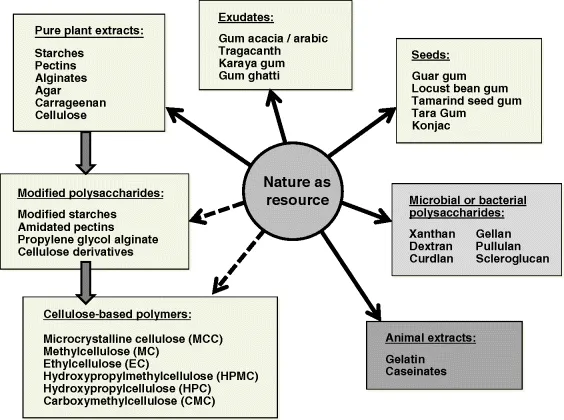
Figure 1.1 Overview of food hydrocolloids used globally.
The individual substances are described in subsequent sections. Information on their origin, manufacturing, structure, properties, and handling are provided. For the most used products there are overview tables; Tables 1.1–1.9 below give a quick orientation.
The individual cellulose-based substances are then described in more detail. Overview tables for selected cellulose derivatives are given in Section 1.6 (Tables 1.10–1.14).
1.2 Plant Extracts
1.2.1 Agar
Raw Material, Harvesting, and Manufacturing
Agar is a structure-building component of the cell wall of red algae (Rhodophyceae). Gelidium, Gracilaria, and Pterocladia species especially serve as a source of raw materials. The main producing countries are Japan, United States of America (California), Chile, and Spain, on whose rocky shores they occur. Agar was discovered in 1658 in Japan.
The red algae are harvested and extracted under pressure with hot water (100–130 °C (212–266 °F)) at pH 5–6. The extract is purified by filtration or centrifugation and subsequently bleached with calcium hypochlorite. To isolate the agar, the extract is frozen and, after thawing, the remaining gelatinous residue is dried. More recently, the water is squeezed out by means of a high-pressure press, and the remaining water is removed by drying. The annual production involves about 55 000 MT of dried seaweed to manufacture 7500 MT of agar [1,2].
Chemical Structure
Agar is a heterogeneous polysaccharide composed of the monomeric substances D-...
Table of contents
- Cover
- Related Titles
- Title Page
- Copyright
- List of Abbreviations
- Preface
- Chapter 1: General Overview of Food Hydrocolloids
- Chapter 2: Rheology of Food Hydrocolloids
- Chapter 3: Cellulose
- Chapter 4: Microcrystalline Cellulose
- Chapter 5: Fundamentals of Water-Soluble Cellulose Ethers and Methylcellulose
- Chapter 6: Ethylcellulose
- Chapter 7: Hydroxypropylcellulose
- Chapter 8: Hydroxypropylmethylcellulose
- Chapter 9: Methylethylcellulose
- Chapter 10: Sodium Carboxymethylcellulose
- Chapter 11: Crosslinked Sodium Carboxymethylcellulose
- Chapter 12: Enzymatically Hydrolysed Carboxymethylcellulose
- Chapter 13: Nanocellulose
- Index
- End User License Agreement
Trusted by 375,005 students
Access to over 1.5 million titles for a fair monthly price.
Study more efficiently using our study tools.
Frequently asked questions
Yes, you can cancel anytime from the Subscription tab in your account settings on the Perlego website. Your subscription will stay active until the end of your current billing period. Learn how to cancel your subscription
No, books cannot be downloaded as external files, such as PDFs, for use outside of Perlego. However, you can download books within the Perlego app for offline reading on mobile or tablet. Learn how to download books offline
Perlego offers two plans: Essential and Complete
- Essential is ideal for learners and professionals who enjoy exploring a wide range of subjects. Access the Essential Library with 800,000+ trusted titles and best-sellers across business, personal growth, and the humanities. Includes unlimited reading time and Standard Read Aloud voice.
- Complete: Perfect for advanced learners and researchers needing full, unrestricted access. Unlock 1.5M+ books across hundreds of subjects, including academic and specialized titles. The Complete Plan also includes advanced features like Premium Read Aloud and Research Assistant.
We are an online textbook subscription service, where you can get access to an entire online library for less than the price of a single book per month. With over 1.5 million books across 990+ topics, we’ve got you covered! Learn about our mission
Look out for the read-aloud symbol on your next book to see if you can listen to it. The read-aloud tool reads text aloud for you, highlighting the text as it is being read. You can pause it, speed it up and slow it down. Learn more about Read Aloud
Yes! You can use the Perlego app on both iOS and Android devices to read anytime, anywhere — even offline. Perfect for commutes or when you’re on the go.
Please note we cannot support devices running on iOS 13 and Android 7 or earlier. Learn more about using the app
Please note we cannot support devices running on iOS 13 and Android 7 or earlier. Learn more about using the app
Yes, you can access Cellulose and Cellulose Derivatives in the Food Industry by Tanja Wuestenberg in PDF and/or ePUB format, as well as other popular books in Physical Sciences & Industrial & Technical Chemistry. We have over 1.5 million books available in our catalogue for you to explore.