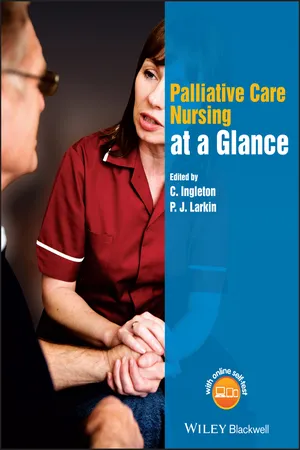
Palliative Care Nursing at a Glance
eBook - ePub

Palliative Care Nursing at a Glance

  1. English
  2. ePUB (mobile friendly)
  3. Available on iOS & Android
eBook - ePub

Palliative Care Nursing at a Glance

About this book

Palliative Care Nursing at a Glance is the perfect companion for nursing students, health and social care practitioners, and all those involved in palliative care delivery, both in the clinical and home setting.  Written by an expert team of academics, nurses, educators and researchers it provides a concise and easy-to-read overview of all the concepts and clinical decision-making skills necessary for the provision of good-quality palliative and end-of-life care.

Divided into six sections, the book includes coverage of all key clinical applications, principles of symptom management, palliative care approaches for a range of conditions and patient groups, exploration of the roles of the multi-professional team, as well as ethical challenges.

  • Superbly illustrated, with full colour illustrations throughout
  • Provides information on delivery of care in a range of settings
  • Broad coverage makes it ideal reading for anyone involved in palliative care delivery
  • User-friendly and accessible resource for those working in both specialist and non-specialist adult settings

Trusted by 375,005 students

Access to over 1.5 million titles for a fair monthly price.

Study more efficiently using our study tools.

Information

Year
2015
Print ISBN
9781118759219
eBook ISBN
9781118759196
Edition
1
Subtopic
Nursing

Introduction

Chapters

1 Setting the scene 2
Christine Ingleton
2 Managing the needs of family caregivers 4
Philip J. Larkin
3 Principles of effective communication 6
Alison Pilsworth and Martyn Geary
4 Advance care planning 8
Christine Ingleton
5 Delivering palliative approaches in different care contexts 10
Christine Ingleton
6 Integrated care pathways 12
Christine Ingleton

Setting the scene

Top: doctor with question mark at center surrounded by seven terms: ÒHospice careÓ, ÒCare of dyingÓ, etc. Bottom: doctor discussing with group of people; list of palliative care workforce, people associated with each type below.
Figure 1.1 Terms associated with caring for dying people
Top: doctor with question mark at center surrounded by seven terms: ÒHospice careÓ, ÒCare of dyingÓ, etc. Bottom: doctor discussing with group of people; list of palliative care workforce, people associated with each type below.
Figure 1.2 Palliative care workforce

Introduction

The aim of this book is to provide an overview of current issues in supporting dying patients and their families in the community (patient’s own home, nursing/residential setting), hospice or in an acute hospital setting. This introduction to palliative care is about the care of people facing death, both those who will die and those who accompany them – families, friends, community workers, volunteer workers and healthcare and social care workers. It is estimated that every year more than 20 million patients need palliative care at the end of life.

What is palliative care?

The use of specialist palliative care services is based on an assumption that people share a common understanding of the terminology and purpose of palliative care. Definitions and terminology are poorly understood and not agreed. Some of the terms used to describe palliative care are shown in Figure 1.1.
There is now a drive in many developed countries, including the United Kingdom, to introduce palliative or supportive care much earlier in the course of an illness or the so-called ‘illness trajectory’. One definition of palliative care is:
‘Palliative care is an approach that improves the quality of life of patients and their families facing the problems associated with life-threatening illness, through the prevention and relief of suffering by means of early identification and impeccable assessment and treatment of pain and other problems, physical, psychosocial and spiritual.’ (WHO, 2014)
Palliative care:
  • provides relief from pain and other distressing symptoms;
  • affirms life and regards dying as a normal process;
  • intends neither to hasten nor postpone death;
  • integrates the psychological and spiritual aspects of patient care;
  • offers a support system to help patients live as actively as possible until death;
  • offers a support system to help the family cope during the patient’s illness and in their own bereavement;
  • uses a team approach to address the needs of patients and their families, including bereavement counselling, if indicated;
  • will enhance quality of life and may also positively influence the course of illness; and
  • is applicable early in the course of illness, in conjunction with other therapies that are intended to prolong life, such as chemotherapy or radiation therapy.
It is helpful to differentiate between ‘specialist’ and ‘generalist’ palliative care. The National Council for Hospice and Specialist Palliative Care Services (2002) differentiates between general palliative care, which ‘is provided by the usual professional carers of the patient and family with low to moderate complexity of palliative care need’, and specialist palliative care services, which ‘are provided for patients and their families with moderate to high complexity of palliative care need. They are defined in terms of their core service components, their functions and the composition of the multi-professional teams that are required to deliver them.’

Who receives palliative care?

Access to palliative care typically relates to the availability of services, the funding models of healthcare and the nature of disease. In the United Kingdom, despite repeated calls to widen access to patients, whatever their diagnosis, who are nearing the end of life, approximately 95% of those referred to hospices have cancer.

Where is palliative care delivered?

Palliative care is a ‘philosophy of care’; therefore, it can be delivered in a variety of settings, including institutions such as hospitals, in-patient hospices and care homes for older people as well as in people’s own homes. Most patients with advanced illness are in the care of the primary healthcare team, consisting of general practitioners, community nurses and associated healthcare and social care professionals. Care is therefore delivered in patients’ homes, where they spend the majority of their time during the final year of life.
Home is overwhelmingly the preferred place of care for the majority of people (Gomes and Higginson, 2011). General practitioners and community nurses may make referrals to specialist palliative care providers. Specialist palliative care services themselves offer a range of provision, from a single specialist nurse to a comprehensive multi-disciplinary team. Specialist palliative care services have developed an array of different types of provision and include the following:
  • In-patient units – hospices
  • Hospital teams
  • Community teams
  • O...

Table of contents

  1. Cover
  2. Series
  3. Title Page
  4. Copyright
  5. Contributors
  6. Preface
  7. Abbreviations
  8. About the companion website
  9. Part 1: Introduction
  10. Part 2: Clinical applications
  11. Part 3: Palliative care for all
  12. Part 4: Professional roles in palliative care
  13. Part 5: Ethical challenges in palliative care practice
  14. Part 6: Managing end-of-life care
  15. Index
  16. EULA

Frequently asked questions

Yes, you can cancel anytime from the Subscription tab in your account settings on the Perlego website. Your subscription will stay active until the end of your current billing period. Learn how to cancel your subscription
No, books cannot be downloaded as external files, such as PDFs, for use outside of Perlego. However, you can download books within the Perlego app for offline reading on mobile or tablet. Learn how to download books offline
Perlego offers two plans: Essential and Complete
  • Essential is ideal for learners and professionals who enjoy exploring a wide range of subjects. Access the Essential Library with 800,000+ trusted titles and best-sellers across business, personal growth, and the humanities. Includes unlimited reading time and Standard Read Aloud voice.
  • Complete: Perfect for advanced learners and researchers needing full, unrestricted access. Unlock 1.5M+ books across hundreds of subjects, including academic and specialized titles. The Complete Plan also includes advanced features like Premium Read Aloud and Research Assistant.
Both plans are available with monthly, semester, or annual billing cycles.
We are an online textbook subscription service, where you can get access to an entire online library for less than the price of a single book per month. With over 1.5 million books across 990+ topics, we’ve got you covered! Learn about our mission
Look out for the read-aloud symbol on your next book to see if you can listen to it. The read-aloud tool reads text aloud for you, highlighting the text as it is being read. You can pause it, speed it up and slow it down. Learn more about Read Aloud
Yes! You can use the Perlego app on both iOS and Android devices to read anytime, anywhere — even offline. Perfect for commutes or when you’re on the go.
Please note we cannot support devices running on iOS 13 and Android 7 or earlier. Learn more about using the app
Yes, you can access Palliative Care Nursing at a Glance by C. Ingleton, P. J. Larkin, C. Ingleton,P. J. Larkin in PDF and/or ePUB format, as well as other popular books in Medicine & Nursing. We have over 1.5 million books available in our catalogue for you to explore.