The main aim of this book is to offer companies a simple and practical method to assess their maturity in the Governance Information System, so that they are in working order to face the challenges of Digital Transformation. How can companies effectively manage their investment in IT systems and make the most of their development?
eBook - ePub
Digital Transformation
Information System Governance
- English
- ePUB (mobile friendly)
- Available on iOS & Android
eBook - ePub
About this book
Information
PART 1
Information Systems Governance at the Service of the Digital Transformation
1
Enterprise Governance: A Framework that Includes IS Governance
Enterprise governance is a decision-making process addressing, in a “balanced” way, two main components: compliance1 and value creation.
As was discussed in the preface, IT assumes a more and more important strategic role concerning the business in the context of the “digital transformation”. Therefore, it must necessarily become a “stakeholder” in all decision-making and enterprise governance processes at the highest level.
The problems, opportunities and challenges posed by the alignment of information systems to the strategy of the company, as well as a consistent management of the investments, resources and technological projects, thus become a major concern for boards of directors and executive committees in enterprises.
In the recommendations of the International Federation of accountants (IFAC), enterprise governance comprises both corporate governance and performance governance, as represented in the following figure.
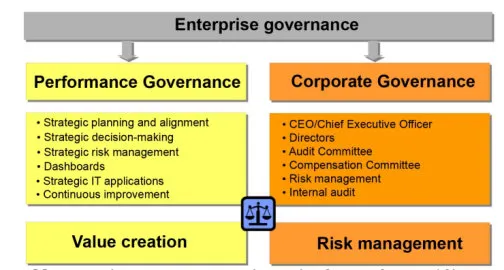
Figure 1.1.
Illustration source: adapted from CIMA (Chartered Institute of Management Accountants)
This definition has the merit of correctly highlighting that enterprise governance has two balanced objectives, namely “value creation” associated with the performance governance and “risk management” associated with corporate governance.
Enterprise governance deals with all of the decisions made throughout the life of the enterprise aiming to create lasting value by ensuring the development in the medium/long term of the company and by making sure that the risks that might pose a threat to it be quickly identified and controlled.
To do this, enterprise governance specifies all the responsibilities and the practices to be implemented by the boards of directors and the Executive Committees to:
- – define the strategy of the company by exploiting as much as possible the opportunities offered by the new technologies;
- – establish the targets to be achieved and ensure their declination at all levels of the organization;
- – make the necessary resources available to achieve the objectives;
- – verify that these are met;
- – make sure that the risks are under control at an appropriate level with respect to the objectives of the company.
It concerns the following:
- – administrators who will acquire knowledge of the company and its modes of operation;
- – all the managers who will find a context for reflection and for best practices;
- – all stakeholders (shareholders, employees, public administrations, etc.), which will have in their possession a measure of the quality of management processes.
Enterprise governance revolves around the company’s “business” macro-processes
By specifying the roles and the responsibilities of the actors of the company in all of the decisions to be taken, in terms of value creation, risk management or resources optimization, enterprise governance is therefore a real process.
It can be represented in the form of a diagram comprising four axes for the implementation of “best practices” plus a “transversal” key success factor: the “business macro-processes”.
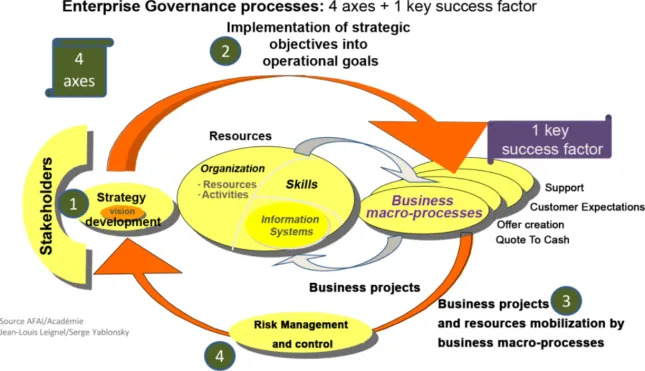
Figure 1.2.
Axis no. 1: development of the strategy
The company takes into account the expectations of its “stakeholders” (current and future customers, competitors, shareholders, employees, suppliers, bankers, public administrations, etc.) and the predictable evolutions of the environment (technological, economic, social, financial, ecological, political/geopolitical) as part of a formalized and structured approach that relies, for example, on the concepts introduced by M. Porter in his book “Competitive Strategy: Techniques for Analyzing Industries and Competitors”.
At the same time, it ensures the involvement of the relevant actors (“right men”), in this case, the Executive Committee, directors and managers at the “right time” and the “right place” in the decision-making process.
This approach should in fine ultimately lead to ambitious and realistic growth targets for each of the families of the company’s products, but also in the definition of industrial, human and financial resources required to achieve this growth.
Axis no. 2: operational break down of the strategy into objectives
Medium-term business planning makes it possible to assign concrete improvement goals consistent with the strategic objectives to the business macro processes (end-to-end management of customer orders, creation of product and services supply, integration of customers’ expectations, supporting processes, etc.).
Obviously this approach should combine all of the company’s management areas, that are the Executive Committee, the business units management, the finance, management control, audit and IT departments, etc.
Axis no. 3: business projects and resources mobilization in relation with the macro-processes objectives
The improvement goals associated at a first stage to the “macro-processes” of the company are “results objectives”, such as the time to market reduction of a new product for the “offer creation” process, the production costs reduction for the “supply chain” process and the improvement of the rate of customer satisfaction for the “managing client expectations” process.
They must now be translated into “activities objectives” that can be attributed to the managers in charge of the functions contributing to the operation of the process: optimization of the production work plan, decrease in the response times to customer questions, ideas for new products or services better targeted, faster design of new products or services, etc.
Within the framework of the budgetary approach, “activities objectives” attributed to operational managers will be translated into action plans or business projects likely to mobilize the resources of the company in order to achieve the established objectives. These action plans or business projects always involve three inseparable components, the weight of each being highly variable depending on the context:
- – organization;
- – internal or external skills;
- – information systems.
Axis no. 4: performance management and risk management
It concerns in fact two control processes that complement each other.
1) Performance management is a process implemented by the Executive Committee to ensure that business projects that it launches will correctly meet their objectives of performance and value creation for the business.
It is a process of continuous improvement, which results in verifying that the objectives assigned to the business processes are achieved with the aim of:
- – implementing the preventive or corrective measures necessary for ongoing projects;
- – redirecting, when necessary, the project business activities or the resources allocated to these projects;
- – capitalizing on the e...
Table of contents
- Cover
- Table of Contents
- Title
- Copyright
- Foreword
- Preface
- Acknowledgments
- Part 1: Information Systems Governance at the Service of the Digital Transformation
- Part 2: Evaluation of the Maturity of Enterprise Information Systems Governance
- Appendices
- Bibliography
- Index
- End User License Agreement
Trusted by 375,005 students
Access to over 1.5 million titles for a fair monthly price.
Study more efficiently using our study tools.
Frequently asked questions
Yes, you can cancel anytime from the Subscription tab in your account settings on the Perlego website. Your subscription will stay active until the end of your current billing period. Learn how to cancel your subscription
No, books cannot be downloaded as external files, such as PDFs, for use outside of Perlego. However, you can download books within the Perlego app for offline reading on mobile or tablet. Learn how to download books offline
Perlego offers two plans: Essential and Complete
- Essential is ideal for learners and professionals who enjoy exploring a wide range of subjects. Access the Essential Library with 800,000+ trusted titles and best-sellers across business, personal growth, and the humanities. Includes unlimited reading time and Standard Read Aloud voice.
- Complete: Perfect for advanced learners and researchers needing full, unrestricted access. Unlock 1.5M+ books across hundreds of subjects, including academic and specialized titles. The Complete Plan also includes advanced features like Premium Read Aloud and Research Assistant.
We are an online textbook subscription service, where you can get access to an entire online library for less than the price of a single book per month. With over 1.5 million books across 990+ topics, we’ve got you covered! Learn about our mission
Look out for the read-aloud symbol on your next book to see if you can listen to it. The read-aloud tool reads text aloud for you, highlighting the text as it is being read. You can pause it, speed it up and slow it down. Learn more about Read Aloud
Yes! You can use the Perlego app on both iOS and Android devices to read anytime, anywhere — even offline. Perfect for commutes or when you’re on the go.
Please note we cannot support devices running on iOS 13 and Android 7 or earlier. Learn more about using the app
Please note we cannot support devices running on iOS 13 and Android 7 or earlier. Learn more about using the app
Yes, you can access Digital Transformation by Jean-Louis Leignel,Thierry Ungaro,Adrien Staar in PDF and/or ePUB format, as well as other popular books in Computer Science & Information Technology. We have over 1.5 million books available in our catalogue for you to explore.