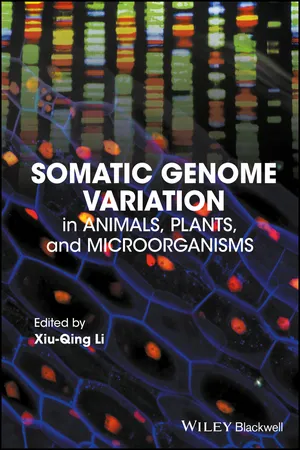
Written by an international team of experts, Somatic Genome Variation presents a timely summary of the latest understanding of somatic genome development and variation in plants, animals, and microorganisms. Wide-ranging in coverage, the authors provide an updated view of somatic genomes and genetic theories while also offering interpretations of somatic genome variation. The text provides geneticists, bioinformaticians, biologist, plant scientists, crop scientists, and microbiologists with a valuable overview of this fascinating field of research.
- English
- ePUB (mobile friendly)
- Available on iOS & Android
eBook - ePub
About this book
Information
Part I
Somatic Genome Variation in Animals and Humans
Chapter 1
Polyploidy in Animal Development and Disease
Jennifer L. Bandura1 and Norman Zielke2*
1Biology Department, Roanoke College, Salem, USA
2Genome-Scale Biology Research Program, Institute of Biomedicine, University of Helsinki, Helsinki, Finland
* Corresponding author: [email protected] Bandura J.L. and Zielke N. (2017) Polyploidy in animal development and disease. In: Li X.-Q., editor. Somatic Genome Variation in Animals, Plants, and Microorganisms: Wiley-Blackwell, Hoboken, NJ, Ch. 1, pp. 3-44.
Abstract
Somatic polyploidization is a developmentally controlled process that can be found in many animal species, including mammals. Polyploidy is utilized as a mechanism to amplify gene expression via an increase in DNA copy number, to drive cellular growth, and to initiate cellular differentiation. Moreover, polyploidy has been implicated in the response to injury or disease. This chapter discusses the processes by which polyploid cells arise and the underlying molecular mechanisms, with a focus on endoreplication in Drosophila and mice. In addition, it summarizes recent progress on the related subjects of endomitosis, ploidy reversal, and gene amplification.
Keywords polyploidy; endoreplication; endomitosis; gene amplification
1.1 Introduction
A fundamental characteristic of the canonical eukaryotic cell cycle is that the genome is only replicated once per cycle, and becomes then equally distributed between two daughter cells during the following mitosis. This strict constraint on DNA replication ensures that each daughter cell receives exactly one diploid set of chromosomes. However, some cell types depart from this rule and differentiate into viable polyploid cells, in which the entire set of chromosomes has been multiplied. While the term polyploid refers to cells with virtually any chromosomal configuration, the term polytene refers to a subclass of polyploid cells in which sister chromatids remain closely associated in parallel arrays. The degree of polyploidy is indicated by the C-value, which represents the DNA content as a multiple of the normal haploid genome. Hence, tetraploid cells have a DNA content of 4 C, while octoploid cells are 8 C. Polyploidy is clearly distinguishable from aneuploidy, which refers to cells containing an aberrant number of chromosomes that is not a multiple of the haploid genome. Polyploidy is often confused with the term re-replication, which describes genome duplications originating from unscheduled initiation of DNA replication during S phase. DNA re-replication is an aberrant event that produces cells characterized by a heterogeneous DNA content, incomplete chromosome duplications, stalled replication forks, and DNA damage. In cells with a compromised DNA damage response, re-replication events can cause genomic instability and thereby promote cancer formation.
Polyploidy occurs in two forms that can be distinguished by their mechanisms of origin: Germline polyploidy refers to genome duplications in the germline, which are often caused by chromosome mis-segregation during meiosis. In this case, all the cells in the resulting progeny will be polyploid and, because the multiplied chromosomes may be inherited by future generations, germline polyploidization is generally thought to promote speciation. In this chapter, we focus on the more common somatic polyploidy, which is often intrinsically connected to cellular differentiation and is therefore also referred to as developmentally programmed polyploidy. Somatic polyploidy occurs frequently in ferns, flowering plants, mollusks, arthropods, amphibians, and fish, but is also found in a few specialized cell types in mammals. Somatic polyploidy is utilized to increase tissue size, to initiate cell differentiation, and to multiply gene copy number to enhance tissue-specific functions. Somatic polyploidy has also been implicated in tissue regeneration and the suppression of tumorigenesis.
1.2 Mechanisms Inducing Somatic Polyploidy
The formation of somatic polyploid cells relies on four distinct mechanisms: cell fusion, acytokinetic mitosis, endomitosis, and endoreplication (Figure 1.1; Table 1.1).

Figure 1.1 Mechanisms introducing somatic polyploidy. (A) Nuclear configurations in mitotic and polyploid cell types. C, C-value, multiples of the haploid DNA content arising from different mechanisms. (B) Overview of non-canonical cell cycle variants leading to somatic polyploidy. Hepatocytes (HPC) bypass cytokinesis, and as a consequence this cell cycle variant is called an acytokinetic mitosis. Megakaryocyte polyploidization occurs through endomitosis, which is another abortive mitosis lacking anaphase B, telophase, and cytokinesis. Mouse trophoblast giant cells (TGC) and Drosophila salivary glands (SG) both undergo endocycles, which are completely devoid of M phase. TGCs undergo full genome replications, while SGs exit S phase before completing late replication. (C) Schematic of an under-replicated region, which results from differential firing of replication origins and within the euchromatin usually encompasses 100–400 kb. (D) Genomic organization of amplified loci, which arise from reiterative origin firing, resulting in copy number gradients stretching approximately 100 kb.
Table 1.1 Polyploidization achieved by varying mechanisms across animal species.
| Organism | Tissue/cell type | Developmental stage | Maximal ploidy | Mechanism of polyploidization | Reference |
| C. elegans | Hypodermis | Larva and adult | 16 C a | Cell fusion, Endocycles | (Flemming et al. 2000) |
| Intestine | Larva | 32 C | Endocycles | (Hedgecock and White 1985) | |
| D. melanogaster | Salivary gland | Larva | 1035 C | Endocycles | (Hammond and Laird 1985b) |
| Ovary/follicle cell | Adult | 16 C | Endocycles | (Hammond and Laird 1985a) | |
| Ovary/nurse cell | Adult | 1500 C | Endocycles | (Hammond and Laird 1985a) | |
| Brain/subperineural glia | Larva | 22 C | Endocycles, Acytokinetic mitosis | (Unhavaithaya and Orr-Weaver 2012) | |
| Fat body | Adult | 256 C | Endocycles | (Richards 1980) | |
| Malpighian tubules | Adult | 256 C | Endocycles | (Lamb 1982) | |
| Mechanosensory bristles | Pupa | 8 C | Endocycles | (Hartenstein and Posakony 1989; Audibert et al. 2005) | |
| Hindgut/rectal papillae | Larva and pupa | 16 C | Endocycles b | (Fox et al. 2010) | |
| Midgut | Adult | 64 C | Endocycles | (Lamb 1982) | |
| Epidermis | Throughout development | 1300 C | Endocycles | (Ganot and Thompson 2002) | |
| O. dioica | Liver/hepatocytes | Postnatal (onset ~ 3 weeks) | 8 C–16 C | Acytokinetic mitosis b, c | (Guidotti et al. 2003; Wirth et al. 2006; Margall-Ducos et al. 2007) |
| M. musculus | Placenta/trophoblast giant cells | Embryo (onset at E4.5) | 512 C–1024 C | Endocycles c | (Barlow and Sherman 1974; Varmuza et al. 1988; Sher et al. 2013) |
| M. musculus, H. sapiens | Megakaryocytes | Embryo (onset at E7.5) | 128 C | Endomitosis, Acytokinetic mitosis | (Nagata et al. 1997; Ravid et al. 2002; Sher et al. 2013) |
| Heart/cardiomyocytes | Postnatal (onset at day 4) | 8 C | Acytokinetic mitosis c | (Soonpaa et al. 1996; Pandit et al. 2013) | |
| H. sapiens | Skin/keratinocytes | Throughout development | 12 C | Endocycles, Acytokinetic mitosis | (Zanet et al. 2010; Gandarillas 2012) |
Note: This is not a comprehensive list of all polyploid tissues in animals.
a There are 65 nuclei per hypodermis.
b Also undergo ploidy reversal.
c Additional unidentifiedmechanisms.
1.2.1 Cell Fusion
Cell fusion describes the fusion of two cells residing in G1 phase, which results in the formation of a multinucleated cell. A striking example is found during the development of nematodes such as Caenorhabditis elegans, whose hypodermis is a single syncytium that grows through successive cell fusion events (Flemming et al. 2000). Cell fusion also occurs during the fusion of skeletal muscle myoblasts into myotubes, when monocytes differentiate into osteoclasts, and during the formation of syncytiotrophoblasts in the human placenta (Cross 2005).
1.2.2 Acytokinetic Mitosis
Acytokinetic mitosis refers to an abortive ...
Table of contents
- Cover
- Title Page
- Copyright
- Table of Contents
- List of Contributors
- Preface and Introduction
- Acknowledgments
- About the Editor
- Part I: Somatic Genome Variation in Animals and Humans
- Part II: Somatic Genome Variation in Plants
- Part III: Somatic Genome Variation in Microorganisms
- Part IV: General Genome Biology
- Index
- End User License Agreement
Trusted by 375,005 students
Access to over 1.5 million titles for a fair monthly price.
Study more efficiently using our study tools.
Frequently asked questions
Yes, you can cancel anytime from the Subscription tab in your account settings on the Perlego website. Your subscription will stay active until the end of your current billing period. Learn how to cancel your subscription
No, books cannot be downloaded as external files, such as PDFs, for use outside of Perlego. However, you can download books within the Perlego app for offline reading on mobile or tablet. Learn how to download books offline
Perlego offers two plans: Essential and Complete
- Essential is ideal for learners and professionals who enjoy exploring a wide range of subjects. Access the Essential Library with 800,000+ trusted titles and best-sellers across business, personal growth, and the humanities. Includes unlimited reading time and Standard Read Aloud voice.
- Complete: Perfect for advanced learners and researchers needing full, unrestricted access. Unlock 1.5M+ books across hundreds of subjects, including academic and specialized titles. The Complete Plan also includes advanced features like Premium Read Aloud and Research Assistant.
We are an online textbook subscription service, where you can get access to an entire online library for less than the price of a single book per month. With over 1.5 million books across 990+ topics, we’ve got you covered! Learn about our mission
Look out for the read-aloud symbol on your next book to see if you can listen to it. The read-aloud tool reads text aloud for you, highlighting the text as it is being read. You can pause it, speed it up and slow it down. Learn more about Read Aloud
Yes! You can use the Perlego app on both iOS and Android devices to read anytime, anywhere — even offline. Perfect for commutes or when you’re on the go.
Please note we cannot support devices running on iOS 13 and Android 7 or earlier. Learn more about using the app
Please note we cannot support devices running on iOS 13 and Android 7 or earlier. Learn more about using the app
Yes, you can access Somatic Genome Variation by Xiu-Qing Li in PDF and/or ePUB format, as well as other popular books in Biological Sciences & Genetics & Genomics. We have over 1.5 million books available in our catalogue for you to explore.