Accelerating Performance
eBook - ePub

Accelerating Performance

How Organizations Can Mobilize, Execute, and Transform with Agility

  1. English
  2. ePUB (mobile friendly)
  3. Available on iOS & Android
eBook - ePub

Accelerating Performance

How Organizations Can Mobilize, Execute, and Transform with Agility

About this book

Transform your organization into a dynamic catalyst for success

Accelerating Performance is not just another "warm and fuzzy" change management book—it's a practical, comprehensive, data-driven action plan for picking up the pace and achieving more. Co-written by one of the authors of Beyond Performance, this book draws on a combination of empirical research and decades of experience advising global companies to show you how to reduce time to value by building and changing momentum more quickly than your competitors.

The META framework (short for Mobilize, Execute, and Transform with Agility) offers advice for leading change at four levels: strategy, the organization, teams, and individuals. In addition to step-by-step guidance toward assessment, planning, and implementation, the book offers:

  • A diagnostic tool for leaders, teams, and organizations to assess their starting place, and highlight the specific areas needed to improve the ability to accelerate performance.
  • A detailed look at the factors proven to create drag—and drive—at each of the four levels: strategy, organizations, teams, and individuals.
  • An exploration of the 39 differentiating actions that organizations can combine as dictated by their strategy and context into a winning recipe.
  • A closer look at the practices of 23 "superaccelerators, " a global (and perhaps unexpected) mix of companies that have demonstrated a consistent ability to accelerate performance.

A single taste of success is all it takes to spark change, but the hard work of following through requires constant vigilance—and a plan. Learn how to capture that drive, bottle it, and use it to sustain motivation, inspiration, and achievement. Deliver at the highest level, and then turn around and do even better next time. Accelerating Performance gives leaders a step-by-step framework for taking action and transforming their organizations, teams, and even themselves—starting today.

Tools to learn more effectively

Saving Books

Saving Books

Keyword Search

Keyword Search

Annotating Text

Annotating Text

Listen to it instead

Listen to it instead

Information

Publisher
Wiley
Year
2016
Print ISBN
9781119147497
eBook ISBN
9781119163589

SECTION II
The Acceleration Imperative

Now that you have seen the basic outline for META, this section takes a deep dive into the specifics, at each of the four levels where META applies: strategy, the organization, teams, and leaders.
Chapter 6, on how to accelerate strategy, observes that many companies do a curious thing: They may focus 100 percent of their effort on things they can control, even though analysis shows that 45 percent or more of a company’s profitability depends on events in the environment, outside its control. This chapter explains how to sense better what’s going on in the environment and then respond faster, to turn that 45 percent-plus from uncertainty into opportunity. The chapter goes through 13 factors that can either create drag or drive performance. For instance, it explains how to fail fast—most companies hold on to failing strategies for too long. The chapter explains how to check for “execution feasibility”—many companies set strategy without fully understanding whether they can make it work, rather than trying to develop a strategy with the fewest execution hurdles in front of it. The chapter also describes how to respond rapidly, based on less-than-perfect information, and how to get to the goal ahead of the competition.
In Chapter 7, on how to accelerate organizations, we note that it has been a very long time since there has been fundamental innovation in organizational structure. As a result, developments in technology and other factors that change the pace and nature of work are creating real pressures that need to be resolved. Given the complexity of these nuanced issues, the only way to act with accuracy is through the data. So, based on our research, we lay out the 13 factors that our analysis has shown determine drag and drive at the organization level, and then we delve into the 3 actions that are most important to take for each of the 13 factors—so, 39 action steps in all. We describe how to co-innovate with customers and how to use a higher purpose as fuel that can excite employees and align them behind the company’s goals. We also explore how to get employees to speak truth to power, how to act as one firm, how to learn from mistakes, how to either improve or atomize the corporate center, how to develop what we call digital dexterity—and much more.
Chapter 8, on how to accelerate teams, provides a telling statistic: Our research found that, on average, a high-performing team (called accelerating, on our scale) delivered 22.8 percent more economic value than a low-performing team (derailing, on our scale). We also found that teams that dealt directly with customers generally performed far better than those with an internal focus—suggesting that ways need to be found to put all teams, especially top teams, directly in contact with customers. Creating “psychological safety” is also crucial, to allow for open and productive conversations—a study by Google found that that was the most important factor in determining the success of its teams. In all, we identified 16 drag and drive factors for teams, with two key actions that will generate the best performance for each factor. The chapter includes an extended look at Nationwide Building Society, where the chief operating officer has been working on these accelerating principles with his top team since 2012. While he would acknowledge that he still has work to do, he has made such progress that, in the first quarter of 2016, Nationwide was ranked number one for customer service satisfaction among its peers and has assets larger than the remaining 44 British building societies combined.
In Chapter 9, on how to accelerate leaders, we observe that, in a world where capital costs essentially nothing, all value comes from leaders who harness and implement ideas better than their competitors do. Yet most companies say their leaders only reliably get 50 percent of the full potential of their people. As we sought to understand this crucial issue of leadership, our research identified 11 drag and drive factors that must be addressed. How leaders manage energy turned out to be a key issue. For instance, the best leaders adopt tactics such as looking at the 80-20 rule and deciding that, if 80 percent of the outcomes come from 20 percent of the activities, they will identify the 20 percent and ignore the rest. Our research also turned up a plethora of other practical advice—for example, that leaders need to embrace the power of doubt and that, no matter how hard it may be to act otherwise, it’s not okay to be grumpy.
A note on examples: We use lots, to illustrate our points, and name names wherever we can. We typically use a company as an example only once, in the interests of readability, but we make an exception for the superaccelerators. The material from our interviews with them was so rich, and their success so significant, that we include their observations and stories wherever they are relevant, even though that means repeating names at times.
CHAPTER 6
Accelerating Strategy Less Plan, More Planning

Imagine it is the late 15th century; you are an explorer, preparing to sail into the fog. No one has ever come back from the fog, so you do not know what is on the other side. As the captain, how do you pack for the journey? What will help you deal with rapidly changing and uncertain conditions on the other side of the fog?
This is the challenge that many business leaders face today in the midst of the rapid and confusing change we’re all experiencing. Leaders confront a foggy future without a reliable guide—no one has been to the future and returned. Yet they need to make critical decisions that will set their organization up for success many years into the future.
With limited and imperfect information, business leaders must pack and plan so well that they not only survive but also thrive no matter what future environment they find themselves in.
This requires a series of steps within our META framework to achieve acceleration at the strategy level. The steps allow you to make crisp decisions in the face of uncertainty and then adapt as circumstances change and, ultimately, get to the destination much faster than you would have otherwise—and then start moving to the next destination.
But most leaders don’t see themselves as explorers of the unknown. They dislike uncertainty. So they tend to focus on what they can control. To the extent that they think about the unknown, they talk about “future-proofing” their organizations. This is a fool’s errand.
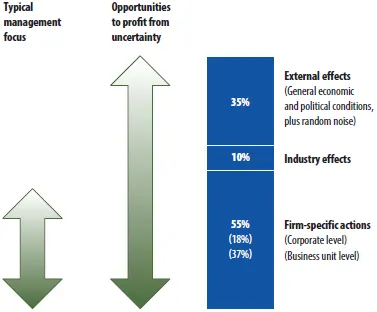
Left diagram shows two bidirectional arrow representing typical management focus and opportunities to profit from uncertainty with respect to the bar diagram on right with columns for external effects, industry effects and firm-specifications.
FIGURE 6.1 Half the business is left to fate
Note: The percentages refer to how much of the variance in return on assets is due, on average, to various influences. The data reflect over 100 U.S. manufacturing firms consisting of at least two strategic business units covering 160 industries.
Source: Jaime A. Roquebert, Robert L. Phillips, and Peter A. Westfall, “Markets vs. management: What ‘drives’ profitability?” Strategic Management Journal, October 1996.
Reprinted with the permission of Atria, a division of Simon & Schuster, Inc., from Profiting from Uncertainty: Strategies for Succeeding No Matter What the Future Brings by Paul J. H. Schoemaker, PhD with Robert E. Gunther. Copyright © 2002 by Paul J. H. Schoemaker. All rights reserved.
“I’ve been doing business plans in banks for 30 years, and they’ve all been wrong,” says Juerg Zeltner, the CEO of UBS Wealth Management. The world is just too ambiguous. A major study found that, on average, approximately 45 percent of a company’s profitability depends on how beneficial or detrimental external and industry events are for its performance—in other words, on what happens in the fog (Figure 6.1). That study was completed before some of the most significant black swan events of the modern era, such as the 9/11 attacks and the 2008–2009 financial crisis, and volatility and uncertainty have only increased in recent years.
On average, oil and gas businesses have about 90 percent of profitability driven by the external environment (the price of oil). Over the past 10 years, in working sessions with hundreds of leadership teams within the financial services and health care industries, we found that the C-suite perceived profits to be approximately 70 percent dependent on external and industry events (r...

Table of contents

  1. Cover
  2. Praise
  3. Title page
  4. Copyright
  5. Dedication
  6. Foreword
  7. Acknowledgments
  8. About the Authors
  9. Introduction
  10. Section I move fast or die faster
  11. Section II The acceleration imperative
  12. Section III How to start
  13. Section IV The four key skills
  14. Research Appendix
  15. Index
  16. EULA

Frequently asked questions

Yes, you can cancel anytime from the Subscription tab in your account settings on the Perlego website. Your subscription will stay active until the end of your current billing period. Learn how to cancel your subscription
No, books cannot be downloaded as external files, such as PDFs, for use outside of Perlego. However, you can download books within the Perlego app for offline reading on mobile or tablet. Learn how to download books offline
Perlego offers two plans: Essential and Complete
  • Essential is ideal for learners and professionals who enjoy exploring a wide range of subjects. Access the Essential Library with 800,000+ trusted titles and best-sellers across business, personal growth, and the humanities. Includes unlimited reading time and Standard Read Aloud voice.
  • Complete: Perfect for advanced learners and researchers needing full, unrestricted access. Unlock 1.4M+ books across hundreds of subjects, including academic and specialized titles. The Complete Plan also includes advanced features like Premium Read Aloud and Research Assistant.
Both plans are available with monthly, semester, or annual billing cycles.
We are an online textbook subscription service, where you can get access to an entire online library for less than the price of a single book per month. With over 1 million books across 990+ topics, we’ve got you covered! Learn about our mission
Look out for the read-aloud symbol on your next book to see if you can listen to it. The read-aloud tool reads text aloud for you, highlighting the text as it is being read. You can pause it, speed it up and slow it down. Learn more about Read Aloud
Yes! You can use the Perlego app on both iOS and Android devices to read anytime, anywhere — even offline. Perfect for commutes or when you’re on the go.
Please note we cannot support devices running on iOS 13 and Android 7 or earlier. Learn more about using the app
Yes, you can access Accelerating Performance by Colin Price,Sharon Toye in PDF and/or ePUB format, as well as other popular books in Business & Organisational Behaviour. We have over one million books available in our catalogue for you to explore.