A COLLECTION OF SOME OF THE JET PROPULSION LABORATORY'S SPACE MISSIONS SELECTED TO REPRESENT THE PLANETARY COMMUNICATIONS DESIGNS FOR A PROGRESSION OF VARIOUS TYPES OF MISSIONS
The text uses a case study approach to show the communications link performance resulting from the planetary communications design developed by the Jet Propulsion Laboratory (JPL). This is accomplished through the description of the design and performance of six representative planetary missions. These six cases illustrate progression through time of the communications system's capabilities and performance from 1970s technology to the most recent missions. The six missions discussed in this book span the Voyager for fly-bys in the 1970s, Galileo for orbiters in the 1980s, Deep Space 1 for the 1990s, Mars Reconnaissance Orbiter (MRO) for planetary orbiters, Mars Exploration Rover (MER) for planetary rovers in the 2000s, and the MSL rover in the 2010s.
Deep Space Communications:
Provides an overview of the Deep Space Network and its capabilities
Examines case studies to illustrate the progression of system design and performance from mission to mission and provides a broad overview of the mission systems described
Discusses actual flight mission telecommunications performance of each system
Deep Space Communications serves as a reference for scientists and engineers interested in communications systems for deep-space telecommunications link analysis and design control.
Chapter 1 Deep Space Communications: An Introduction
Joseph H. Yuen
1.1 Introduction and Overview
Communications are required and critical to the success of space missions. From the moment of launch, the only connection between a spacecraft and the Earth is the communications system. This system enables return of data from spacecraft to Earth, the tracking of the spacecraft, and commanding the spacecraft to perform any actions that it cannot perform automatically.
Since the beginning, with Sputnik in 1957 and Explorer in 1958, space missions have gone farther and have become more and more demanding in data return to enable far more ambitious science goals. This is particularly so for probes in deep space—at the Moon and farther. In the 1960s and 1970s, the missions were planet flybys, which typically have short encounter periods. Then the missions progressed in the 1980s and 1990s to plant orbiters, which have long and sustained scientific observations—often years of continuous operation. In the 2000s, missions involved landing rovers that moved around on the surface of planets to engage in scientific investigations. In 2012, the latest of these, Mars Science Laboratory (MSL) rover was landed on Mars for years of continuous active scientific investigations.
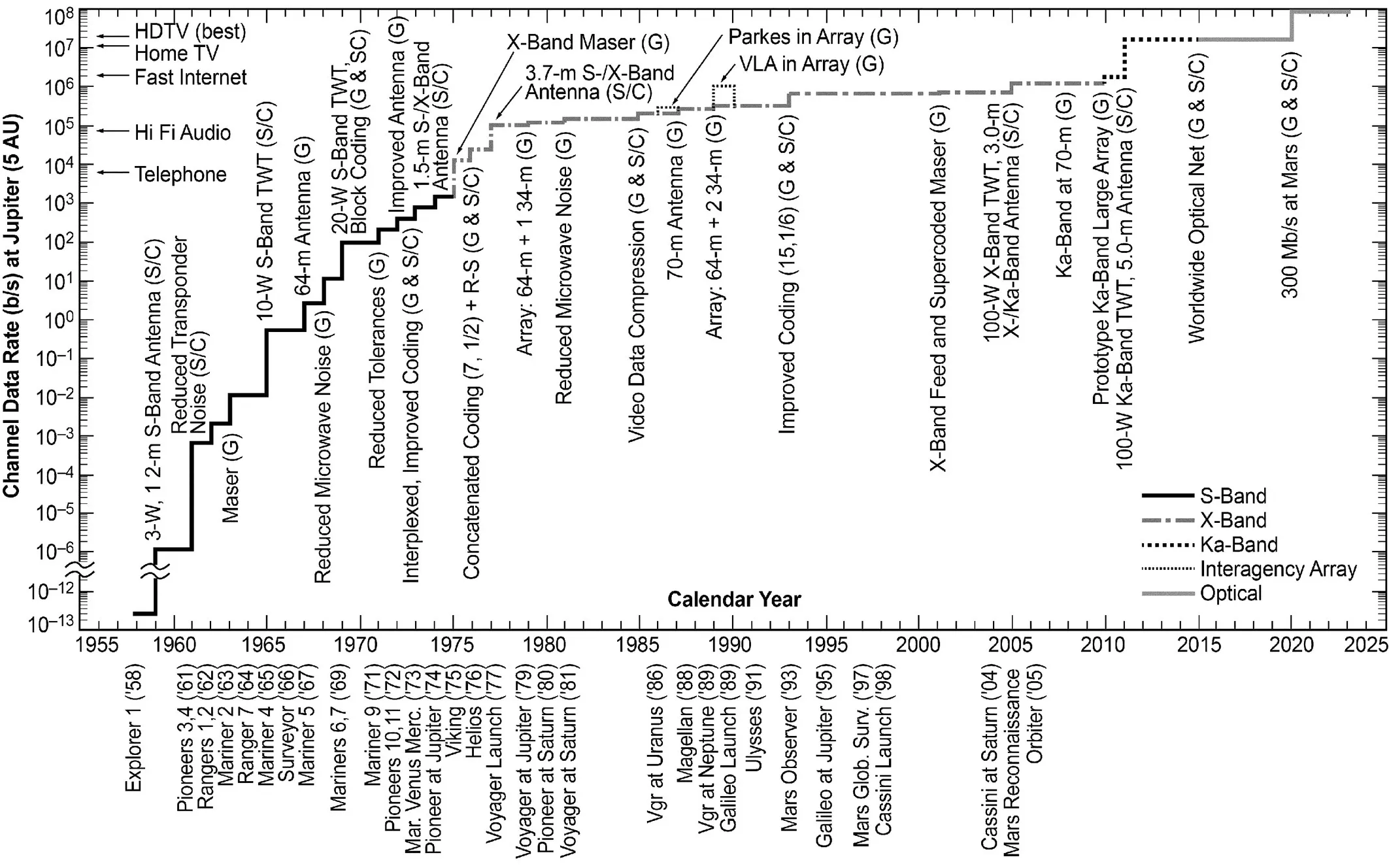
To overcome the enormous communication distance and the limited spacecraft mass and power available in space, the Jet Propulsion Laboratory’s (JPL’s) deep space communications technologies developed for spacecraft of the National Aeronautics and Space Administration (NASA) and NASA’s Deep Space Network (DSN)1 have enabled every JPL deep space mission ever flown, and contributed to the development of exciting new mission concepts. Figure 1-1 summarizes the evolution of deep space communications capabilities and performance of our spacecraft since the first NASA spacecraft in 1958, and it projects to the future capabilities. One can see the tremendous improvements over the years. To continue meeting the increasing demand on deep space communications systems, JPL will need to increase its capability by a factor of ten during each of the coming decades.
Fig. 1-1.Deep space communications downlink data rate evolution.
This book is a collection of some JPL space missions selected to represent typical designs for various types of missions; namely, Voyager for fly-bys in the 1970s, Galileo for orbiters in the 1980s, Deep Space 1 for the 1990s, Mars Reconnaissance Orbiter (MRO) for planetary orbiters, Mars Exploration Rover (MER) for planetary rovers in the 2000s, and the MSL rover in the 2010s. The cases we have selected were chosen from the JPL Design and Performance Summary series, issued by the Deep Space Communications and Navigation Systems Center of Excellence (DESCANSO) [1]. The case studies of this book illustrate the progression of system design and performance from mission to mission; as stated in the foreword of the series by DESCANSO leader Joseph H. Yuen when the series was launched. The case studies provide the reader with a broad overview of the missions systems described. Besides the systems designs, the case studies provide actual flight mission performance details of each system.
We have provided only the necessary editing to fit within the book and some updates as missions have progressed. As much as possible, we have preserved the original authors’ content largely unchanged.
This chapter summarizes the theoretical background for telecommunications link analysis and telecommunications design control, respectively. The chapter has been adopted from Yuen, 1982 [2], and refers to chapters of that monograph for greater detail.
1.2 Telecommunications Link Analysis
The performance of a telecommunications system depends on numerous link parameters. Advanced modulation techniques, coding schemes, modern antennas, transmitters, and other advances all improve communications efficiency in their own ways. For designing an entire communications system, communications engineers put all the components or subsystems together and determine performance capability. Signal performance metrics, such as signal-to-noise-spectral-density ratios, are defined in this section. In addition, the component link parameters that enhance or impair the performance are defined.
1.2.1 Received Power
General questions used for performance computation are derived from the basic equations of communications in the medium between transmitting and receiving systems [3]. The first step in link analysis is to calculate the received signal power. Received power PR is computed by the following equation:
(1.2-1)
Where PR is the received signal power at the input to the rec...
Table of contents
Cover
Title Page
Table of Contents
Foreword
Preface
Acknowledgments
Contributors
Chapter 1: Deep Space Communications
Chapter 2: The Deep Space Network
Chapter 3: Voyager Telecommunications
Chapter 4: Galileo Telecommunications
Chapter 5: Deep Space 1
Chapter 6: Mars Reconnaissance Orbiter
Chapter 7: Mars Exploration Rover Telecommunications
Chapter 8: Mars Science Laboratory
Acronyms and Abbreviations
About the Companion Website
Index
End User License Agreement
Trusted by 375,005 students
Access to over 1.5 million titles for a fair monthly price.
Study more efficiently using our study tools.
Frequently asked questions
Yes, you can cancel anytime from the Subscription tab in your account settings on the Perlego website. Your subscription will stay active until the end of your current billing period. Learn how to cancel your subscription
No, books cannot be downloaded as external files, such as PDFs, for use outside of Perlego. However, you can download books within the Perlego app for offline reading on mobile or tablet. Learn how to download books offline
Perlego offers two plans: Essential and Complete
Essential is ideal for learners and professionals who enjoy exploring a wide range of subjects. Access the Essential Library with 800,000+ trusted titles and best-sellers across business, personal growth, and the humanities. Includes unlimited reading time and Standard Read Aloud voice.
Complete: Perfect for advanced learners and researchers needing full, unrestricted access. Unlock 1.5M+ books across hundreds of subjects, including academic and specialized titles. The Complete Plan also includes advanced features like Premium Read Aloud and Research Assistant.
Both plans are available with monthly, semester, or annual billing cycles.
We are an online textbook subscription service, where you can get access to an entire online library for less than the price of a single book per month. With over 1.5 million books across 990+ topics, we’ve got you covered! Learn about our mission
Look out for the read-aloud symbol on your next book to see if you can listen to it. The read-aloud tool reads text aloud for you, highlighting the text as it is being read. You can pause it, speed it up and slow it down. Learn more about Read Aloud
Yes! You can use the Perlego app on both iOS and Android devices to read anytime, anywhere — even offline. Perfect for commutes or when you’re on the go. Please note we cannot support devices running on iOS 13 and Android 7 or earlier. Learn more about using the app
Yes, you can access Deep Space Communications by Jim Taylor in PDF and/or ePUB format, as well as other popular books in Technology & Engineering & Electrical Engineering & Telecommunications. We have over 1.5 million books available in our catalogue for you to explore.