The aim of the book is to educate government agencies, operators, vendors and other regulatory institutions how LTE can be deployed to serve public safety market and offer regulatory / public safety features. It is written in such a way that it can be understood by both technical and non-technical personnel with just introductory knowledge in wireless communication. Some sections and chapters about public safety services offered by LTE network are intended to be understood by anyone with no knowledge in wireless communication.
- English
- ePUB (mobile friendly)
- Available on iOS & Android
eBook - ePub
LTE for Public Safety
About this book
Information
1
Introduction to LTE/SAE
1.1 Role of 3GPP
The 3rd Generation Partnership Project (in short 3GPP) is a joint international standardization initiative between North American (Alliance for Telecommunications Industry Solutions (ATIS)), European (European Telecommunications Standards Institute (ETSI)), and Asian organizations (Association of Radio Industries and Businesses (ARIB) and Telecommunication Technology Committee (TTC) in Japan, Telecommunications Technology Association (TTA) in Korea and China Communication Standards Association (CCSA) in China) that was originally established in December 1998. The participating organizations are also called organizational partners. Scope of 3GPP was to specify a new worldwide mobile radio system (the Global System for Mobile Communications (GSM) was a European initiative while Code Division Multiple Access (CDMA) was initiated in North America, both are not compatible with each other) based on the evolved GSM techniques General Packet Radio Service (GPRS)/EDGE. This activity has led to the standardization of the third-generation Universal Mobile Telecommunications System (UMTS), which consists of Wideband Code Division Multiple Access (WCDMA) as radio technology and a core network supporting both circuit-based voice calls and packet-based data services. UMTS was meant as a universal standard that allows subscribers to use their UMTS-capable mobile phones and subscriptions worldwide through roaming (for an explanation of the term “roaming,” see Section 1.13.1) agreements between mobile operators. UMTS is a big success story with around 1.4 billion WCDMA subscriptions deployed until now.
But 3GPP did not stop work after UMTS, in the following years enhancements of UMTS like High-Speed Packet Access (HSPA)/HSPA+, new services such as Multicast/Broadcast delivery, Location services, and the IP Multimedia Subsystem (IMS) were introduced. Long-Term Evolution (LTE) with a new Orthogonal Frequency-Division Multiplexing (OFDM)-based radio technology and an All-IP core network architecture is the newest development of 3GPP.
3GPP is organized in different working groups (see Figure 1.1) that are responsible for different parts of the 3GPP system. The Radio Access Network (RAN) groups define the radio parts of the UMTS/LTE system, i.e. the physical layer, and radio protocols. The GSM/EDGE Radio Access Networks (GERAN) groups work specifically on the maintenance and development of GSM/EDGE access technologies. The System Architecture (SA) and Core/Terminal (CT) groups specify all parts of the overall system (e.g., architecture, security, charging) and all non-radio protocols (between the mobile device and network, within the network and between networks). A new working group SA6 will be operational from January 2015 onwards to standardize a Mission Critical Push To Talk (MCPTT) application in 3GPP. For details regarding MCPTT, please refer to Chapter 5.
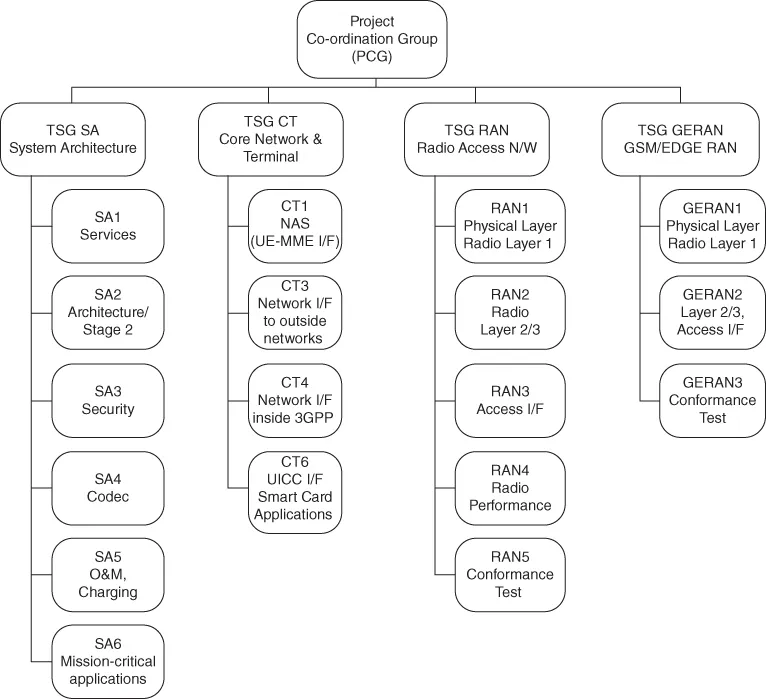
Figure 1.1 3GPP organizational structure
3GPP follows a phased approach; working output is delivered as a set of Technical Specifications (TS) in so-called System Releases. Technical Specifications contain normative requirements that have to be implemented by chipset, device, and network equipment vendors. Interim results of ongoing work in 3GPP are usually captured in non-normative Technical Reports (TR). Test specifications are also created by 3GPP (mainly test cases for User Equipment (UE) to network communication). It has to be noted that 3GPP defines only functions and protocols, how these functions are implemented in concrete network nodes or whether some functions are implemented in the same node is up to the network vendor. One basic design principle in 3GPP's standardization process is backward compatibility of new features with existing ones. This ensures that new features can be introduced in one network without the need to upgrade all interconnected networks or all other nodes within this network at the same time.
Table 1.1 provides a brief overview of the official release dates and milestones of the 3GPP releases up to Release 12.
Table 1.1 3GPP milestones up to Release 12
| Release | Date | Main content |
| Phases 1 and 2 | 1992 and 1995 | Basic GSM functions |
| Release 96, 97, 98, 99 | 1996, 1997, 1998, 1999 | GPRS, HSCSD, EDGE, UMTS |
| Release 4 | 2001 | MSC server split architecture |
| Release 5 | 2002 | HSDPA, IMS |
| Release 6 | 2004 | HSUPA, MBMS, Push to Talk over Cellular (PoC) |
| Release 7 | 2007 | HSPA, EDGE evolution |
| Release 8 | 2008 | LTE/SAE |
| Release 9 | 2009 | LTE/SAE enhancements, Public Warning System (PWS), IMS emergency sessions over LTE/HSPA |
| Release 10 | 2011 | LTE Advanced Local IP Access (LIPA) Selective IP Traffic Offload (SIPTO) |
| Release 11 | 2012 | Heterogeneous Network (HetNet) Support Coordinated Multipoint Operation (CoMP) |
| Release 12 | 2014 | Public Safety Machine type communication HSPA/LTE carrier aggregation |
For more information on the history and structure of 3GPP, visit the official 3GPP site at http://www.3gpp.org/about-3gpp/about-3gpp.
1.2 History of LTE
Main drivers for evolution of mobile networks are usually higher bandwidth on the air interface and better spectral efficiency (i.e., the information rate transmitted over a given bandwidth). After improving these key factors for WCDMA over several years, which led to the specification of HSPA and its evolution HSPA+, the 3GPP standardization forum, in 2004, started evaluating a new radio technology as successor for WCDMA. Objectives for starting this work were higher peak data rates (>100 Mbit/s in Downlink and >50 Mbit/s in Uplink) and lower latency besides other improvements. This work is formed under the name LTE. As the search for a more appealing name/acronym had no result, LTE is now used as the radio interface name in most official publications. Inside 3GPP the newly developed radio access network is called Evolved UMTS Radio Access Network (E-UTRAN) to indicate the evolution path from GERAN (GSM/GPRS/EDGE) second-generation networks (2G) to UTRAN (WCDMA/HSPA) third-generation networks (3G), and finally to E-UTRAN (LTE) fourth-generation networks (4G). It has to be noted that LTE initially did not fulfill International Telecommunication Union's (ITU) International Mobile Telecommunication (IMT) Advanced requirement...
Table of contents
- Cover
- Title Page
- Copyright
- Table of Contents
- Foreword
- About the Authors
- Preface
- Acknowledgments
- Introduction
- Terminology
- Chapter 1: Introduction to LTE/SAE
- Chapter 2: Regulatory Features
- Chapter 3: LTE for Public Safety Networks
- Chapter 4: Proximity Services
- Chapter 5: Group Communication Over LTE
- Chapter 6: Summary and Outlook
- Appendix A
- Index
- End User License Agreement
Trusted by 375,005 students
Access to over 1.5 million titles for a fair monthly price.
Study more efficiently using our study tools.
Frequently asked questions
Yes, you can cancel anytime from the Subscription tab in your account settings on the Perlego website. Your subscription will stay active until the end of your current billing period. Learn how to cancel your subscription
No, books cannot be downloaded as external files, such as PDFs, for use outside of Perlego. However, you can download books within the Perlego app for offline reading on mobile or tablet. Learn how to download books offline
Perlego offers two plans: Essential and Complete
- Essential is ideal for learners and professionals who enjoy exploring a wide range of subjects. Access the Essential Library with 800,000+ trusted titles and best-sellers across business, personal growth, and the humanities. Includes unlimited reading time and Standard Read Aloud voice.
- Complete: Perfect for advanced learners and researchers needing full, unrestricted access. Unlock 1.5M+ books across hundreds of subjects, including academic and specialized titles. The Complete Plan also includes advanced features like Premium Read Aloud and Research Assistant.
We are an online textbook subscription service, where you can get access to an entire online library for less than the price of a single book per month. With over 1.5 million books across 990+ topics, we’ve got you covered! Learn about our mission
Look out for the read-aloud symbol on your next book to see if you can listen to it. The read-aloud tool reads text aloud for you, highlighting the text as it is being read. You can pause it, speed it up and slow it down. Learn more about Read Aloud
Yes! You can use the Perlego app on both iOS and Android devices to read anytime, anywhere — even offline. Perfect for commutes or when you’re on the go.
Please note we cannot support devices running on iOS 13 and Android 7 or earlier. Learn more about using the app
Please note we cannot support devices running on iOS 13 and Android 7 or earlier. Learn more about using the app
Yes, you can access LTE for Public Safety by Rainer Liebhart,Devaki Chandramouli,Curt Wong,Jürgen Merkel in PDF and/or ePUB format, as well as other popular books in Technology & Engineering & Mobile & Wireless Communications. We have over 1.5 million books available in our catalogue for you to explore.