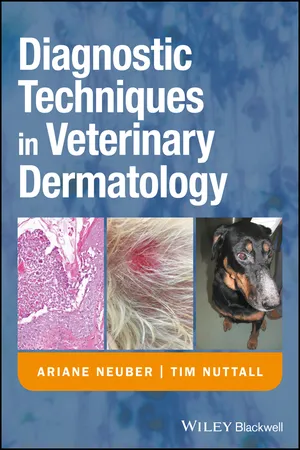
Diagnostic Techniques in Veterinary Dermatology
eBook - ePub

Diagnostic Techniques in Veterinary Dermatology

  1. English
  2. ePUB (mobile friendly)
  3. Available on iOS & Android
eBook - ePub

Diagnostic Techniques in Veterinary Dermatology

About this book

The first book devoted solely to the techniques used to investigate skin problems in animals

A practical everyday reference for veterinary practitioners, Diagnostic Techniques in Veterinary Dermatology focuses on contemporary techniques for investigating skin problems in small animals, horses and exotic pets. Written by experienced specialists in veterinary dermatology, this book offers clear, step-by-step guidance on how to perform tests and interpret their results.

The first book devoted exclusively to the subject, this hands-on guide demonstrates how to carry out and interpret a huge range of dermatology tests, as well as how to avoid common mistakes and pitfalls. Featuring full colour photographs and illustrations throughout, key topics include: looking for parasites, hair plucks and trichograms, dermoscopy, cytology, fungal and bacterial cultures, histopathology, allergy testing, immune-mediated skin diseases, endocrine and metabolic skin diseases, infectious diseases, diagnostic imaging, otoscopy and examination of the ear, genetic tests, and more.

Diagnostic Techniques in Veterinary Dermatology is a valuable working resource for busy practitioners in first opinion practice, as well as veterinary nurses and technicians. It is also an ideal reference for veterinary students and specialists in-training. 

Trusted by 375,005 students

Access to over 1.5 million titles for a fair monthly price.

Study more efficiently using our study tools.

Information

Year
2017
Print ISBN
9781405139489
eBook ISBN
9781119233060
Edition
1

1
Introduction to Dermatological Tests

Recent studies show that skin and ear diseases comprise 25% of all veterinary consultations. They are often complex and ongoing conditions that are a challenge to manage. Very few can be diagnosed on history and appearance alone. The modern approach to dermatology emphasises using the history and clinical signs to construct a logical differential diagnosis list. The diagnosis is then achieved by utilising appropriate tests to eliminate and/or confirm conditions in the differential diagnosis. On the other hand it is all too easy to become over-reliant on tests; it is most important that the clinical pathology is made to fit the history and clinical signs, not vice versa.
There is a very wide range of tests that can be used to investigate skin problems, but selecting, performing and interpreting the most appropriate tests in each case requires some experience. Many textbooks and journals, however, concentrate on individual skin conditions and assume that the reader is experienced enough to undertake the relevant diagnostic procedures. In practice, some of the most common reasons for poor management of skin conditions involve the inappropriate use of diagnostic tests, suboptimal execution of test procedures, inadequate sample choice and misinterpretation of results. The aim of this book, therefore, is to provide an illustrated, step-by-step guide to help you select, perform and interpret clinical tests and procedures for a range of dermatological presentations.

What Equipment Will You Need?

A wide range of equipment is necessary for thorough examination of the skin, which may seem daunting. The vast majority, however, are inexpensive, non-specialist items that are common to virtually all veterinary practices and do not need special skills to operate. The few items that are expensive and/or need specific training to use are all optional; they are undoubtedly useful, especially to dermatology specialists, but are not necessary to successfully practise veterinary dermatology.

Essential Equipment

  • Good lighting is essential for proper examination of the skin, lesions and collected material. Good fluorescent room lighting is a minimal requirement and a high-intensity spotlight is necessary for any serious examination.
  • Flea comb for coat combings (Figure 1.1).
  • Hand lens or magnifying glass for close examination of the skin, coat and collected material; the large illuminated lenses sold for reading are most useful (Figure 1.2).
  • A good-quality binocular microscope for examining hair plucks, skin scrapes and cytology (Figure 1.3).
  • Glass slides for mounting material; frosted slides are easier to label (Figure 1.1 and Figure 1.4).
  • Cover-slips are essential for any microscopic examination (Figure 1.4).
  • Immersion oil for using the ×100 oil immersion microscope lens; different types of oil with different viscosities are available. Type A is the least viscous and is often preferred as it is the least messy and the cheapest. Type NVH is the most viscous. For in-house use, type B would also be suitable also but it is messier than type A (Figure 1.4).
  • Lens tissue or cloth and cleaning fluid or alcohol for cleaning microscope lenses without damage.
  • Otoscope for examining the ears (Figure 1.5).
  • Wood's lamp for screening for fluorescent dermatophytes (Figure 1.2).
  • Electric clippers for removing hair, allowing access to the skin.
  • Curved scissors for more precise and less traumatic hair removal.
  • Fine-tipped curved artery (mosquito) forceps for hair plucks (Figure 1.1).
  • Liquid paraffin for skin scrapes (Figure 1.1).
  • 20% potassium hydroxide as a clearing agent when looking for parasites or dermatophytes (optional).
  • No. 10 and No. 15 scalpel blades for skin scrapes and biopsies (Figure 1.1).
  • Cotton buds for collecting material from the ears (Figure 1.6).
  • Adhesive tape (Sellotape®, Scotch Tape® etc.) for skin surface parasites and cytology (Figure 1.1).
  • Sterile bacteriology swabs with and without transport media; fine-tipped ENT swabs are useful for taking samples from narrow sites or when using otoscopes etc. (Figure 1.6).
  • Sterile universal (30 mL) and bijoux (5 mL) containers for storing and transporting tissue samples (Figure 1.7).
  • Diff-Quik® type stain for routine cytology (Figure 1.4).
  • Toothbrushes to collect material for dermatophyte culture (Figure 1.8).
  • Syringes and needles of various sizes for taking blood samples and aspirates (Figure 1.9).
  • Blood collection tubes: plain, EDTA, heparin and gel-clotting tubes.
  • Indelible marker pen to mark biopsy and skin test sites.
  • 4-, 6- and 8-mm skin biopsy punches (Figure 1.7).
  • Basic surgical kit and suture material for performing skin biopsies and closing skin wounds.
  • 10% neutral buffered formalin for fixing biopsy specimens (Figure 1.7).
Figure 1.1 Some equipment needed for taking samples for skin parasitology: a flea comb, clear sticky tape, No. 10 scapel blades, cotton buds, liquid paraffin, artery forceps for taking hair pluckings and microscopic slides.
Figure 1.2 A magnifying lens with illumination. In this case the lamp doubles up as a Wood's lamp for dermatophyte detection.
Photograph depicting a trinocular microscope with the option to attach a camera to document the findings.
Figure 1.3 A good-quality microscope is essential to be able to correctly identify parasites, cells and microorganisms in the samples examined. The image shows a trinocular microscope with the option to attach a camera to document the findings.
Figure 1.4 Essential microscope equipment: glass slides with a frosted edge for easy labelling, glass cover-slips to improve the optic performance under the microscope, immersion oil and a modified Romanowsky-type rapid staining solution kit.
Figure 1.5 Equipment used for otoscopy: a handheld otoscope, various sizes of cones to be attached to the otoscope (all packaged individually after autoclaving to sterilise the cones after each use) and a cone cleaner to remove otic debris after use prior to sterilising.
Figure 1.6 Equipment for obtaining samples from the ear canal: cotton buds, bac...

Table of contents

  1. Cover
  2. Title Page
  3. Copyright
  4. Chapter 1: Introduction to Dermatological Tests
  5. Chapter 2: Looking for Parasites
  6. Chapter 3: Hair Plucks and Trichograms
  7. Chapter 4: Dermoscopy
  8. Chapter 5: Cytology
  9. Chapter 6: Fungal and Bacterial Cultures and Identification
  10. Chapter 7: Introduction to Histopathology
  11. Chapter 8: Allergy Testing
  12. Chapter 9: Immune-Mediated Skin Diseases
  13. Chapter 10: Endocrine and Metabolic Skin Diseases
  14. Chapter 11: Infectious Diseases
  15. Chapter 12: Diagnostic Imaging
  16. Chapter 13: Otoscopy and Examination of the Ear
  17. Chapter 14: Which Test to Choose When
  18. Chapter 15: Genetic Tests for Skin Diseases
  19. References
  20. Index
  21. End User License Agreement

Frequently asked questions

Yes, you can cancel anytime from the Subscription tab in your account settings on the Perlego website. Your subscription will stay active until the end of your current billing period. Learn how to cancel your subscription
No, books cannot be downloaded as external files, such as PDFs, for use outside of Perlego. However, you can download books within the Perlego app for offline reading on mobile or tablet. Learn how to download books offline
Perlego offers two plans: Essential and Complete
  • Essential is ideal for learners and professionals who enjoy exploring a wide range of subjects. Access the Essential Library with 800,000+ trusted titles and best-sellers across business, personal growth, and the humanities. Includes unlimited reading time and Standard Read Aloud voice.
  • Complete: Perfect for advanced learners and researchers needing full, unrestricted access. Unlock 1.5M+ books across hundreds of subjects, including academic and specialized titles. The Complete Plan also includes advanced features like Premium Read Aloud and Research Assistant.
Both plans are available with monthly, semester, or annual billing cycles.
We are an online textbook subscription service, where you can get access to an entire online library for less than the price of a single book per month. With over 1.5 million books across 990+ topics, we’ve got you covered! Learn about our mission
Look out for the read-aloud symbol on your next book to see if you can listen to it. The read-aloud tool reads text aloud for you, highlighting the text as it is being read. You can pause it, speed it up and slow it down. Learn more about Read Aloud
Yes! You can use the Perlego app on both iOS and Android devices to read anytime, anywhere — even offline. Perfect for commutes or when you’re on the go.
Please note we cannot support devices running on iOS 13 and Android 7 or earlier. Learn more about using the app
Yes, you can access Diagnostic Techniques in Veterinary Dermatology by Ariane Neuber,Tim Nuttall in PDF and/or ePUB format, as well as other popular books in Medicine & Veterinary Medicine. We have over 1.5 million books available in our catalogue for you to explore.