Agricultural, energy or mineral commodities are traded internationally in two market categories: physical markets and financial markets. More specifically, on the financial markets, contracts are negotiated, the price of which depends on the price of a commodity. These contracts are called derivatives (futures, options contracts, swaps).
This book presents, on the one hand, the characteristics of these derivatives and the markets on which they are traded and, on the other hand, those transactions that typically combine an action on the physical market and a transaction on the corresponding financial market.
The understanding of commodity financial markets mainly relies on the resources of economic analysis, especially the financial economy, because the use of this discipline is essential to understanding the major operations that are conducted daily by the operators of these markets: traders, producers, processors, financiers.
- English
- ePUB (mobile friendly)
- Available on iOS & Android
eBook - ePub
Financial Markets for Commodities
About this book
Information
1
General Observations on the Physical Trading of Commodities
The physical trading of large commodities clearly differs from the trade of transformed products on several important points. Competition through prices plays a decisive role as these commodities are standardized and there cannot really be competition through differentiation in the product itself, only in the logistical services and financial conditions attached to the transaction. There may be large fluctuations in price, both in the short term as well as in the long term, which could be problematic for producers as well as intermediaries and transformers. Finally, given their strategic importance, states intervene in the trading of commodities either directly (as vendors, buyers or stockers) or indirectly through regulations that are put in place.
1.1. The standardization of commodities and commercial contracts
In the context of a commercial transaction related to transformed products, vendors and buyers negotiate both the technical characteristics and prices. In the case of commodities, the standardized physical characteristics are agreed upon by all operators and, thus, negotiations revolve chiefly around the prices. In practice, these negotiations are very brief: if, at a given point of time, a certain price is acceptable to both a buyer and a seller, an agreement is very quickly established between the two parties and the transaction is carried out. If the quality of the products delivered is better than standard quality, the vendor asks for a higher payment, if it is inferior to the standard quality, the buyer asks for a discount. Let us note that the conditions of physical delivery and the modes of the financial transaction may also be negotiated; nonetheless, the price remains the primary criterion.
For greater precision, the negotiation itself is standardized. This standardization is perfect when operators use an organized market (stock exchange) as the platform of negotiation. It is still of a high standard when the negotiation is carried out through direct telephonic contact between buyers and vendors. In this case, the language used by the negotiators is very highly codified and if an agreement is concluded, there are not many conditions (chiefly price, site and date of delivery, and the mode of payment). The various modalities of negotiations that we find either in organized markets or over-the-counter markets will be studied in greater detail in section 1.2. To illustrate the principle of the standardization of commodity trading, we use the case of the quality of milling wheat, traded on the futures market Euronext Paris1: “Wheat of good quality, conforming to a quality standard, and saleable, whose specifications are: specific weight 76 kg/hl, moisture content 15%, percentage of broken seeds at 4%, germ seeds 2%, and a maximum impurity content of 2%. The bonuses or deductions are applied as per Incograin formula no. 23 and technical addendum no. 2”2.
The standardization also relates to commercial contracts, for example:
“The Paris Syndicate [for Commerce and Seed Industries] establishes and diffuses the models for buying and selling contracts adapted to European commerce around primary agricultural products. These agreements are characterized by a balance between the interests of the buyer and those of the seller. These documents, known as the ‘Incograin formulae’ (for example: the Paris formulae) are periodically revised to take into account the evolution of commerce and uses, as well as of arbitrage decisions”3.
At the risk of oversimplification, we can thus consider that the price is the heart of the commercial negotiation on the physical markets for commodities. Further on we will examine, in detail, how prices are formed. This question is crucial to the study of the problem of price fluctuations, for which we use the term “volatility”.
1.2. Price volatility of commodities
Most commodities see large fluctuations in price, as can be seen, for instance, in the World Bank price index for commodities.
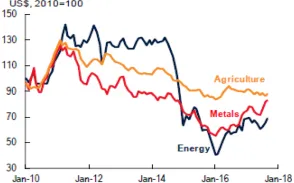
Figure 1.1. Price index of commodities in agriculture, metal and fuels [WOR 17]. For a color version of this figure, see www.iste.co.uk/priolon/markets.zip
The concept of volatility encompasses two aspects:
- – the prices of commodities sometimes see large variations over the medium and long term, as can be observed from the graph shown in Figure 1.2, which represents changes in the price of corn between 2012 and 2017;
- – the prices of commodities also see multiple fluctuations in the short term, as can be seen in the evolution of the price of corn over 24 h, knowing that evolutions similar to those represented here are perfectly normal.
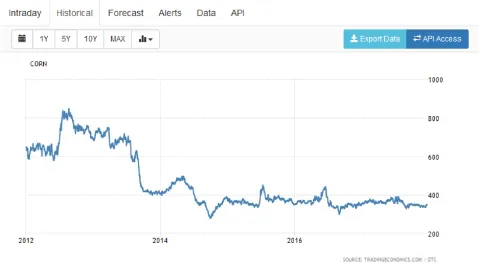
Figure 1.2. Corn prices in USD/BU: 2012–20174
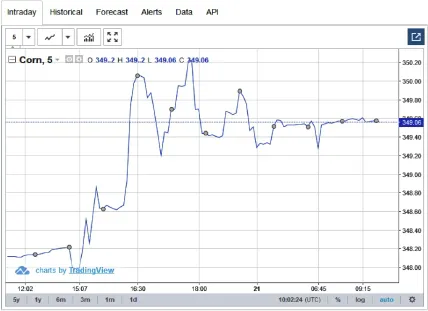
Figure 1.3. Corn prices in USD/BU: December 20–21, 20175
In a general sense, the concept of volatility designates these fluctuations in price. In a narrower sense, volatility is a measure of these fluctuations. This measure almost exclusively takes the form of a variance, calculated either through the price itself, or the variations in price. We will point out right away that the formula for calculating volatility, as well as the parameters for this formula (periodicity of measurements, duration of observations, etc.) cannot be canonically defined. We will return to this point in Chapter 5. Knowing that volatility is often compared to an assessment of the risks taken by operators, we see that this lack of clarity on the optimal measurement results in problems in evaluating the risks operators take on the markets.
More importantly, perhaps, using variance is a questionable strategy. This is because this measure of distribution of a series “flattens out” extreme phenomena, which represent large risks. More generally, the Gaussian models, widely used in economics and financial mathematics, risk underestimating the magnitude of extreme phenomena. Among the many authors who support this idea is, notably, the mathematician Benot Mandelbrot [MAN 97], as well as his direct or indirect successors, sometimes grouped together under the term “econophysicists” [JOV 16].
Price volatility is a problem for the majority of actors operating on physical markets: producers, traders, stocking organizations and transformers. Finally, the consumers of those transformed products that incorporate the commodities whose prices are volatile are impacted by these fluctuations. In order to combat the problems brought in by price volatility, public authorities can schematically offer two strategies:
- – putting in place measures that aim to stabilize prices;
- – making available to operators the tools that are needed for private risk management as concerns prices.
We will review these public policies in detail in Chapter 8. We continue here with the study of causes for, and the consequences of, price volatility. The co...
Table of contents
- Cover
- Table of Contents
- Preface
- Introduction
- 1 General Observations on the Physical Trading of Commodities
- 2 The Financial Commodity Markets
- 3 Futures Contracts and Forward Contracts
- 4 The Storage and Term Structure of Commodity Futures Prices
- 5 Options Markets
- 6 A Selective Review of Classic Literature in Economics
- 7 A Very Selective Review of Modern Literature in Economics
- 8 Questions Surrounding Regulation
- Appendix: The Cox, Ross and Rubinstein model
- References
- List of Authors
- Index
- End User License Agreement
Trusted by 375,005 students
Access to over 1.5 million titles for a fair monthly price.
Study more efficiently using our study tools.
Frequently asked questions
Yes, you can cancel anytime from the Subscription tab in your account settings on the Perlego website. Your subscription will stay active until the end of your current billing period. Learn how to cancel your subscription
No, books cannot be downloaded as external files, such as PDFs, for use outside of Perlego. However, you can download books within the Perlego app for offline reading on mobile or tablet. Learn how to download books offline
Perlego offers two plans: Essential and Complete
- Essential is ideal for learners and professionals who enjoy exploring a wide range of subjects. Access the Essential Library with 800,000+ trusted titles and best-sellers across business, personal growth, and the humanities. Includes unlimited reading time and Standard Read Aloud voice.
- Complete: Perfect for advanced learners and researchers needing full, unrestricted access. Unlock 1.5M+ books across hundreds of subjects, including academic and specialized titles. The Complete Plan also includes advanced features like Premium Read Aloud and Research Assistant.
We are an online textbook subscription service, where you can get access to an entire online library for less than the price of a single book per month. With over 1.5 million books across 990+ topics, we’ve got you covered! Learn about our mission
Look out for the read-aloud symbol on your next book to see if you can listen to it. The read-aloud tool reads text aloud for you, highlighting the text as it is being read. You can pause it, speed it up and slow it down. Learn more about Read Aloud
Yes! You can use the Perlego app on both iOS and Android devices to read anytime, anywhere — even offline. Perfect for commutes or when you’re on the go.
Please note we cannot support devices running on iOS 13 and Android 7 or earlier. Learn more about using the app
Please note we cannot support devices running on iOS 13 and Android 7 or earlier. Learn more about using the app
Yes, you can access Financial Markets for Commodities by Joel Priolon in PDF and/or ePUB format, as well as other popular books in Business & Corporate Finance. We have over 1.5 million books available in our catalogue for you to explore.