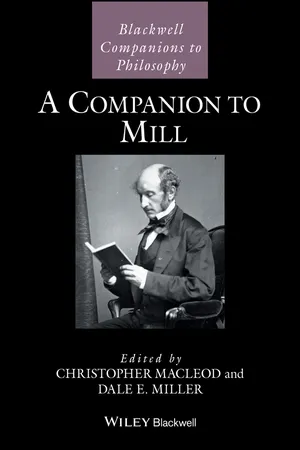
Benjamin Franklin exhorted his fellows to “either write something worth reading or do something worth writing.” John Stuart Mill (like Franklin himself) is among that rare breed who managed to do both. It hardly needs stating – especially in a volume such as the one in your hands – that Mill’s writing and thought is influential. Across the field of political philosophy, ethics, gender studies, and economics, his writings still carry a good deal of weight. If the true measure of greatness is posthumous productivity, as Goethe suggested, Mill’s status is assured.
But Mill’s life holds plenty of interest, too, not least for the additional light it shines on the development of his thought. In this brief biographical sketch, I hope to show this relationship between life and work in two areas in particular. First, the way in which Mill’s extraordinary upbringing and education fuelled his journey away from utilitarianism towards liberalism; and second, how his relationship with Harriet Taylor influenced his thinking on gender equality, most obviously, but also on the potentially damaging influence of social custom.
Mill was a quintessential public intellectual before the term was created; an advocate for a humanist, self‐reflective life – the “Saint of Rationalism,” as William Gladstone dubbed him – but also a man of political action. John Morley, a Liberal politician and writer and a disciple of Mill’s, described him as “a man of extreme sensibility and vital heat in things worth waxing hot about” (Morley 1921: i.55).
There were many such things, too: parliamentary reform, the US Civil War and slavery, the Irish potato famine, religious freedom, inherited power and wealth, and women’s rights, to name only the most obvious. These were issues to which Mill was intellectually and politically committed. But they became personal, too. It is useful to consider Mill’s personal journey, not simply because it is interesting in itself, but because his ideas bear a strong imprint of the personal and political circumstances of his life. Mill was an intensely autobiographical thinker: for him, the political and personal were intertwined.
Mill’s life was out of the ordinary from the beginning. After his birth on May 20, 1806, his father, James Mill, wrote to another new father and proposed “to run a fair race … in the education of a son. Let us have a well‐disputed trial which of us twenty years hence can exhibit the most accomplished and virtuous young man” (Mill 1976: 11).
Mill was home‐schooled by his father, a historian and disciple of Jeremy Bentham. The education was, as Isaiah Berlin observed, “an appalling success” (Berlin 2002: 220). By six, Mill had written a history of Rome; by seven he was reading Plato in Greek, at eight soaking up Sophocles, Thucydides and Demosthenes; at nine enjoying the Pope’s translation of The Iliad, reading it “twenty to thirty times.” By the age of 11 he was devouring Aristotle’s works on logic, before being moved on at 12 to political economy. Not that the young Mill has to be coerced: as he recalled later, “I never remember being so wrapt up in any book, as I was in Joyce’s Scientific Dialogues.” In 1819 he undertook “a complete course of political economy” (Autobiography, I: 13, 21, 31). (It may have helped that David Ricardo had become a friend of the family, and was fond of Mill junior).
But Mill was lonely, and reserved. “As I had no boy companions, my amusements, which were mostly solitary, were in general of a quiet, if not a bookish turn,” he observed. He could talk to his father about cerebral matters, but never emotional ones. Mill’s mother does not feature in the final, published version of his Autobiography at all: but in earlier, discarded drafts, he ponders how different life might have been if he had been blessed with “that rarity in England, a really warm‐hearted mother” (Rejected Leaves, I: 610, 612).
After a year in France as an adolescent – turning Mill into a lifelong Francophile – he was baptized into the utilitarian faith, after being presented with Jeremy Bentham’s work on the moral foundation of the law. The opening sentences of the work are surely among the clearest in moral philosophy:
Bentham was in fact a very close family friend to the Mills, providing them with financial support in the form of what amounted to a rent subsidy, intellectual engagement and even access to a country home, where the Mill–Bentham routine of reading, writing, editing, and educating was interrupted by bracing walks, even the occasional dance.
When Mill read Bentham, in Dumont’s French translation, as he recounted,
But during a self‐described “mental crisis” in 1826 and 1827, Mill began his long and difficult journey away from a narrow, Benthamite utilitarianism vision towards a profound belief in the inalienable value of individuality and the humanist liberalism that would illuminate his most famous work, On Liberty. Mill was helped out of his depression by poetry – famously dismissed by Bentham as no better than push‐pin – including the verse of Wordsworth and Coleridge, very far from being required reading for the philosophical radicals clustered under the Benthamite banner. (When Mill visited Wordsworth in the Lake District in 1831, his more orthodox radical friend and travelling companion, Henry Cole, pointedly stayed away.) Mill’s much‐tested friendship with Carlyle survived the accidental burning by Mill’s maid of the only copy of the first volume of Carlyle’s monumental history of the French revolution.
Mill’s “crisis,” and his increasingly negative reflections on his own upbringing, had a clear impact on the development of his philosophy. I do not intend, here, to adjudicate the various attempts to reconcile Mill’s utilitarianism and liberalism; that is better left to others in this volume. I will restrict myself to suggesting that Mill was a weak utilitarian, because he was a good liberal.
Biography matters in understanding the development of Mill’s thought here. He became highly sensitive to criticism, from those such as Thomas Carlyle, that he was a “manufactured man.” And not least because he agreed with it:
Mill felt trapped by one element of his youthful creed, the “associationist” psychology of Hartley, which implied that everyone is shaped by their circumstances into the person they are destined to remain. We are what we are raised to be:
Mill’s departure from this brand of psychological determinism was painful, both personally and intellectually. But following his crisis, and during subsequent bouts of depression, it became vitally important to Mill to feel that he was the master of his destiny, living under his own intellectual propulsion. Mill’s rejection of the Benthamite version of utilitarianism – at first sotto voce, but increasingly loudly – and his embrace and advocacy of a Humboldtian, developmental liberalism are reflections of his own private journey.
In On Liberty, Mill criticized those who conform to any of “the small number of moulds which society provides in order to save its members the trouble of forming their own character” (Liberty, XVIII: 267–8). It is hard to read this description without thinking of how Mill himself saw himself as breaking free from a mould provided not by “society,” but by his father. We are only truly free when our “desires and impulses” are our own, in Mill’s view: when we have our own character, rather than the character prescribed for us by others (Liberty, XVIII: 264).
Although one of Mill’s best‐known works is his Utilitarianism, he was ambivalent, even dismissive, about the work himself. In a letter to Alexander Bain, on October 15, 1859, he described the work as “a little treatise” (Letter to Alexander Bain, Oct 15, 1859, XV: 640). A few weeks later, also to Bain, he wrote: “I do not think of publishing my Utilitarianism till next winter at the earliest, though it is now finished … It will be but a small book…” (Lett...