Growth is a dominant economic driver accounting for the wealth of nations and organizations alike. However, in the face of environmental pressures, widespread social and economic imbalance, and the reigning climate of uncertainty we are experiencing today, there is now a need for a viable interpretation of what growth really means. In this book, the author redefines the limits to economic growth and tackles the issues involved in three parts, in order to study a variety of international issues, including the world economic system, climate change and environmental degradation.
- English
- ePUB (mobile friendly)
- Available on iOS & Android
eBook - ePub
About this book
Information
PART 1
A Present-Day Imperative
1
A Present-Day Imperative To Think or Not To Think…
“Society is facing a new and unprecedented challenge–responding to its own overwhelming complexity. The structure of our society must change.”Yaneer BAR-YAM, NECSI
“Grow, baby, grow.” Here is a spiraling mantra that resonates in economic and political spheres about infinite growth, jobs sourcing and improving the already set economic indexes.
All right, so it be. But is there somebody listening out there?
The world – the material world – is finite. How then, could mankind sustain such an infinite spiral? At stakes is the way we think it. To think mankind, its role and its ambient effects.
1.1. Where are we by now?
Over the past few centuries, as civilization progressed, it transformed its rooting mechanisms, its governing methods and its intangible orientation. Figure 1.1 sums up the transitions from the 19th Century onwards and the late one from the 20th Century onwards.
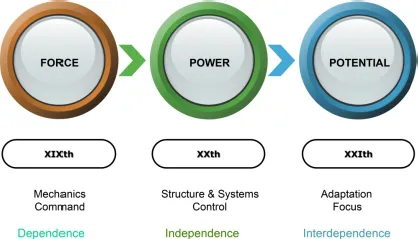
Figure 1.1. As civilization progressed, it transformed itself profoundly
The original 1972 Club of Rome report famously illustrated the consequences of the latest evolutionary cycles through a series of curves which, whatever the scenario, ended up being cursed, however with notable variations in lapse time. The plots are recapitulated in Figure 1.2.
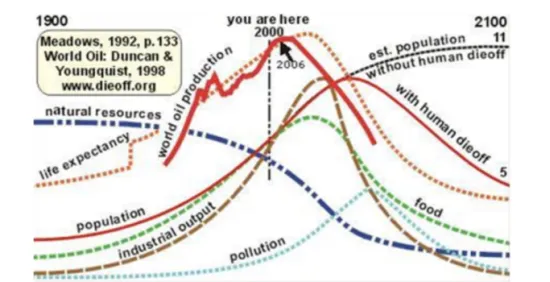
Figure 1.2. The simulations’ outcomes published by the Club of Rome 1972 report were plotted against all odds
A good half of a century later, and to begin with – let’s pause a bit and make a point – where has humanity arrived? Will humanity proceed easily and safely towards such a goal through the present and coming changes? Knowing that these very changes promise to become really exponential within decades.
Our civilization labors strenuously in finding a sustainable sequel to the Industrial Revolution. Albert Einstein famously said, “We cannot solve our problems with the same thinking we used when we created them”, who comes as a poor help anyway.
Even time escapes us: we don’t have the time anymore to run from one part of the planet to another just to meet a few specific individuals. We require technology to supply the faculty to liaise with the many, from the many, and fast. Technology that substitutes us but that also offers the means to work collective consciousness in an instant.
There is a sentient need to rebalance… everything. Us included, probably. But the act and art of rebalancing has not enshrined our constitutions, at any level, it seems. Instead, the way our society functions is to mass employ resources – populations, minerals, whatever. Social capital is at odds.
Should we dare refresh our memory with the very words of the then contemporary UN Secretary General U. Thant, which served as the front introductory citation to the historical 1972 Report for the Club of Rome:
“I do not wish to seem overdramatic, but I can only conclude from the information that is available to me as Secretary-General, that the Members of the United Nations have perhaps ten years left In which to subordinate their ancient quarrels and launch a global partnership to curb the arms race, to improve the human environment, to defuse the population explosion, and to supply the required momentum to development efforts. If such a global partnership is not forged within the next decade, then I very much fear that the problems I have mentioned will have reached such staggering proportions that they will be beyond our capacity to control”.
These words were written in 1969. How can we push the production frontier in new ways that rebalance the whole lot? It is probably a preparation that day after day works on our consciousness, on the energy quality of our consciousness. But we need to go deep inside to find it. To balance outside, we are to balance ourselves inside. And this in a sense requires reprogramming the way we use our brain. After all, how can we churn out new things with an older software?
To begin, let’s make a few critical observations that seem to characterize our 2010’s times.
The economic cursor has shifted in recent years. For one, the wealth is ever more concentrated, and the lubricant for distributing it widely is a rarer resource. This is quite clearly a source of unbalance, if only of the economic system.
Education has shifted to mere instruction, that is content. Or information, if we prefer. And at younger ever ages. But offering data deluge isn’t a recipe to free the inner/innate potentialities of our children, or is it? How do you address creativity and imagination? How do you train the exploration of fresh, original, varied paths – those that will lead to future innovations? The more developed countries aren’t much better in that respect compared to the less developed ones.
Many people suffer depressive states of being under the social pressures they experience. Gaps creep between the social environment and themselves. Perhaps they are demotivated by their jobs, have a poor self-esteem, can’t dream a better living. A rampant generational divide may not help: while younger generations are striving and jumping into the future, older ones find it hard to regenerate themselves in a mobile, hyper connected and accelerated society. Inclusiveness becomes harder to achieve as a social objective. Do our children being in their twenties or less have factual past reference based on pre-Internet age models?
And what about ethics, the cornerstone of our civilizational roots? When lacking, we simply collectively loose the societal spinal cord that underpins our societal structures. Social motivation suffers and cohesion disappears.
Yet, at the individual level, the basic balancing act between what I give and what I receive sources the value tone found in any social transaction. To sustain a postural contribution, I would at some point need to see the enlarged value picture that goes forward beyond myself. This in the end builds the global balance. A global poise and steadiness built from our differences! What a paradoxical construction: each of our uniqueness, when assembled together, brings a unity, a sense of belonging, even a feeling of wholeness.
And this also constitutes the “Third Industrial Revolution” (TIR) narrative developed by Jeremy Rifkin which basically says how the lateral power will transform economy, energy, and the world [RIF 11]. A narrative that is based on the convergence of information and communication technologies (ICT), energy and transportation. It is first the Internet of Information that underpins the TIR. Then, an Internet of Energy is now developing through a decentralization of the production. As for the automatization of transportation, this is a current trend via more autonomous vehicles guided by positioning systems.
The Internet alone was and still is a computing-centric network; it thus cannot provide the global solution it is commonly expected to deliver by each of us when using it. Any progress will result from ubiquitous and pervasive access and secured network transactions and not from the possession of connecting devices, as this was brilliantly demonstrated by the visionary Jeremy Rifkin two decades ago [RIF 00].
As we endorse a TIR vision, we can only begin to understand the power of a hyper-connected world sourcing enormous growths via a sharing economy and the collaborative commons. The basic tenet for the new growth power is that every asset – a product, service, data, information, knowledge, know-how, etc. – was previously a “fixed given” and now can become an enabler of new values. “Lateral power” says Rifkin. The previous motto “Anywhere, anytime, from any device” of the birth of Internet is being radically transformed into:
Anything contributing to anything from anywhere
For instance, any use or building houses a micro energy plant that powers the sharing activities of a local community team which contributes to circular economies involving third communities, which in turn involve etc. The enormous difference in terms of growth potential between the two expressions lies in unleashing the exponential power of the contributive links within networks. Networks fundamentally develop exponential laws1. Our world has followed the dominant rule of an extensive growth path: more resources, more work force, more inequalities, more debts, more pollution – more is good, more is better, only is more. But we know we have collectively reached limits. Not only to growth, but to everything that has a material correspondence. And that we cannot function as cycles only, such as growth–wars–regrowth or bear market–bull market, because a host of contingent epiphenomena become more impacting than the nominal activity (e.g. population increase, raw resources attrition, traffic congestions, etc.). What then is worth the accumulation of money or any wealth for instance, if taken in isolation? Beware reader, humanity is secretly churning out new fundamental and more inclusive values, which may have such names as creativity, sharing, belonging, cooperation… well, quality it is.
A big transformation is at play that radically transcends the linear model views of the past epochs. It engages into spiraling dynamics based on a huge convergence of means, for which Rifkin uses the term “distributed capitalism”. This represents the c...
Table of contents
- Cover
- Table of Contents
- Title
- Copyright
- Foreword: Why We Should Grow Beyond Economic Growth
- Acknowledgments
- List of Abbreviations
- PART 1: A Present-Day Imperative
- PART 2: A Methodology for Tackling Growth Problematics
- PART 3: Going Beyond the Notion of GDP
- PART 4: Appendices
- Bibliography
- Index
- End User License Agreement
Trusted by 375,005 students
Access to over 1.5 million titles for a fair monthly price.
Study more efficiently using our study tools.
Frequently asked questions
Yes, you can cancel anytime from the Subscription tab in your account settings on the Perlego website. Your subscription will stay active until the end of your current billing period. Learn how to cancel your subscription
No, books cannot be downloaded as external files, such as PDFs, for use outside of Perlego. However, you can download books within the Perlego app for offline reading on mobile or tablet. Learn how to download books offline
Perlego offers two plans: Essential and Complete
- Essential is ideal for learners and professionals who enjoy exploring a wide range of subjects. Access the Essential Library with 800,000+ trusted titles and best-sellers across business, personal growth, and the humanities. Includes unlimited reading time and Standard Read Aloud voice.
- Complete: Perfect for advanced learners and researchers needing full, unrestricted access. Unlock 1.5M+ books across hundreds of subjects, including academic and specialized titles. The Complete Plan also includes advanced features like Premium Read Aloud and Research Assistant.
We are an online textbook subscription service, where you can get access to an entire online library for less than the price of a single book per month. With over 1.5 million books across 990+ topics, we’ve got you covered! Learn about our mission
Look out for the read-aloud symbol on your next book to see if you can listen to it. The read-aloud tool reads text aloud for you, highlighting the text as it is being read. You can pause it, speed it up and slow it down. Learn more about Read Aloud
Yes! You can use the Perlego app on both iOS and Android devices to read anytime, anywhere — even offline. Perfect for commutes or when you’re on the go.
Please note we cannot support devices running on iOS 13 and Android 7 or earlier. Learn more about using the app
Please note we cannot support devices running on iOS 13 and Android 7 or earlier. Learn more about using the app
Yes, you can access Going Past Limits To Growth by Patrick Corsi in PDF and/or ePUB format, as well as other popular books in Business & Entrepreneurship. We have over 1.5 million books available in our catalogue for you to explore.