- Provides fast access to essential information on prescribing antibiotics, antifungals, antiparasitics, and antivirals
- Offers alphabetical searching by either drug or organism
- Focuses on clinically relevant information
- Covers information on each drug using a common format for ease of use
- Presents a reliable quick reference to the correct use of antibiotics in veterinary practice
- English
- ePUB (mobile friendly)
- Available on iOS & Android
eBook - ePub
Drug Therapy for Infectious Diseases of the Dog and Cat
About this book
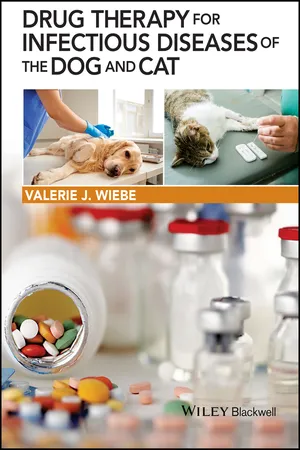
Drug Therapy for Infectious Diseases of the Dog and Cat provides fast access to all the information needed to effectively and responsibly treat infectious disease in dogs and cats, with easy searching by either drug or organism.
Information
SECTION D
Antibiotics
Chapter 126: Amikacin
US Generic (Brand) Name: Amikacin (Amikin, Amiglyde-V, Amiject D, Amikacin C, Caniglide)
Availability: Human approved – Amikacin sulfate sterile injectable (50 mg/mL, 250 mg/mL × 2 mL, vials or 2 mL syringes). Veterinary approved – Amikacin sulfate sterile injectable (50 mg/mL × 50 mL bottles)
Resistance mechanisms: Aminoglycoside modifying enzymes, ribosome alteration, decreased permeability
Use
Serious gram negative infections due to Pseudomonas, Proteus, Serratia, or gram positive bacilli involving the respiratory tract, urinary tract, septicemia, endocarditis, or bone infections that are resistant to gentamycin and tobramycin. May be useful in severe bacterial endophthalmitis. Poor efficacy against intracellular bacilli✔ anaerobes, and mycoplasma. Only effective against some strains of Mycobacteria (M. avium), Actinomyces, Nocardia spp., Corynebacterium, and Bacillus spp.
Contraindications/warnings
Use with caution in animals with renal impairment, monitor the animal closely for signs of tubular necrosis (casts appear early in urine). Avoid use in animals with pre-existing vestibular impairment, electrolyte imbalances, and/or myasthenia gravis. Discontinue drug if signs of hypersensitivity, ototoxicity, or nephrotoxicity. Avoid use with other renal toxic drugs or prolonged therapy.
Dosage
Dosing should be individualized due to the low therapeutic index. Base the dose on ideal body weight in obese animals. Animals with endotoxemia may have increased risk of renal toxicity.
Canine
15–30 mg/kg IV, IM, SC q24 h. Dose reduce in greyhounds and sight hounds to 10–12 mg/kg IV, IM, SC q24 h. Use higher doses for sepsis (Papich 2002, Kukanich and Coetzee 2008).
Feline
10–14 mg/kg IV, IM, SC q24 h. SC dosing is preferred because of rapid absorption, good bioavailability and ease of administration (Jernigan et al., 1988, Papich 2002).
Dose adjustments
Dose adjust in renal failure. Give a loading dose, then give 50% of the dose with moderate renal failure and 25% of the dose in severe renal failure. Monitor serum levels and adjust doses accordingly. No dose adjustment for hepatic insufficiency.
Administration
Hydrate animals prior to administration. SC or IV fluids are recommended to prevent renal toxicity. For IM or SC dosing, the dose should be drawn up from the 50 or 250 mg/mL vial and injected directly, either SC or in a large muscle. For IV administration the dose should be drawn up and diluted with 100–200 mL of a compatible solution (0.9% saline, 5% dextrose in water, lactated ringers, normasol, plasma-lyte 56 or 148, etc.). The infusion rate should be sufficient to provide the dose over 1–2 h in small animals or 0.5–1 h in larger animals.
Electrolyte contents
Sodium concentration in one gram is 29.9 mg (1.3 mEq).
Storage/stability
May change to a light straw color, but not indicative of a loss in potency. Final concentrations between 0.25–5 mg/mL in most IV fluids are stable for 24 h at room temperature or 2 days under refrigeration when mixed with 5% dextrose in water, 0.9% saline, or lactated ringers. Dilute solutions (0.25 and 5 mg/mL) can be frozen at −15°C for 30 days if used within 24 h when brought to room temperature.
Adverse reactions
>10%
Renal toxicity is common at high doses (30 mg/kg/day) (gentamicin > amikacin > tobramycin). Nephrotoxicity is polyuric with increased fractional electrolyte excretion, glycosuria, and tubular casts, may progress to oliguria. Acute tubular necrosis manifested by increases in serum creatinine and BUN have been reported in dogs and cats. Renal damage is typically reversible if good urine output is maintained. Diarrhea, vomiting and injection site reactions (SC, IM doses) are reported commonly in dogs and cats.
1–10%
Ototoxicity may be irreversible. Neurotoxicity to the eighth cranial nerve (cochlear toxicity > vestibular toxicity with amikacin in dogs), vestibular injury and bilateral irreversible damage is related to the amount of drug given ...
Table of contents
- Cover
- Title page
- Table of Contents
- Preface
- Acknowledgments
- SECTION A: Pharmacology Guidelines
- SECTION B: Empiric Therapy Pending Diagnostic Results
- SECTION C: Therapy of Established Infections
- SECTION D: Antibiotics
- SECTION E: Antifungal Agents
- SECTION F: Antiparasitic Agents
- SECTION G: Antiviral Agents
- Index
- End User License Agreement
Trusted by 375,005 students
Access to over 1.5 million titles for a fair monthly price.
Study more efficiently using our study tools.
Frequently asked questions
Yes, you can cancel anytime from the Subscription tab in your account settings on the Perlego website. Your subscription will stay active until the end of your current billing period. Learn how to cancel your subscription
No, books cannot be downloaded as external files, such as PDFs, for use outside of Perlego. However, you can download books within the Perlego app for offline reading on mobile or tablet. Learn how to download books offline
Perlego offers two plans: Essential and Complete
- Essential is ideal for learners and professionals who enjoy exploring a wide range of subjects. Access the Essential Library with 800,000+ trusted titles and best-sellers across business, personal growth, and the humanities. Includes unlimited reading time and Standard Read Aloud voice.
- Complete: Perfect for advanced learners and researchers needing full, unrestricted access. Unlock 1.5M+ books across hundreds of subjects, including academic and specialized titles. The Complete Plan also includes advanced features like Premium Read Aloud and Research Assistant.
We are an online textbook subscription service, where you can get access to an entire online library for less than the price of a single book per month. With over 1.5 million books across 990+ topics, we’ve got you covered! Learn about our mission
Look out for the read-aloud symbol on your next book to see if you can listen to it. The read-aloud tool reads text aloud for you, highlighting the text as it is being read. You can pause it, speed it up and slow it down. Learn more about Read Aloud
Yes! You can use the Perlego app on both iOS and Android devices to read anytime, anywhere — even offline. Perfect for commutes or when you’re on the go.
Please note we cannot support devices running on iOS 13 and Android 7 or earlier. Learn more about using the app
Please note we cannot support devices running on iOS 13 and Android 7 or earlier. Learn more about using the app
Yes, you can access Drug Therapy for Infectious Diseases of the Dog and Cat by Valerie J. Wiebe in PDF and/or ePUB format, as well as other popular books in Medicine & Veterinary Medicine. We have over 1.5 million books available in our catalogue for you to explore.