Color is a sensation generated both by the interaction of the visual sensors in the eyes with the natural environment and by the elaboration of visual information by higher brain functions. This book presents the mathematical framework needed to deal with several models of color processing of digital images. The book starts with a short yet exhaustive introduction to the basic phenomenological features of color vision, which are constantly used throughout the book. The discussion of computational issues starts with color constancy, which is dealt with in a rigorous and self-contained mathematical setting. Then, the original Retinex model and its numerous variants are introduced and analyzed with direct discrete equations. The remainder of the book is dedicated to the variational analysis of Retinex-like models, contextualizing their action with respect to contrast enhancement.
In this chapter, the basic facts about the processing of a visual signal by the retina and brain will be recalled. The purpose of this chapter is not only to provide an exhaustive treatise about the Human Visual System (HVS), but also to introduce some important concepts and formulae that will have a fundamental role in the development of the models described in Chapter 5. For complete details on these topics, see, for example, [FAI 05].
1.1. The retina
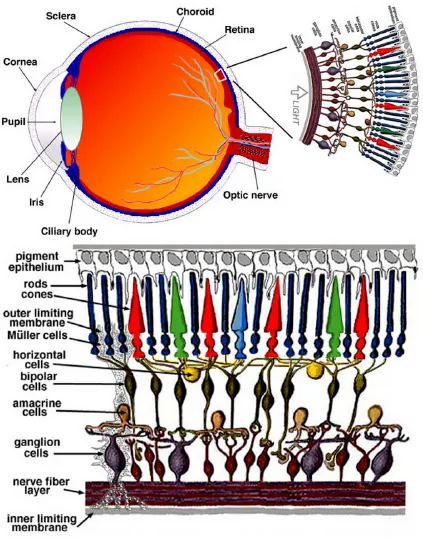
In Figure 1.1, a human eye and the cross-section of a retina are represented.
Several layers of neural cells constitute the retina, beginning with around 130 million photoreceptors (rods and cones) and ending with about 1 million ganglion cells. The specific processing that occurs in each type of cell is complex and not yet completely understood.
What we know for certain is that retinal cells may respond nonlinearly to stimuli and are connected via links called synapses, which are able to perform basic mathematical operations such as addition, subtraction, multiplication, division, amplification and gain control. Considered as a whole, these operations result in a clever and sophisticated modification of the visual input.
Among all retinal cells, the most important for our purposes are the photoreceptors (rods and cones), to which the next section is devoted.
Figure 1.1.Top: a human eye. Bottom: the cross-section of a human retina. Courtesy of [KOL 95]. For a color version of the figure, see www.iste.co.uk/provenzi/color.zip
1.1.1. Photoreceptors: rods and cones
Rods and cones are labelled in this way because of their shape. Rods work in the so-called scotopic region, below 10−3 cd/m2, while cones respond to luminance levels higher than 10 cd/m2, a range called the photopic region. In the intermediate range, called the mesopic region, both rods and cones are activated, but their response is less efficient than when they work in isolation from each other. Henceforward, we will only consider photopic conditions and thus the properties of cones.
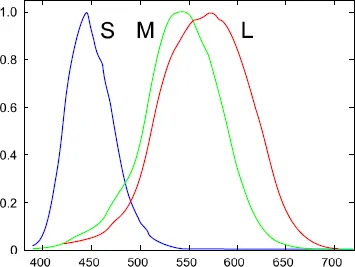
Color vision in the photopic region is possible, thanks to the existence of three types of cone receptors with peak spectral sensibilities distributed along the visual spectrum (see Figure 1.2). This is due to the existence of three slightly different molecular structures in each cone type, which are referred to as L, M and S cones. They refer to the long, middle and short wavelengths where cones have their maximal sensitivity at 560 nm, 530 nm and 420 nm, respectively.
The LMS cones can also be referred to as the RGB cones. Of course, RGB is the notation for monochromatic red, green and blue, but, as shown in Figure 1.2, this is an abuse of language, in particular because the L cones are gathered in the region of monochromatic green-yellow, not red.
Figure 1.2.The normalized spectral sensitivity functions of the LMS cones. Courtesy of [KOL 95]. For a color version of the figure, see www.iste.co.uk/provenzi/color.zip
Note that the spectral sensibilities of the three cone types are broadly overlapping, in particular those of the L and M cones. This constitutes a substantial difference with respect to most physical imaging systems, in particular digital cameras (see, e.g., [JIA 13]), where sensor responses are only slightly overlapping.
Finally, it must be noted that the distribution of cones in the retina is not uniform: S cones are relatively sparse and completely absent in the fovea, the central part of the retina with the highest density of L and M cones.
1.2. Adaptation and photo-electrical...
Table of contents
Cover
Table of Contents
Title
Copyright
Preface
1 Rudiments of Human Visual System (HVS) Features
2 Computational Color Constancy Algorithms
3 Retinex-like Algorithms for Color Image Processing
4 Variational Formulation of Histogram Equalization
5 Perceptually-inspired Variational Models for Color Enhancement in the RGB Space
Appendix: Rudimentals of Variational Principles
Bibliography
Index
End User License Agreement
Trusted by 375,005 students
Access to over 1.5 million titles for a fair monthly price.
Study more efficiently using our study tools.
Frequently asked questions
Yes, you can cancel anytime from the Subscription tab in your account settings on the Perlego website. Your subscription will stay active until the end of your current billing period. Learn how to cancel your subscription
No, books cannot be downloaded as external files, such as PDFs, for use outside of Perlego. However, you can download books within the Perlego app for offline reading on mobile or tablet. Learn how to download books offline
Perlego offers two plans: Essential and Complete
Essential is ideal for learners and professionals who enjoy exploring a wide range of subjects. Access the Essential Library with 800,000+ trusted titles and best-sellers across business, personal growth, and the humanities. Includes unlimited reading time and Standard Read Aloud voice.
Complete: Perfect for advanced learners and researchers needing full, unrestricted access. Unlock 1.5M+ books across hundreds of subjects, including academic and specialized titles. The Complete Plan also includes advanced features like Premium Read Aloud and Research Assistant.
Both plans are available with monthly, semester, or annual billing cycles.
We are an online textbook subscription service, where you can get access to an entire online library for less than the price of a single book per month. With over 1.5 million books across 990+ topics, we’ve got you covered! Learn about our mission
Look out for the read-aloud symbol on your next book to see if you can listen to it. The read-aloud tool reads text aloud for you, highlighting the text as it is being read. You can pause it, speed it up and slow it down. Learn more about Read Aloud
Yes! You can use the Perlego app on both iOS and Android devices to read anytime, anywhere — even offline. Perfect for commutes or when you’re on the go. Please note we cannot support devices running on iOS 13 and Android 7 or earlier. Learn more about using the app
Yes, you can access Computational Color Science by Edoardo Provenzi in PDF and/or ePUB format, as well as other popular books in Technology & Engineering & Signals & Signal Processing. We have over 1.5 million books available in our catalogue for you to explore.