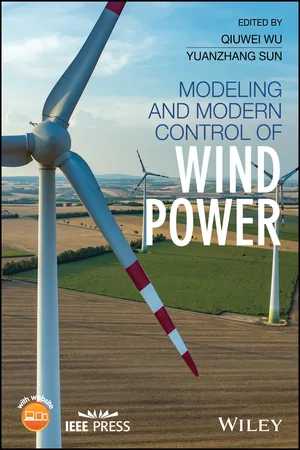
An essential reference to the modeling techniques of wind turbine systems for the application of advanced control methods
This book covers the modeling of wind power and application of modern control methods to the wind power control—specifically the models of type 3 and type 4 wind turbines. The modeling aspects will help readers to streamline the wind turbine and wind power plant modeling, and reduce the burden of power system simulations to investigate the impact of wind power on power systems. The use of modern control methods will help technology development, especially from the perspective of manufactures.
Chapter coverage includes: status of wind power development, grid code requirements for wind power integration; modeling and control of doubly fed induction generator (DFIG) wind turbine generator (WTG); optimal control strategy for load reduction of full scale converter (FSC) WTG; clustering based WTG model linearization; adaptive control of wind turbines for maximum power point tracking (MPPT); distributed model predictive active power control of wind power plants and energy storage systems; model predictive voltage control of wind power plants; control of wind power plant clusters; and fault ride-through capability enhancement of VSC HVDC connected offshore wind power plants. Modeling and Modern Control of Wind Power also features tables, illustrations, case studies, and an appendix showing a selection of typical test systems and the code of adaptive and distributed model predictive control.
Analyzes the developments in control methods for wind turbines (focusing on type 3 and type 4 wind turbines)
Provides an overview of the latest changes in grid code requirements for wind power integration
Reviews the operation characteristics of the FSC and DFIG WTG
Presents production efficiency improvement of WTG under uncertainties and disturbances with adaptive control
Deals with model predictive active and reactive power control of wind power plants
Describes enhanced control of VSC HVDC connected offshore wind power plants
Modeling and Modern Control of Wind Power is ideal for PhD students and researchers studying the field, but is also highly beneficial to engineers and transmission system operators (TSOs), wind turbine manufacturers, and consulting companies.
Although wind power has been utilized by humans for more than 3000 years, the history of wind power for electricity production is only 120 years long.
In July 1887, Professor James Blyth (1839–1906) of Anderson's College, Glasgow built the first windmill for the production of electricity at Marykirk in Kincardineshire, Scotland [1]. The windmill was 10 m high, and was used to charge accumulators to power the lighting in the cottage. Around the same period, a wind turbine was designed and constructed in the winter of 1887-1888 by Charles F. Brush (1849–1929) in Cleveland, USA [2]. The rotor of Brush's wind turbine was 17 m in diameter and had 144 blades. The rated power was 12 kW. It was used either to charge a bank of batteries or to operate up to 100 incandescent light bulbs and various motors in Brush's laboratory.
A pioneer of modern aerodynamics, Poul la Cour (1846–1908) of Askov, Denmark, built the world's first wind tunnels for the purpose of aerodynamic tests to identify the best shape of the blades for turbines. Based on his experiments, he realized that wind turbines with fewer rotor blades were more efficient for electricity production. He designed the first four-blade wind turbine in 1891 [3].
The developments in the 20th century can be divided into two periods. From 1900–1973, the prices of wind-powered electricity were not competitive. The gradual extension of electrical networks and the availability of low-cost fossil fuels lead to the abandonment of wind turbines. Wind turbine generators (WTGs) were mainly used in rural and remote areas. Although several wind turbines in the hundred-kilowatt class were manufactured and installed for testing, due to high capital costs and reliability problems, they were not widely adopted.
The two oil crises in 1973 and 1979, with supply problems and price fluctuations for fossil fuels, spurred the adoption of non-petroleum energy sources. As an alternative to fossil fuels, wind power was once again put on the agenda. European countries and US government started to invest in research into large commercial wind turbines. The world's first multi-megawatt wind turbine was constructed in 1978, and pioneered many technologies now used in modern wind turbines. From 1975 through to the mid-1980s, NASA developed 3.2 MW and 4 MW wind turbines. Although they were sold commercially, none of these were ever put into mass production. When oil prices declined, electricity generated by wind power became uneconomical and many manufacturers left the business.
At the beginning of the 21st century, although fossil fuels were still relatively cheap, concerns over energy security, global warming, and eventual fossil fuel depletion increased, and this led to an expansion of interest in renewable energy. The wind power industry has since achieved rapid development.
From the point of view of global capacity, according to statistics from the Global Wind Energy Council (GWEC), the global annual and cumulative installed wind capacities for the past ten years are as illustrated in Figures 1.1 and 1.2, respectively. In 2015, the global wind power industry installed 63.5 GW of capacity, representing annual market growth of 22%. By the end of 2015, the total installed capacity reached 432.4 GW, representing cumulative market growth of 17%. As estimated by International Energy Agency (IEA), that figure will reach 2016 GW by 2050, representing 12% of global electricity usage [5].
Figure 1.1 Global annual installed wind capacity 2005-2015 [4].
Figure 1.2 Global cumulative installed wind capacity 2005-2015 [4].
From the point of view of development in each country, more than 83 countries around the world were using wind power on a commercial basis by 2010. The top ten countries in terms of 2015-installed and cumulative wind power capacities at 2015 are illustrated in Figures 1.3 and 1.4, respectively. More than half of all new installed wind power was added outside the traditional markets of Europe and North America. Asia has been the world's largest regional market for new wind power development, with capacity additions of 33.9 GW. China maintained its leadership position. China accounted for nearly half of the installations (48.4%) and its total wind power reached 145.1 GW.
Figure 1.3 Newly installed capacity during 2015 [4].
Figure 1.4 Cumulative capacities at 2015 [4].
In many countries, relatively high levels of wind power penetration have been achieved. Figure 1.5 presents the estimated wind power penetration in leading wind markets [6]. The installed capacity is estimated to supply around 40% of Denmark's electricity demand, and between 20% to 30% in Portugal, Ireland, and Spain, respectively. Denmark has a even more ambitious target of 50% by 2020. In the United States, 5.6% of the nation's electricity demand is estimated to be covered by the wind power. On a global basis, the contribution of wind power is estimated to be around 4.3% [6].
Figure 1.5 Wind power penetration in leading wind markets in 2014
2015 [6].
1.2 Wind Turbine Generator Technology
As at 2015, the largest wind turbine is the 8 MW capacity Vestas V164, for offshore use. By 2014, over 240,000 commercial-sized wind turbines were operating in the world, and these met 4% of the world's electricity demand. WTG-based wind energy conversion systems (WECS) can be divided into the following four main types [7, 8].
1.2.1 Type 1
Type 1 generators are directly grid-connected induction generators (IGs) with fixed rotor resistance. An example is the squirrel cage induction generator (SCIG). As illustrated in Figure 1.6, the wind turbine rotor (WTR) is connected to the IG via a gearbox (GB). Most Type 1 WTGs are equipped with mechanically switched capacitor (MSC) banks, which provide reactive power compensation. As the protection device, the main circuit breaker (CB) disconnects the generator and capacitor from the grid in the event of a fault. Through a step-up transformer (TR), the WTG is connected to the grid.
Figure 1.6 Structure of Type 1 WTG [8]. Refer to main text for explanation of acronyms.
Because of the direct connection t...
Table of contents
Cover
Title Page
Copyright
Table of Contents
List of Contributors
About the Companion Website
Chapter 1: Status of Wind Power Technologies
Chapter 2: Grid Code Requirements for Wind Power Integration
Chapter 3: Control of Doubly-fed Induction Generators for Wind Turbines
Chapter 4: Optimal Control Strategies of Wind Turbines for Load Reduction
Chapter 5: Modeling of Full-scale Converter Wind Turbine Generator
Chapter 6: Clustering-based Wind Turbine Generator Model Linearization
Chapter 7: Adaptive Control of Wind Turbines for Maximum Power Point Tracking
Chapter 8: Distributed Model Predictive Active Power Control of Wind Farms
Chapter 9: Model Predictive Voltage Control of Wind Power Plants
Chapter 10: Control of Wind Farm Clusters
Chapter 11: Fault Ride Through Enhancement of VSC-HVDC Connected Offshore Wind Power Plants
Chapter 12: Power Oscillation Damping from VSC-HVDC-connected Offshore Wind Power Plants
Index
End User License Agreement
Trusted by 375,005 students
Access to over 1.5 million titles for a fair monthly price.
Study more efficiently using our study tools.
Frequently asked questions
Yes, you can cancel anytime from the Subscription tab in your account settings on the Perlego website. Your subscription will stay active until the end of your current billing period. Learn how to cancel your subscription
No, books cannot be downloaded as external files, such as PDFs, for use outside of Perlego. However, you can download books within the Perlego app for offline reading on mobile or tablet. Learn how to download books offline
Perlego offers two plans: Essential and Complete
Essential is ideal for learners and professionals who enjoy exploring a wide range of subjects. Access the Essential Library with 800,000+ trusted titles and best-sellers across business, personal growth, and the humanities. Includes unlimited reading time and Standard Read Aloud voice.
Complete: Perfect for advanced learners and researchers needing full, unrestricted access. Unlock 1.5M+ books across hundreds of subjects, including academic and specialized titles. The Complete Plan also includes advanced features like Premium Read Aloud and Research Assistant.
Both plans are available with monthly, semester, or annual billing cycles.
We are an online textbook subscription service, where you can get access to an entire online library for less than the price of a single book per month. With over 1.5 million books across 990+ topics, we’ve got you covered! Learn about our mission
Look out for the read-aloud symbol on your next book to see if you can listen to it. The read-aloud tool reads text aloud for you, highlighting the text as it is being read. You can pause it, speed it up and slow it down. Learn more about Read Aloud
Yes! You can use the Perlego app on both iOS and Android devices to read anytime, anywhere — even offline. Perfect for commutes or when you’re on the go. Please note we cannot support devices running on iOS 13 and Android 7 or earlier. Learn more about using the app
Yes, you can access Modeling and Modern Control of Wind Power by Qiuwei Wu, Yuanzhang Sun, Qiuwei Wu,Yuanzhang Sun in PDF and/or ePUB format, as well as other popular books in Physical Sciences & Energy. We have over 1.5 million books available in our catalogue for you to explore.