The aim of this book is to review the innovation systems in their "classical" version before defining them in the light of emerging economies through the objectives of economic and sustainable development. If we return particularly to the innovation system and its importance, we will show through these new MINTs that their innovation systems are perpetuated, based on very localized experiments, despite the fragility of their links, the lack of national coherence of innovation and above all the weakness of their innovation policy.
eBook - ePub
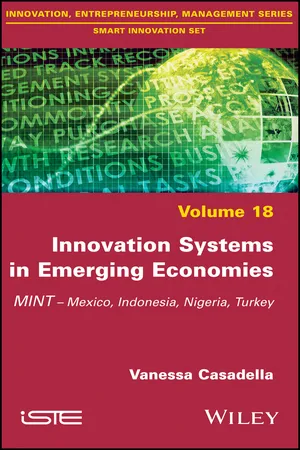
Innovation Systems in Emerging Economies
MINT (Mexico, Indonesia, Nigeria, Turkey)
- English
- ePUB (mobile friendly)
- Available on iOS & Android
eBook - ePub
About this book
Information
1
Innovation Systems: From Classic Models to Those Linked to Economic Development
1.1. NISs: relevant approaches
Broadly disseminated for the past 20 years, the NIS concept has found practical and intellectual consistency in academic circles as well as within political contexts and in international organizations (OECD, European Commission and UNCTAD). This rapid dissemination of the approach was not without consequence. Not only is the literature on the topic abundant, but it is also extremely ambitious in what it seeks to understand and explain. Finally, the interpretations of NIS vary remarkably from one to the other and sentiments can sometimes be quite diverse. With this in mind, the open and flexible nature of NIS is generally accepted and entails the possibility, with regard to the different facts analyzed, of accentuating certain aspects or suggesting different hypotheses without making the concept lose its consistency. Beyond the different approaches adopted, there are, however, recurrent semantics in most of the interpretations. A number of characteristics converge to gain credibility of the approach and the research carried out.
In this regard, we will try to first examine the plural nature of NIS (section 1.1.1) before detecting the common characteristics and the foundations of this approach (section 1.1.2).
1.1.1. NISs and conceptual flexibility
Conceptual pluralism, as Edquist [EDQ 97] called it, relates to the spirit of the approach, given the many variations based on this concept. Far from being a stable and unified concept, the diversity and huge scope of the approach are widely considered as actual advantages. Like Lundvall [LUN 02a, p. 221] put it, “The pragmatic and flexible character of the concept may be seen as a great advantage since it makes it useful for practical purposes”. Edquist [EDQ 97, p. 27] highlighted the potential justification when he wrote: “In the early breakthrough period of a new technology area it is normal to find different solutions competing. It is important to allow such diversity so that we do not prematurely exclude solutions that may have large potential”. Here, the undefined character of the NIS is sought because it is inherent in the conceptual foundation of the NIS and its evolutionary footprint, marked by diversity and variety [MCK 91]. It is in fact through their convergent and divergent tendencies that NIS still makes sense [NIO 92]. By attempting to accept this logic, we arrive at a solution that can shift the question from the conceptual rigor of the NIS to the subject of its analysis: the elements to be taken into account depend on the object studied [EDQ 97]. However, there a number of legibility issues with the approach. These problems are a sign of an evident weakness that research must address in order to ensure that the NIS is not under theorized [LUN 92] or not better suited terminologically [EDQ 97]. Nevertheless, this does not seem to have been taken seriously because, despite the number of attempts at clarification, there are two main conceptualizations of NIS.
According to Lundvall [LUN 92], List was the first to prepare the ground for the conceptual structure of NIS. In his 1841 publication, Das Nationale System der Politischen Ökonomie, List showed the importance of knowledge, links between scientific and technological institutions, the production sector and foreign technology required for economic development. It was only in the 1980s that the approach really spread because of the impetus given by three main publications: that of Freeman [FRE 87], Technology policy and economic performance: lessons from Japan; that of Lundvall [LUN 92], National innovation systems: toward a theory of innovation and interactive learning; and finally, that of Nelson [NEL 93], National innovation systems: a comparative analysis.
As in the evolutionary tradition of Nelson and Winter [NEL 82], the first works undertaken criticized the hypotheses put forward by the neoclassical theory of the firm. These hypotheses included the idea that firms, equipped with a perfect rationale, knew the best available technology. The initial studies adopted in line with the innovation economy attempted to thus build on the determining factors of the innovation process and divide the stages of a linear mode. However, this was soon replaced by the interactive model of innovation [KLI 86] that made it possible to go beyond the linear input/output vision and represent the different types of innovation as a continuum, going from incremental innovations to radical innovations.
In this regard, the different phases of innovation are interlinked by the feedback effects between the different stages of innovation activities. From there, innovation does not end once the diffusion/imitation phase ends. On the contrary, innovative actions are influenced by interactions between the different actors: researchers, marketing experts, consumers, etc.

Figure 1.1. Interactive model of innovation
(source: [CAN 00])
The year in which the term “NIS” was first used in writing is not clearly known and neither is the person who used it. Archibugi and Michie [ARC 97] attribute the essence of the term NIS to Freeman [FRE 87], who in turn attributes it to Lundvall [FRE 95]. According to Edquist [EDQ 97], it is Lundvall who coined the title National systems of innovation in the fifth part of Technical change and economic theory [DOS 88], which consolidates the contributions of Nelson, Freeman and Lundvall. But according to a recent statement by Lundvall [LUN 02a], it is Freeman [FRE 82] who, in an unpublished document for the OECD, used the NIS concept for the first time. One of the main aspects of his article titled “Technological infrastructure and international competitiveness” tries to explain why and how the world economical supremacy shifts in parallel with the presence of national institutional models.
However, while the concept originated from Freeman [FRE 82], the real pioneers of the NIS approach are Freeman, Lundvall and Nelson, who presented their preliminary ideas on the subject in the work by Dosi et al. [DOS 88]. This publication had a huge impact on the development of systemic approaches to innovation. Without claim...
Table of contents
- Cover
- Table of Contents
- Preface
- 1 Innovation Systems: From Classic Models to Those Linked to Economic Development
- 2 Heterogeneity in Innovation Systems in Emerging Economies: Experiences in MINT
- Conclusion
- Postface: Innovation Systems for Microfinance
- Bibliography
- Index
- End User License Agreement
Trusted by 375,005 students
Access to over 1.5 million titles for a fair monthly price.
Study more efficiently using our study tools.
Frequently asked questions
Yes, you can cancel anytime from the Subscription tab in your account settings on the Perlego website. Your subscription will stay active until the end of your current billing period. Learn how to cancel your subscription
No, books cannot be downloaded as external files, such as PDFs, for use outside of Perlego. However, you can download books within the Perlego app for offline reading on mobile or tablet. Learn how to download books offline
Perlego offers two plans: Essential and Complete
- Essential is ideal for learners and professionals who enjoy exploring a wide range of subjects. Access the Essential Library with 800,000+ trusted titles and best-sellers across business, personal growth, and the humanities. Includes unlimited reading time and Standard Read Aloud voice.
- Complete: Perfect for advanced learners and researchers needing full, unrestricted access. Unlock 1.5M+ books across hundreds of subjects, including academic and specialized titles. The Complete Plan also includes advanced features like Premium Read Aloud and Research Assistant.
We are an online textbook subscription service, where you can get access to an entire online library for less than the price of a single book per month. With over 1.5 million books across 990+ topics, we’ve got you covered! Learn about our mission
Look out for the read-aloud symbol on your next book to see if you can listen to it. The read-aloud tool reads text aloud for you, highlighting the text as it is being read. You can pause it, speed it up and slow it down. Learn more about Read Aloud
Yes! You can use the Perlego app on both iOS and Android devices to read anytime, anywhere — even offline. Perfect for commutes or when you’re on the go.
Please note we cannot support devices running on iOS 13 and Android 7 or earlier. Learn more about using the app
Please note we cannot support devices running on iOS 13 and Android 7 or earlier. Learn more about using the app
Yes, you can access Innovation Systems in Emerging Economies by Vanessa Casadella in PDF and/or ePUB format, as well as other popular books in Economics & Development Economics. We have over 1.5 million books available in our catalogue for you to explore.