"Creative competitive intelligence" is an information-seeking and monitoring activity of an information environment for the purpose of creativity and innovation. It involves the process leading up to the development of an informational supply adapted to the inspiration of creative or innovative personnel.
This dynamic aims for the recognition of novelties (ideas, products, technologies, etc.), the identification of new players in the world of creation and innovation, and the identification of forgotten or neglected developmental paths.
This book is aimed at readers who already have some experience of innovation and who are now looking for new ways to discover new products under development, anticipate the design of future products, identify unexplored tracks of inventions, develop and analyze innovation strategies, or recognize the emergence of budding artists.
1 Intelligence and Creative Competitive Intelligence
1.1. Supplying intelligence
Carrying out intelligence requires the employment of several technologies, such as but not limited to those linked to the Web. There are also situations in which we may bypass technology in order to go back to basics: the purely human capacities to understand, investigate, collect, treat, analyze, format and disseminate information. Even if nowadays there are tools that are highly efficient and despite the fact that a great quantity of interesting information can be found on the Internet, the fact remains that the individual and their abilities are at the heart of creating an adapted and relevant intelligence system. I would also add that from the point of view of an expert in charge of collecting information, intellectual capacities are sought after without really relying on technologies when in the phase of understanding the problem posed as well as that of identifying the relevant sources of information. In this way, the first problem with which the intelligence expert is often confronted concerns identifying the informational supply to search for, in order to produce a satisfying response for their partner.
In fact, information investigation generally at least implies searching on the Web. Or in simpler terms, searching for information or for sources of information on the Web, which points to the problem of creating a series of queries to be entered into a search engine. However, before launching into a search engine blindly, it is definitely preferable to reflect on the question and to carefully create one or several queries which will then be adapted and entered into one or several search engines. Consequently, it is necessary to have already selected the search engine(s) that will be used. As you already know, a rigorous intelligence expert cannot be satisfied with a search engine chosen by way of default. In the same way, before embarking upon investigations which will take a long time, we must have fully understood what was initially asked. This corresponds first to the specifications, which must be met in order to satisfy the request-maker. In order to do this, like every list of specifications, it must be created equally between the two parties: that of the request-maker(s) or receiver(s) and that of the creator(s) of the intelligence or intelligence system. Nevertheless, in terms of intelligence, a perfect list of specifications is impossible to establish. There will always be some ambiguities and different ways of interpreting the request which are left at the discretion of the intelligence expert. This is why, in order to fully understand the informational need to which we must respond, an intelligence expert must identify and explore the informational need hidden behind the informational request that was transferred to them. To do this, the intelligence expert must first have an explicit and reasonable informational needs document at their disposal.
Concerning the explicit part, it is about having a list of needs which does not cover a specific theme (competition, technologies, trends, legislation, etc.), but which instead targets responses to apply or a series of questions which the informational provision must clarify or bring an adequate response to [BUL 14, p. 53]. Thanks to this type of document, the intelligence expert reduces interpretation ambiguities which are inevitably linked to requests which use generic terms such as “put a strategic intelligence system into place”, “carry out competitive intelligence”, “undertake technological and sector-specific intelligence”, etc. By focusing on provision and its usefulness, the intelligence expert can easily realize if they do not understand what is expected of them or if a suitable response will be put forward. To get there, it is convenient to question the receiver by asking them questions such as “why are you doing this?”, “what objectives are you aiming to fulfill?”, “in order to respond to what questions, for example?” In fact, in the majority of cases, making examples of provisions to produce or employing information for more explicitness can prove to be of great use in order to better discern the needs of an intelligence system.
In terms of the reasonable aspect of the document of need, it must allow the intelligence expert to signal and to conclude, according to the amount of time that they are given as well as their abilities and means at their disposal, whether or not they can respond to the request effectively. This may be the case for a cartography request with competitive principles for a company, which includes their profile and a monitoring of their actions. In general, this type of work cannot be reasonably carried out by a single person in a single day, unless part of a type of pre-programmed package which the intelligence expert already has more or less at their disposal. If the request is above all that concerns theme, for example, “put a technological competitive intelligence system into place which responds to the needs of a R&D service”, the intelligence expert must link this request with an explicit and reasonable formulation of informational needs to be fulfilled. Even if they are granted full rein as an intelligence specialist, they must be able to take the time to locate the recipients of their work, understand their needs and formulate with each one of them explicit documents of specific provisions as well as numerous other criteria such as quantity, frequency and the form of information to provide. It is unimaginable to carry out this work without locating the recipients of the information, obtaining the technical information and preliminary knowledge about what is created using the R&D service, or spending a few weeks to properly establish the needs and adjust the provisions.
As stated earlier, this process of making the informational needs more explicit is as relevant to requests for information and intelligence investigation which will exploit the Web as to the others, that is to say those which do not target the Web or are not limited to information found on the Web. Whatever the details of the request, every reflection that aims to make the useful response more explicit stays the same. The use or non-use of search engines, the use of an original flux RSS aggregator, the exploration of a database with the use of a data mining software system or its use at trade shows are only a few of the possible applications. Every element is needed in order to collect information effectively, to fully understand the need that these actions are meant to respond to. In this way, every information researcher or intelligence expert must be capable of putting strategies in place to better understand the demand and informational need of their request-maker.
Unfortunately, as it has been expressed notably by M. Mugur-Schächter [MUG 07] and B. Simonnot [SIM 13], information is an ambiguous and complex notion which in the framework of intelligence too often provokes misunderstandings and provision errors. Making the request more explicit is thus absolutely necessary and must pass through clearly identifying the needs of the real request-maker while avoiding intermediaries. When the request is complex, the needs must be put into an explicit hierarchy. By default, it is up to the intelligence expert to propose ideal responses to their request-maker that they will be able to produce. Generally, a discussion surrounding these provision propositions will have the advantage of refocusing, rendering the need more explicit making it more about the practical usage of information to look out for and the likely responses that they could bring. It may also shed light on the context of the informational request which is made and predict, in an ideal situation, what would be the best result to propose. The strategic reflection framework presented in the introduction (Figure 1.1) can serve as a model to follow in order to automate this very delicate first part of understanding an informational problem which the intelligence expect is responsible for solving.
Obviously, these problems can also be posed in the context of putting creative competitive intelligence into place, even if this form of intelligence most regularly imposes an additional process. In order to further explore the problems posed by understanding an informational need, whether it be linked to a more traditional intelligence framework (strategic, competitive, technological, legislative, etc.) or creative competitive intelligence, I will call upon two series of illustrations, starting with those in Figure 1.1. In this way, as already mentioned, the first problem to be dealt with when we try to understand an informational need in order to create an adequate response consists of limiting the difference in understanding the problem between the recipient on one side and the intelligence expert on the other.
Figure 1.1.Difference in knowledge between the thoughts of the request-maker (A) and the final product (D)
In the series of illustrations shown in Figure 1.1, A represents the field of informational investigation that the request-maker thinks about. They have identified the need themselves. B shows what is eventually expressed as the informational need to the intelligence expert. C demonstrates what the intelligence expert has understood (of course, another intelligence expert would have interpreted this differently) and in D, we see what the intelligence expert has been able to produce after the information retrieval, verification, treatments and formatting. In contrast, E presents the different areas of investigation identified by the request-maker which are not found in the response that was created. In order to avoid this type of problem, an intelligence expert must be able to have discussions with the request-maker, asking additional questions and if necessary, leaving them the chance to adjust their response so that they can better understand the needs of the request-maker during the project. Intermediaries, which separate the two sides, must also be kept to a minimum since the gap between real informational need and the request eventually created will increase with the number of people for whom the request will pass through. If the intelligence expert has the time to improve their bank of information, through repetitions and regular feedback with their recipients, it is obvious that their understanding of the needs will look more and more like illustration A in Figure 1.1. But not everyone has the luxury of several months to refine their understanding of each one of the intelligence requests.
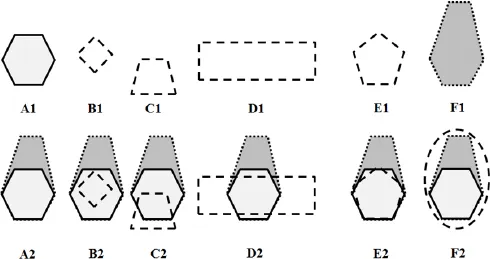
With this taken into consideration, there is another problem which emerges in terms of the collection of information. This problem corresponds, on the one hand, to the gap that will separate what we wish to provide from what we successfully provide with regard to the needs of the request-maker and, on the other hand, to the gap that will separate the proposed informational provision from the ideal informational provision that would have been provided. Figure 1.2 illustrates some cases of intelligence provision which can be carried out by linking them with the wishes of the request-maker, the understanding of the intelligence expert and the ideal provision that can be carried out.
Figure 1.2.Different cases of informational provisions with regard to an identified need and an ideal provision
In Figure 1.2, A1 illustrates what the request-maker has identified as the informational need and wants to be the provision of information, even if there may be certain difficulties in expressing this request (as in the case used above). F1 shows the ideal provision of information, which would allow us to respond to all of the informational needs of the request-maker included in their request or hidden by it. As it has probably already been noted, there are many cases where the intelligence expert can provide very relevant informational elements which the request-maker would not even dream of. As a general rule, the request-maker is not considered an expert in information retrieval, as they can demand things that cannot be realized, but they may also underestimate the ability of the intelligence expert.
In A2, illustrations A1 and F1 overlap to effectively show their similarities and differences. When we ask an intelligence expert for information, we must try to be as close to A1 as possible, and if possible approach F1. B1 and C2 represent the informational responses in terms of intelligence provision, which does not respond to the request. The advantage of this type of provision is that the request-maker will be disappointed very quickly. B2 to C2 represent their position in relation to the request as well as the ideal informational supply. Response B1 is too limited (B2) and must be more detailed while that of C1 is moved (useless information have been provided and others have been ignored) and so must be redefined (C2). Responses D1 and E1 must satisfy both, but response D1 brings forward a lot of useless information, even though it has allowed us to find one or two pieces of inf...
Table of contents
Cover
Table of Contents
Title
Copyright
Introduction
1 Intelligence and Creative Competitive Intelligence
2 Researching and Identifying Trends
3 Formatting, Analysis and Inspiration Using Trends
4 Presenting and Analyzing Networks
5 Visual Tools for Problem Solving
6 Investigating the Past and Present
7 Inspiration Using TRIZ
8 Reasoning with the Aid of Operators
9 Use of Games for Serious Purposes
10 Diversion of Role-playing Games
11 Tactical or Strategic Reflection and Wargames
12 Use of Objective-based Games
13 Creative Competitive Intelligence and Territorial Intelligence
Conclusion
Bibliography
Index
End User License Agreement
Trusted by 375,005 students
Access to over 1.5 million titles for a fair monthly price.
Study more efficiently using our study tools.
Frequently asked questions
Yes, you can cancel anytime from the Subscription tab in your account settings on the Perlego website. Your subscription will stay active until the end of your current billing period. Learn how to cancel your subscription
No, books cannot be downloaded as external files, such as PDFs, for use outside of Perlego. However, you can download books within the Perlego app for offline reading on mobile or tablet. Learn how to download books offline
Perlego offers two plans: Essential and Complete
Essential is ideal for learners and professionals who enjoy exploring a wide range of subjects. Access the Essential Library with 800,000+ trusted titles and best-sellers across business, personal growth, and the humanities. Includes unlimited reading time and Standard Read Aloud voice.
Complete: Perfect for advanced learners and researchers needing full, unrestricted access. Unlock 1.5M+ books across hundreds of subjects, including academic and specialized titles. The Complete Plan also includes advanced features like Premium Read Aloud and Research Assistant.
Both plans are available with monthly, semester, or annual billing cycles.
We are an online textbook subscription service, where you can get access to an entire online library for less than the price of a single book per month. With over 1.5 million books across 990+ topics, we’ve got you covered! Learn about our mission
Look out for the read-aloud symbol on your next book to see if you can listen to it. The read-aloud tool reads text aloud for you, highlighting the text as it is being read. You can pause it, speed it up and slow it down. Learn more about Read Aloud
Yes! You can use the Perlego app on both iOS and Android devices to read anytime, anywhere — even offline. Perfect for commutes or when you’re on the go. Please note we cannot support devices running on iOS 13 and Android 7 or earlier. Learn more about using the app
Yes, you can access Methods and Tools for Creative Competitive Intelligence by Stéphane Goria in PDF and/or ePUB format, as well as other popular books in Social Sciences & Popular Culture. We have over 1.5 million books available in our catalogue for you to explore.