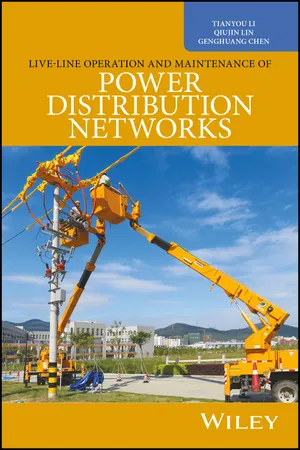
Live-Line Operation and Maintenance of Power Distribution Networks
eBook - ePub

Live-Line Operation and Maintenance of Power Distribution Networks

  1. English
  2. ePUB (mobile friendly)
  3. Available on iOS & Android
eBook - ePub

Live-Line Operation and Maintenance of Power Distribution Networks

About this book

Excellent reference outlining the technical basis and working principles of live-line working, with current application technology, tools and working methods

  • Introduces live-line working technology for the operation and maintenance of medium and low voltage power distribution networks, covering both the methods and techniques of live-line working on distribution networks with O&M field practices and experiences
  • Elaborates the technical basis and working principles of live-line working in detail, with current application technology, tools and working methods
  • Combining theory and practice closely, it provides technical guidance and helpful references to technical personnel who are engaged in distribution operation management, as well as related academics and researchers
  • Written by a team of authors with extensive experience in both industry and academic fields, providing first-hand testimony of the issues facing electricity distribution companies, and offering sound theoretical foundations and rich field experiences

Trusted by 375,005 students

Access to over 1.5 million titles for a fair monthly price.

Study more efficiently using our study tools.

Information

Publisher
Wiley
Year
2017
Print ISBN
9781119055532
Edition
1
eBook ISBN
9781119055563

1
Overview

This chapter introduces the basic concept of non‐service interruption working and the development of working techniques, describes and analyzes indexes of power supply reliability, and explains the effect of non‐service interruption working techniques, thereby giving readers a basic understanding of the significance of non‐service interruption working.

1.1 Basic Concept of Non‐Service Interruption Working

Generally, there are two ways for the construction or maintenance of electric power lines and equipment.
  1. Service interruption working. It is a traditional way in which lines or equipment to be maintained is isolated for service interruption before being constructed and maintained and power supply is restored after working.
  2. Non‐service interruption working. It is a way for testing, maintaining and constructing electric power lines or equipment without interrupted supply to customers. It includes two kinds of ways as follows:
    1. Work directly on live lines or equipment, namely live line working.
    2. Continue to supply power to customers through bypass or mobile power, and then work on de‐energized lines or equipment.

1.1.1 Basic Method of Live Line Working

Live line working refers to an activity in which a worker makes direct contact with live lines (or equipment) or works on live lines (or equipment) with special working tools, equipment (or device), to realize maintenance and testing on live lines (or equipment). It is an effective measure to avoid service interruption for maintenance and ensure normal power supply.
According to the relationship between a worker and a live part, that is, whether or not the worker makes direct contact with the live part with parts of his or her body, live line working method can be divided into two basic methods, namely, contact working and at a distance working; according to the body potential of the worker, live line working can be classified into earth potential working, middle potential working and equipotential working.
  1. Earth Potential Working
    Earth potential working refers to an activity in which the worker makes contact with the live part with insulating tools while is at the same potential as that of the earth (tower). At this time, the relationship between the body and the live part is “earth – body – insulating tools – live part.” See Figure 1.1 for the schematic diagram of earth potential working. Earth potential working is also called zero potential working, known as distance working abroad. Earth potential working is performed using four basic methods of “supporting, dragging, tightening and hanging”, and the coordination of these methods serves as a major means for at a distance working. The key of this method is to maintain a sufficient safety distance between the body and the live part, and that the insulating tools should have useful insulation distance.
  2. Middle Potential Working
    Middle potential working refers to an activity in which the worker makes contact with the live part with insulating tools while is always at the middle potential between the earthed part and the live part. At this time, the relationship between the body and the live part is “live part – insulator – body – insulator – earth.” See Figure 1.2 for the schematic diagram of middle potential working. The body is isolated respectively from the earthed part and the live part by two sections of isolators which restrict electric current from flowing through the body, while the air gap from the body to the earthed part and to the live part prevent the live part from discharging to the earthed part through the body. The sum of the two sections of air gaps is generally known as the complex gap, expressed by Sz. To adopt the middle potential working, it is important to meet the requirement for the complex gap (Sz = S1 + S2). The concept of the complex gap will be specifically introduced in subsequent chapters.
  3. Equipotential Working
    Equipotential working refers to an activity in which the worker makes direct contact with the live part while the body potential is equal to the live part’s potential. Equipotential working is also called contact working, known as bare hand working abroad. At this time, the relationship between the body and the live part is “live part – body – insulator – earth (tower).” See Figure 1.3 for the schematic diagram of equipotential working.
Image described by caption and surrounding text.
Figure 1.1 Schematic diagram of earth potential working. 1—Live part; 2—Insulator; 3—Body; 4—Earthed part.
Image described by caption and surrounding text.
Figure 1.2 Schematic diagram of middle potential working. 1—Live part; 2—Insulator; 3—Body; 4—Earthed part.
Image described by caption and surrounding text.
Figure 1.3 Schematic diagram of equipotential working. 1—Live part; 2—Body; 3—Insulator; 4—Earthed part.

1.1.2 Bypass Working and Mobile Power Working

  1. Bypass working
    Bypass working refers to an activity in which temporary current‐carrying bypass lines or equipment, such as bypass cables (lines) or bypass switches, replace operating lines or equipment (such as circuits, breakers, or transformers) to be de‐energized for maintenance and replacement, and is then removed after the normal power supply is restored upon the working is finished. This method ensures uninterrupted power supply to customers during the working.
    Bypass working brings a new concept to the conventional live line working and realizes “non‐service interruption working” by effectively combining several conventional live line working operations. This shows that the flexible combination of bypass working and conventional live line working can fundamentally change the situation where the existing operations on power grids mainly rely on service interruption working supplemented by live line working.
  2. Mobile power working
    Many operations on power grids, such as replacement of distribution transformers (for capacity increase), relocation of pole lines, or change of conductors, cannot be directly realized through live line working. However, it is possible to realize less (the interruption time is the switching operation time) or no interrupted supply to customers by separating the lines or equipment to be maintained from the power grids and continue to supply power to customers through the mobile power in an independent network, which is then removed after the normal power supply is restored upon the working is finished. This is the basic idea of mobile power working, and mobile power includes mobile generator vehicles, emergency power vehicles or mobile box‐type transformers.

1.2 Development of Working Techniques

1.2.1 Development History of Live Line Working

  1. Domestic development history
    Live line working in China started in the 1950s, which witnessed the recovery and development of national economy with...

Table of contents

  1. Cover
  2. Title Page
  3. Table of Contents
  4. Foreword
  5. Preface
  6. Introduction
  7. 1 Overview
  8. 2 Distribution Grid and Its Working Techniques
  9. 3 Theoretical Basis of Working Techniques
  10. 4 Common Working Tools and Usages
  11. 5 Test Techniques for Working Tools
  12. 6 Application of Aerial Device with Insulating Boom and Insulating Platform
  13. 7 Medium‐Voltage Distribution Live Line Working
  14. 8 Low‐Voltage Distribution Live Line Working
  15. 9 Bypass Working and Mobile Power Working
  16. 10 Working Management and Emergency Measures
  17. Annex: Distribution Non‐service Interruption Working Instructions (Template)
  18. Appendix 1: General Guidelines for Safety of Live Line Working
  19. Appendix 2: Technical Guidelines for Common Working Tools
  20. Index
  21. End User License Agreement

Frequently asked questions

Yes, you can cancel anytime from the Subscription tab in your account settings on the Perlego website. Your subscription will stay active until the end of your current billing period. Learn how to cancel your subscription
No, books cannot be downloaded as external files, such as PDFs, for use outside of Perlego. However, you can download books within the Perlego app for offline reading on mobile or tablet. Learn how to download books offline
Perlego offers two plans: Essential and Complete
  • Essential is ideal for learners and professionals who enjoy exploring a wide range of subjects. Access the Essential Library with 800,000+ trusted titles and best-sellers across business, personal growth, and the humanities. Includes unlimited reading time and Standard Read Aloud voice.
  • Complete: Perfect for advanced learners and researchers needing full, unrestricted access. Unlock 1.5M+ books across hundreds of subjects, including academic and specialized titles. The Complete Plan also includes advanced features like Premium Read Aloud and Research Assistant.
Both plans are available with monthly, semester, or annual billing cycles.
We are an online textbook subscription service, where you can get access to an entire online library for less than the price of a single book per month. With over 1.5 million books across 990+ topics, we’ve got you covered! Learn about our mission
Look out for the read-aloud symbol on your next book to see if you can listen to it. The read-aloud tool reads text aloud for you, highlighting the text as it is being read. You can pause it, speed it up and slow it down. Learn more about Read Aloud
Yes! You can use the Perlego app on both iOS and Android devices to read anytime, anywhere — even offline. Perfect for commutes or when you’re on the go.
Please note we cannot support devices running on iOS 13 and Android 7 or earlier. Learn more about using the app
Yes, you can access Live-Line Operation and Maintenance of Power Distribution Networks by Tianyou Li,Qiujin Lin,Genghuang Chen in PDF and/or ePUB format, as well as other popular books in Computer Science & Computer Engineering. We have over 1.5 million books available in our catalogue for you to explore.