Completely revised and updated, the third edition of this bestseller discusses the concept and ongoing development of using methanol and derived dimethyl ether as a transportation fuel, energy storage medium, and as a chemical raw material to replace fossil fuels.
The contents have been expanded by 35% with new and up to date coverage on energy storage, methanol from biomass and waste products, as well as on carbon dioxide capture and recycling. Written by the late Nobel laureate George Olah, Alain Goeppert and G. K. Surya Prakash, this is an inspiring read for anyone concerned with the major challenge posed by environmental problems including global warming and ocean acidification due to massive increase in fossil fuel use. The book provides a comprehensive and sustainable solution to replace fossil fuels in the long run by chemical recycling of carbon dioxide through renewable methanol utilizing alternative energy sources such as solar, wind, hydro, geothermal and nuclear. The Methanol Economy is being progressively implemented in many parts of the world.
eBook - ePub
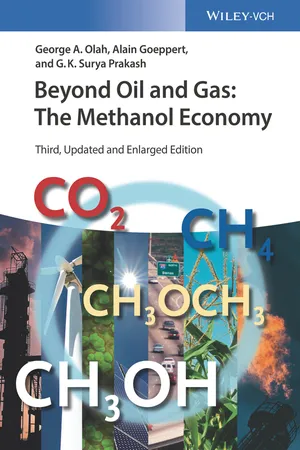
Beyond Oil and Gas
The Methanol Economy
- English
- ePUB (mobile friendly)
- Available on iOS & Android
eBook - ePub
1
Introduction
Ever since our distant ancestors managed to light fire for providing heat, means for cooking and many other essential purposes, humankind’s life and survival are inherently linked with an ever‐increasing thirst for energy. From burning wood, vegetation, peat moss, and other sources to the use of fossil fuels such as coal, followed by petroleum oil and natural gas, humankind has thrived using Mother Nature’s resources[1]. Fossil fuels are all composed of hydrocarbons with varying ratios of carbon and hydrogen. These hydrocarbons derived from petroleum, natural gas, or coal are essential in many ways to modern life and its quality. A large quantity of the world’s hydrocarbons is used as fuel for propulsion, electrical power generation, and heating. The chemical, petrochemical, plastic, and rubber industries also depend on hydrocarbons as raw materials for their products. Indeed, most of the industrially significant synthetic chemicals are derived from petroleum sources. The overall use of oil in the world now exceeds 13 million metric tons per day (95 million barrels per day) [2]. The rapidly growing world population, which stood at 1.6 billion at the beginning of the twentieth century, has now exceeded 7 billion and is expected to reach 8–11 billion by the middle of the twenty‐first century and up to 16 billion by 2100 [3] (Table 1.1 and Figure 1.1). This increase in world population and energy consumption, compared with our finite nonrenewable fossil fuel resources, which are being increasingly depleted, are clearly on a collision course. New solutions are needed for the twenty‐first century and beyond to sustain the standard of living to which the industrialized world has become accustomed and the developing world is striving to achieve.
Table 1.1 World population (in millions).
Source: United Nations, Department of Economic and Social Affairs, Population Division.
| 1650 | 1750 | 1800 | 1850 | 1900 | 1920 | 1952 | 2000 | 2015 | Projection 2050 |
| 545 | 728 | 906 | 1171 | 1608 | 1813 | 2409 | 6200 | 7400 | 8000–11 000 |

Figure 1.1 World population over time and in the future.
Source: United Nations, Department of Economic and Social Affairs, Population Division.
With an increasingly technological society, the world’s resources have difficulty in keeping up with the demands. Satisfying our society’s needs while safeguarding the environment and allowing future generations to continue to enjoy planet Earth as a hospitable home is one of the major challenges that we face today. Humans need not only food, water, shelter, clothing, and many other prerequisites but also huge and growing amounts of energy. In 2010, the world used about 1.33 × 10²⁰ calories per year (154 PWh), equivalent to a continuous power consumption of about 18 TW, which is comparable to the production of 18 000 nuclear power plants each with a 1 GW output (Figure 1.2) [4]. With increasing world population, development, and higher standards of living, this demand for energy is expected to grow to 23 TW in 2025 and to about 30 TW in 2050.

Figure 1.2 World primary energy consumption, 1970–2040 in units of (a) petawatt‐hours; (b) Btu (British thermal units).
Source: Based on data from: Energy Information Administration (EIA), International Energy Outlook 2013.
Our early ancestors discovered fire and began to burn wood. The industrial revolution was fueled by coal, and the twentieth century added oil, natural gas, and introduced atomic energy.
When fossil fuels such as coal, oil, and natural gas (i.e. hydrocarbons) are burned to generate electricity in power plants, or to heat our houses, propel our cars, airplanes, and so on, they form carbon dioxide and water as their combustion products. They are thus used up and are nonrenewable on the human timescale.
Fossil Fuels:
Petroleum oil, natur...
Table of contents
- Cover
- Table of Contents
- Dedication
- Preface
- About the Authors
- Acronyms
- Chapter 1: Introduction
- Chapter 2: Coal in the Industrial Revolution and Beyond
- Chapter 3: History of Petroleum Oil and Natural Gas
- Chapter 4: Fossil‐Fuel Resources and Their Use
- Chapter 5: Oil and Natural Gas Reserves and Their Limits
- Chapter 6: The Continuing Need for Hydrocarbon Fuels and Products
- Chapter 7: Fossil Fuels and Climate Change
- Chapter 8: Renewable Energy Sources and Atomic Energy
- Chapter 9: The Hydrogen Economy and Its Limitations
- Chapter 10: The “Methanol Economy”: General Aspects
- Chapter 11: Methanol and Dimethyl Ether as Fuels and Energy Carriers
- Chapter 12: Production of Methanol from Still Available Fossil‐Fuel Resources
- Chapter 13: Production of Renewable Methanol and DME from Biomass and Through Carbon Capture and Recycling
- Chapter 14: Methanol‐Based Chemicals, Synthetic Hydrocarbons, and Materials
- Chapter 15: Conclusion and Outlook
- Further Reading and Information
- Reference
- Index
- End User License Agreement
Trusted by 375,005 students
Access to over 1.5 million titles for a fair monthly price.
Study more efficiently using our study tools.
Frequently asked questions
Yes, you can cancel anytime from the Subscription tab in your account settings on the Perlego website. Your subscription will stay active until the end of your current billing period. Learn how to cancel your subscription
No, books cannot be downloaded as external files, such as PDFs, for use outside of Perlego. However, you can download books within the Perlego app for offline reading on mobile or tablet. Learn how to download books offline
Perlego offers two plans: Essential and Complete
- Essential is ideal for learners and professionals who enjoy exploring a wide range of subjects. Access the Essential Library with 800,000+ trusted titles and best-sellers across business, personal growth, and the humanities. Includes unlimited reading time and Standard Read Aloud voice.
- Complete: Perfect for advanced learners and researchers needing full, unrestricted access. Unlock 1.5M+ books across hundreds of subjects, including academic and specialized titles. The Complete Plan also includes advanced features like Premium Read Aloud and Research Assistant.
We are an online textbook subscription service, where you can get access to an entire online library for less than the price of a single book per month. With over 1.5 million books across 990+ topics, we’ve got you covered! Learn about our mission
Look out for the read-aloud symbol on your next book to see if you can listen to it. The read-aloud tool reads text aloud for you, highlighting the text as it is being read. You can pause it, speed it up and slow it down. Learn more about Read Aloud
Yes! You can use the Perlego app on both iOS and Android devices to read anytime, anywhere — even offline. Perfect for commutes or when you’re on the go.
Please note we cannot support devices running on iOS 13 and Android 7 or earlier. Learn more about using the app
Please note we cannot support devices running on iOS 13 and Android 7 or earlier. Learn more about using the app
Yes, you can access Beyond Oil and Gas by George A. Olah,Alain Goeppert,G. K. Surya Prakash in PDF and/or ePUB format, as well as other popular books in Physical Sciences & Chemistry. We have over 1.5 million books available in our catalogue for you to explore.