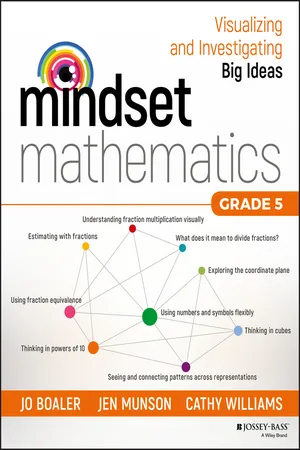
Mindset Mathematics
eBook - ePub

Mindset Mathematics

Visualizing and Investigating Big Ideas, Grade 5

  1. English
  2. ePUB (mobile friendly)
  3. Available on iOS & Android
eBook - ePub

Mindset Mathematics

Visualizing and Investigating Big Ideas, Grade 5

About this book

Engage students in mathematics using growth mindset techniques

The most challenging parts of teaching mathematics are engaging students and helping them understand the connections between mathematics concepts. In this volume, you'll find a collection of low floor, high ceiling tasks that will help you do just that, by looking at the big ideas at the fifth-grade level through visualization, play, and investigation.

During their work with tens of thousands of teachers, authors Jo Boaler, Jen Munson, and Cathy Williams heard the same message—that they want to incorporate more brain science into their math instruction, but they need guidance in the techniques that work best to get across the concepts they needed to teach. So the authors designed Mindset Mathematics around the principle of active student engagement, with tasks that reflect the latest brain science on learning. Open, creative, and visual mathematics tasks have been shown to improve student test scores, and more importantly change their relationship with mathematics and start believing in their own potential. The tasks in Mindset Mathematics reflect the lessons from brain science that:

  • There is no such thing as a math person - anyone can learn mathematics to high levels.
  • Mistakes, struggle and challenge are the most important times for brain growth.
  • Speed is unimportant in mathematics.
  • Mathematics is a visual and beautiful subject, and our brains want to think visually about mathematics.

With engaging questions, open-ended tasks, and four-color visuals that will help kids get excited about mathematics, Mindset Mathematics is organized around nine big ideas which emphasize the connections within the Common Core State Standards (CCSS) and can be used with any current curriculum.

Frequently asked questions

Yes, you can cancel anytime from the Subscription tab in your account settings on the Perlego website. Your subscription will stay active until the end of your current billing period. Learn how to cancel your subscription.
No, books cannot be downloaded as external files, such as PDFs, for use outside of Perlego. However, you can download books within the Perlego app for offline reading on mobile or tablet. Learn more here.
Perlego offers two plans: Essential and Complete
  • Essential is ideal for learners and professionals who enjoy exploring a wide range of subjects. Access the Essential Library with 800,000+ trusted titles and best-sellers across business, personal growth, and the humanities. Includes unlimited reading time and Standard Read Aloud voice.
  • Complete: Perfect for advanced learners and researchers needing full, unrestricted access. Unlock 1.4M+ books across hundreds of subjects, including academic and specialized titles. The Complete Plan also includes advanced features like Premium Read Aloud and Research Assistant.
Both plans are available with monthly, semester, or annual billing cycles.
We are an online textbook subscription service, where you can get access to an entire online library for less than the price of a single book per month. With over 1 million books across 1000+ topics, we’ve got you covered! Learn more here.
Look out for the read-aloud symbol on your next book to see if you can listen to it. The read-aloud tool reads text aloud for you, highlighting the text as it is being read. You can pause it, speed it up and slow it down. Learn more here.
Yes! You can use the Perlego app on both iOS or Android devices to read anytime, anywhere — even offline. Perfect for commutes or when you’re on the go.
Please note we cannot support devices running on iOS 13 and Android 7 or earlier. Learn more about using the app.
Yes, you can access Mindset Mathematics by Jo Boaler,Jen Munson,Cathy Williams in PDF and/or ePUB format, as well as other popular books in Education & Teaching Mathematics. We have over one million books available in our catalogue for you to explore.

Information

Publisher
Jossey-Bass
Year
2018
Print ISBN
9781119358718
eBook ISBN
9781119358763
Edition
1

Big Idea 1
Thinking in Cubes

The new brain science shows that five different pathways are involved when people think about mathematical ideas, and two of these are visual. When we make mathematics visual for students, we help them learn and hold ideas in powerful ways in their brains, as the introduction to this book explains. Similarly, we now know that movement really helps with mathematical ideas and is important for brain development. When students move with mathematics, it means that the mathematical ideas are held in the sensory-motor portions of the brain, which helps students understand the ideas powerfully. We see evidence of people holding mathematical ideas in these parts of their brains when they gesture to illustrate an idea; when people talk about circles, for example, they often draw a circle in the air. This big idea gives students opportunities to touch and feel mathematical ideas, and that is meaningful to students of any age.
In our Visualize activity, students will build with cubes and develop connections between two- and three-dimensional representations of solids. They will be asked to think about the outside and inside of cubes, which is important geometric thinking. As they physically model and also draw, they will build significant brain connections.
In the Play activity, students will construct cities of cubes that match views that we give them, again using brain pathways that will develop mathematical thinking. Students also will build their own cities, which will be engaging and exciting for them, enhancing the learning potential of the activities. As students think visually and also bring in numerical thinking, their brains will develop pathways between the areas that are used for these different types of thinking.
In our Investigate activity, students will again have the opportunity to feel cubes and consider their size physically and with numbers, encouraging brain connections. They also get to work with some constraints that will guide their thinking and learning. Students will be asked to investigate the volume of rectangular solids by packing little boxes into larger boxes of their own design. Any time that students are asked to bring their own ideas into mathematics, such as when they make their own designs, they are working with agency, which will help them enjoy mathematics and also see it as an active subject that they should think deeply about. When students work with agency, their work is closer to that of a mathematician, and inviting students to combine their own ideas with formal mathematical ideas is a really worthwhile goal. The activities that make up this big idea provide plenty of opportunities for students to combine their own thinking with major mathematical ideas and principles.
Jo Boaler

Solids, Inside and Out

Snapshot

Students build connections between two- and three-dimensional representations of solids by using views of a rectangular solid to construct a model with cubes. Students investigate what the inside looks like and compare results.
Connection to CCSS
5.MD.3
5.MD.4

Agenda

Activity Time Description/Prompt Materials
Launch 5 min Show students the two-dimensional views of a rectangular solid constructed out of 60 cubes. Challenge students to build this solid. Rectangular Solids Sheet, to display for the class
Explore 30 min Partnerships try to build a rectangular solid from 60 cubes so that it matches the views provided. Students then consider what the inside looks like and figure out how to construct and draw a model of the cubes that cannot be seen.
  • Rectangular Solids Sheets, one per partnership
  • Snap or multilink cubes for each partnership: 15 each of red, green, yellow, and blue
  • Drawing Solids Sheet, one per partnership
Discuss 20 min Students compare their results and discuss how they used the views to construct the solid. Students discuss the differences between their models of the inside.
Extend 30–60 min Partnerships construct their own rectangular solid puzzles and swap with other groups to solve.
  • Drawing Solids Sheet, at least one per partnership
  • Cubes
  • Colors
  • Baskets, trays, or bags for students' puzzles

To the Teacher

Students often struggle when moving between two-dimensional representations of solids objects, like the ones shown in Figure 1.1, and three-dimensional representations. Two-dimensional drawings of solids force us to imagine the parts we cannot see, an...

Table of contents

  1. Cover
  2. Title Page
  3. Copyright
  4. Dedication
  5. Introduction
  6. Activities for Building Norms
  7. Big Idea 1: Thinking in Cubes
  8. Big Idea 2: Estimating with Fractions
  9. Big Idea 3: Using Fraction Equivalence
  10. Big Idea 4: Exploring the Coordinate Plane
  11. Big Idea 5: Seeing and Connecting Patterns across Representations
  12. Big Idea 6: Understanding Fraction Multiplication Visually
  13. Big Idea 7: What Does It Mean to Divide Fractions?
  14. Big Idea 8: Thinking in Powers of 10
  15. Big Idea 9: Using Numbers and Symbols Flexibly
  16. Appendix
  17. About the Authors
  18. Acknowledgments
  19. Index
  20. End User License Agreement