- Investigates her work as an early leader in the development of feminist philosophy, challenging many preconceptions about the society's norms regarding gender, marriage, and motherhood
- Crossing many disciplinary boundaries, her concept of social death has come to play a significant role in multidisciplinary field of genocide studies
- This volume combines many of Claudia Card's important essays with recently commissioned essays by leading philosophers whose work has been influenced by Card
- The full scope of Card's philosophy is presented here - both in her own words and those of her critics and interpreters
eBook - ePub
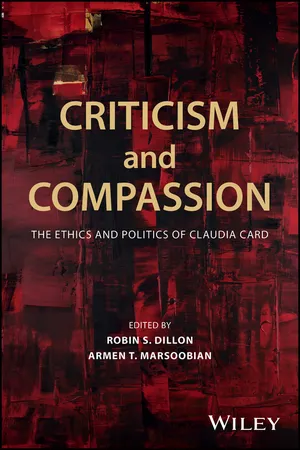
Criticism and Compassion: The Ethics and Politics of Claudia Card
- English
- ePUB (mobile friendly)
- Available on iOS & Android
eBook - ePub
Criticism and Compassion: The Ethics and Politics of Claudia Card
About this book
Criticism and Compassion: The Ethics and Politics of Claudia Card offers a unique perspective on the range of issues explored by Card during her distinguished career in philosophy.
Information
PART ONE
WAR, GENOCIDE, AND EVIL
CHAPTER 1
RAPE AS A WEAPON OF WAR
CLAUDIA CARD
Rape in war—martial rape—has even arrived in the movies. Within the past year, films I have seen featuring or portraying rape in war or in warlike situations include Death and the Maiden (featuring a woman who survived rape by a physician who was hired to oversee her political torture), Rob Roy (portraying a strategic rape—intended to provoke a husband—by an English “nobleman” charged with putting down a Scottish rebellion), and Immortal Beloved (briefly showing the apparently gratuitous rape of a civilian stagecoach passenger by one of Napoleon's soldiers). Closely related is Braveheart, which presents imperial rape in the “rite of the first night,” which licensed English “nobles” to rape Scottish “commoner” brides on their wedding nights.1 Although this imperial rape was not officially an act of war, it had some of the same goals as martial rape: genetic imperialism and a realignment of loyalties in future generations (which are made explicit in Braveheart). Each of these films displays a different aspect of martial rape. No one (to my knowledge) has yet portrayed mass rape in war.
Mass martial rape in the real world, however, is receiving media attention, and public consciousness is being raised about it. What is new is not the practice of mass rape but the extent of its relatively recent publicity and some of rape's consequences for public health in an era of HIV. Martial rape is an ancient practice. Patterns of intelligibility to be found in it have important continuities with patterns to be found also in civilian rape. Despite differences in the structures of the relevant causes, Judith Herman argues that the “shell shock” in World War 1 combat survivors has important similarities to posttraumatic stress disorders as experienced by female survivors of domestic violence and rape. She finds that “the most common post-traumatic disorders are those not of men in war but of women in civilian life” and that women and children subject to civilian rape and domestic violence are in a war:
The subordinate condition of women is maintained and enforced by the hidden violence of men. There is war between the sexes. Rape victims, battered women, and sexually abused children are its casualties. Hysteria is the combat neurosis of the sex war. (Herman 1992, 28–32)
Although my focus here is on martial rape as a weapon wielded by male soldiers of one country (or national, political, or cultural group) against typically unarmed female civilians of another, much of what I say can be applied also with certain modifications in (so-called) civilian contexts.
A little more than ten years ago I began writing about rapes that are often “domestic” in two senses: they are (generally) rapes of citizens (or residents) by other citizens (or residents) of the same state, and they were often committed by members of a household against other members of the same household (Card 1991). I now find that an important aspect of both civilian and martial rape is that it is an instrument of domestication: breaking for house service. It breaks the spirit, humiliates, tames, produces a docile, deferential, obedient soul. Its immediate message to women and girls is that we will have in our own bodies only the control that we are granted by men and thereby in general only that control in our environments that we are granted by men.
Instruments of taming include terrorism and torture, which rely on the energy-consuming and debilitating effects of fear and, as Nietzsche noted (1967, 61–62), our ability to remember what hurts.2 Taming is often for service—utilitarian, recreational, or both—which sets limits to terrorism and torture in that “taming” carried too far may leave an animal who is neither useful for much nor even entertaining. In the case of civilian rape, purposes commonly served include both utilitarian and recreational exploitation. Women and girls raped are often primary instruments of the exploitation of other women and girls. As with other kinds of terrorism, rape as a practice often has two targets (O'Neill 1991). One target may be a throwaway or sacrificial victim who is used to send a message to others. The role of women who are raped and then murdered is like that of people who are murdered in a bombing. They are used to send a message to the second targets, whose compliance with various demands and expectations is sought by the terrorist.
The ubiquitous threat of rape in war, like that of civilian rape, is a form of terrorism. The aim in war, however, may not be service (the aim generally served by civilian rape) but expulsion or dispersion. Expulsion and dispersion do not set limits to the extent and degree of terrorism and torture as the hope of future exploitation would do, because it does not matter to the terrorists whether those to be expelled or dispersed survive. Again, there are often two targets, sacrificial victims and others to whom their sacrifice is used to send a message. Martial rape domesticates not only the women survivors who were its immediate victims but also the men socially connected to them, and men who were socially connected to those who did not survive.
If there is one set of fundamental functions of rape, civilian or martial, it is to display, communicate, and produce or maintain dominance, which is both enjoyed for its own sake and used for such ulterior ends as exploitation, expulsion, dispersion, murder. Acts of forcible rape, like other instances of torture, communicate dominance by removing our control over what enters or impinges on our bodies. Rape is a cross-cultural language of male domination (that is, domination by males; it can also be domination of males). This is its symbolic social meaning. Civilian domination characteristically issues in exploitation for service, although some forms of even civilian rape—such as college fraternity party gang rapes—may be best understood as a kind of training for war.3 An aim of civilian rape is female heterosexual dependency and service. The rapes of some women send a message to others that they need “protection” (Griffin 1979; Card 1991). The ever-present threat of rape from childhood through old age produces a society of females who are generally oriented toward male service—females animated by the hope of securing male protection as a reward for such service—females who often feel bound to those they serve through misplaced gratitude for a “protection” that is mostly only a withholding of abuse (Card 1991). By contrast, martial rape aims to splinter families and alliances and to bind not women to men but warrior rapists to one another. The activity of martial rape, often relatively public, can serve as a bonding agent among perpetrators and at the same time work in a variety of ways to alienate family members, friends, and former neighbors from each other, as in cases where the perpetrators had been friends or neighbors of those they later raped.
Accounts from recently surviving rape victims and perpetrators indicate that purposes currently served in Bosnia-Herzegovina include genocide, expulsion, revenge, and obedience (although in many cases, not service) and that its ultimate targets are entire peoples (Stiglmayer 1993). The same patterns are discernible historically in the rapes of Vietnamese women by U.S. GI's (Brownmillet 1975, 86–113) and of Native American women by British soldiers (Storm 1972).4 As forcible impregnation, martial rape can also be a tool of genetic imperialism. Where the so-conceived child's social identity is determined by that of the biological father, impregnation by martial rape can undermine family solidarity. Even if no pregnancy results, knowledge of the rape has been sufficient for many men in patriarchal societies to reject wives, mothers, and daughters, as was reported to have happened to many Bengali women raped by Pakistani soldiers in 1971 (Brownmiller 1975, 76–86). Ultimately, martial rape can undermine national, political, and cultural solidarity, changing the next generation's identity, confusing the loyalties of all victimized survivors.
There is more than one way to commit genocide. One way is mass murder, killing individual members of a national, political, or cultural group. Another is to destroy a group's identity by decimating cultural and social bonds. Martial rape does both. Many women and girls are killed when rapists are finished with them. If survivors become pregnant or are known to be rape survivors, cultural, political, and national unity may be thrown into chaos. These have been among the apparently intended purposes of the mass rapes of women in Bosnia-Herzegovina, of Rwandan women by Hutu soldiers (Lorch 1995), of Vietnamese women by U.S. GI's, of the systematic rapes of Bengali women by Pakistani soldiers in 1971, and earlier of Native American women by British soldiers.
Where genocide by cultural decimation is the principal aim, universal slaughter of captives is unnecessary. Instead of being slaughtered, captives may be enslaved or dispersed. Historically, women have often been thus enslaved for sexual service. In his history of slavery, Milton Meltzer (1993) notes that one primary source of slaves in the ancient world was the practice of taking war captives who, in a pre-agricultural age, would have been slaughtered. John Rawls observed in A Theory of Justice:
There may be transition cases where enslavement is better than current practice. For example, suppose that city-states that previously have not taken prisoners of war but have always put captives to death agree by treaty to hold prisoners as slaves instead. Although we cannot allow the institution of slavery on the grounds that the greater gains of some outweigh the losses to others, it may be that under these conditions, since all run the risk of capture in war, this form of slavery is less unjust than present custom. … The arrangement seems an advance on established institutions, if slaves are not treated too severely. In time it will presumably be abandoned altogether, since the exchange of prisoners of war is a still more desirable arrangement, the return of the captured members of the community being preferable to the services of slaves. (Rawls 1971, 248)
This semi-speculative account, however, does not address the situation of women who are enslaved as war captives and treated as booty. Even in a pre-agricultural age, the practice prior to enslavement of enemy soldiers may have been to slaughter the males but enslave females for sexual service. Captured and impregnated females might be “persuaded” to alter their loyalties where nothing comparable could have been done to change the loyalties of their fathers or spouses. Mary Renault's historical novels (e.g., Renault 1972) present captive women and adolescents of both sexes as enslaved for sexual service in the ancient world and sold on an international market, a practice that may have existed long before any such an agreement as Rawls imagined was reached among men. What would such a new agreement do to improve the lot of women?
For men, enslavement rather than slaughter as war captives has two apparent advantages. First, if any man might become a war captive, it could be to his advantage to survive (rather than be killed) even as a slave and hope for a reversal of fortune. Second, slavery instituted a class system, providing exploitable productive labor for conquerors. But to what advantages could a woman look forward who was enslaved rather than slaughtered? Would a captured woman who was impregnated, gave birth, and then survived to be freed when political fortunes changed be better off after the change of political fortune? What would have become of her identity? Of her children and her ties to them? If she were not a lesbian, who would be eager to have her returned in an exchange of prisoners of war? Or, as a woman of the victorious party, what would it do for her were her husband to take female concubines from defeated peoples?
Under universal (bisexual) slavery for productive labor (as opposed to female concubinage), enslaved women have been permitted to live temporarily in families with enslaved men. This was true, for example, under American slavery. That practice, however, coexisted with enslaved women's continual liability to rape by free men and to fear of being sold. Here rape continues t...
Table of contents
- Cover
- Title Page
- Copyright
- Notes on Contributors
- Introduction
- Part One: War, Genocide, and Evil
- Part Two Feminist Ethical Theory and Its Applications
- Index
- EULA
Trusted by 375,005 students
Access to over 1.5 million titles for a fair monthly price.
Study more efficiently using our study tools.
Frequently asked questions
Yes, you can cancel anytime from the Subscription tab in your account settings on the Perlego website. Your subscription will stay active until the end of your current billing period. Learn how to cancel your subscription
No, books cannot be downloaded as external files, such as PDFs, for use outside of Perlego. However, you can download books within the Perlego app for offline reading on mobile or tablet. Learn how to download books offline
Perlego offers two plans: Essential and Complete
- Essential is ideal for learners and professionals who enjoy exploring a wide range of subjects. Access the Essential Library with 800,000+ trusted titles and best-sellers across business, personal growth, and the humanities. Includes unlimited reading time and Standard Read Aloud voice.
- Complete: Perfect for advanced learners and researchers needing full, unrestricted access. Unlock 1.5M+ books across hundreds of subjects, including academic and specialized titles. The Complete Plan also includes advanced features like Premium Read Aloud and Research Assistant.
We are an online textbook subscription service, where you can get access to an entire online library for less than the price of a single book per month. With over 1.5 million books across 990+ topics, we’ve got you covered! Learn about our mission
Look out for the read-aloud symbol on your next book to see if you can listen to it. The read-aloud tool reads text aloud for you, highlighting the text as it is being read. You can pause it, speed it up and slow it down. Learn more about Read Aloud
Yes! You can use the Perlego app on both iOS and Android devices to read anytime, anywhere — even offline. Perfect for commutes or when you’re on the go.
Please note we cannot support devices running on iOS 13 and Android 7 or earlier. Learn more about using the app
Please note we cannot support devices running on iOS 13 and Android 7 or earlier. Learn more about using the app
Yes, you can access Criticism and Compassion: The Ethics and Politics of Claudia Card by Robin S. Dillon, Armen T. Marsoobian, Robin S. Dillon,Armen T. Marsoobian in PDF and/or ePUB format, as well as other popular books in Philosophy & Political Philosophy. We have over 1.5 million books available in our catalogue for you to explore.