- English
- ePUB (mobile friendly)
- Available on iOS & Android
About this book
Integrate big data into business to drive competitive advantage and sustainable success
Big Data MBA brings insight and expertise to leveraging big data in business so you can harness the power of analytics and gain a true business advantage. Based on a practical framework with supporting methodology and hands-on exercises, this book helps identify where and how big data can help you transform your business. You'll learn how to exploit new sources of customer, product, and operational data, coupled with advanced analytics and data science, to optimize key processes, uncover monetization opportunities, and create new sources of competitive differentiation. The discussion includes guidelines for operationalizing analytics, optimal organizational structure, and using analytic insights throughout your organization's user experience to customers and front-end employees alike. You'll learn to "think like a data scientist" as you build upon the decisions your business is trying to make, the hypotheses you need to test, and the predictions you need to produce.
Business stakeholders no longer need to relinquish control of data and analytics to IT. In fact, they must champion the organization's data collection and analysis efforts. This book is a primer on the business approach to analytics, providing the practical understanding you need to convert data into opportunity.
- Understand where and how to leverage big data
- Integrate analytics into everyday operations
- Structure your organization to drive analytic insights
- Optimize processes, uncover opportunities, and stand out from the rest
- Help business stakeholders to "think like a data scientist"
- Understand appropriate business application of different analytic techniques
If you want data to transform your business, you need to know how to put it to use. Big Data MBA shows you how to implement big data and analytics to make better decisions.
Frequently asked questions
- Essential is ideal for learners and professionals who enjoy exploring a wide range of subjects. Access the Essential Library with 800,000+ trusted titles and best-sellers across business, personal growth, and the humanities. Includes unlimited reading time and Standard Read Aloud voice.
- Complete: Perfect for advanced learners and researchers needing full, unrestricted access. Unlock 1.4M+ books across hundreds of subjects, including academic and specialized titles. The Complete Plan also includes advanced features like Premium Read Aloud and Research Assistant.
Please note we cannot support devices running on iOS 13 and Android 7 or earlier. Learn more about using the app.
Information
Part I
Business Potential of Big Data
In This Part
- Chapter 1: The Big Data Business Mandate
- Chapter 2: Big Data Business Model Maturity Index
- Chapter 3: The Big Data Strategy Document
- Chapter 4: The Importance of the User Experience
Chapter 1
The Big Data Business Mandate
Having trouble getting your senior management team to understand the business potential of big data? Can't get your management leadership to consider big data to be something other than an IT science experiment? Are your line-of-business leaders unwilling to commit themselves to understanding how data and analytics can power their top initiatives?If so, then this “Big Data Senior Executive Care Package” is for you!And for a limited time, you get an unlimited license to share this care package with as many senior executives as you desire. But you must act NOW! Become the life of the company parties with your extensive knowledge of how new customer, product, and operational insights can guide your organization's value creation processes. And maybe, just maybe, get a promotion in the process!!
NOTE
Big Data MBA Introduction
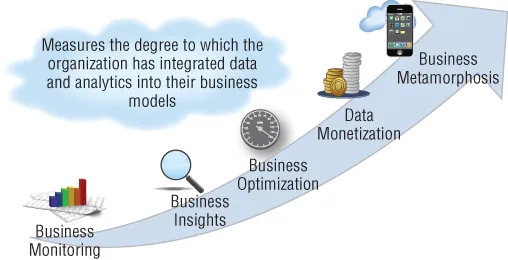
How effective is our organization at integrating data and analytics into our business models?

- Phase 1: Business Monitoring. In the Business Monitoring phase, organizations are leveraging data warehousing and Business Intelligence to monitor the organization's performance.
- Phase 2: Business Insights. The Business Insights phase is about leveraging predictive analytics to uncover customer, product, and operational insights buried in the growing wealth of internal and external data sources. In this phase, organizations aggressively expand their data acquisition efforts by coupling all of their detailed transactional and operational data with internal data such as consumer comments, e-mail conversations, and technician notes, as well as external and publicly available data such as social media, weather, traffic, economic, demographics, home values, and local events data.
- Phase 3: Business Optimization. In the Business Optimization phase, organizations apply prescriptive analytics to the customer, product, and operational insights uncovered in the Business Insights phase to deliver actionable insights or recommendations to frontline employees, business managers, and channel partners, as well as customers. The goal of the Business Optimization phase is to enable employees, partners, and customers to optimize their key decisions.
- Phase 4: Data Monetization. In the Data Monetization phase, organizations leverage the customer, product, and operational insights to create new sources of revenue. This could include selling data—or insights—into new markets (a cellular phone provider selling customer behavioral data to advertisers), integrating analytics into products and services to create “smart” products, or re-packaging customer, product, and operational insights to create new products and services, to enter new markets, and/or to reach new audiences.
- Phase 5: Business Metamorphosis. The holy grail of the Big Data Business Model Maturity Index is when an organization transitions its business model from selling products to selling “business-as-a-service.” Think GE selling “thrust” instead of jet engines. Think ...
Table of contents
- Cover
- Table of Contents
- Introduction
- Part I: Business Potential of Big Data
- Part II: Data Science
- Part III: Data Science for Business Stakeholders
- Part IV: Building Cross-Organizational Support
- End User License Agreement