Plant Breeding Reviews presents state-of-the-art reviews on plant genetics and the breeding of all types of crops by both traditional means and molecular methods. Many of the crops widely grown today stem from a very narrow genetic base; understanding and preserving crop genetic resources is vital to the security of food systems worldwide. The emphasis of the series is on methodology, a fundamental understanding of crop genetics, and applications to major crops.
- English
- ePUB (mobile friendly)
- Available on iOS & Android
eBook - ePub
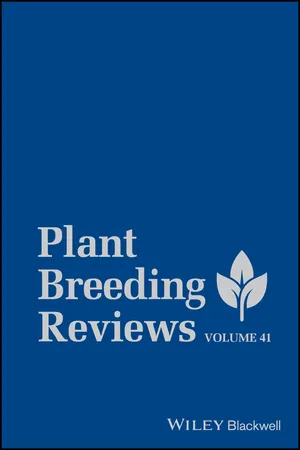
Plant Breeding Reviews, Volume 41
About this book
Information
1
Hari Deo Upadhyaya: Plant Breeder, Geneticist and Genetic Resources Specialist
Sangam L Dwivedi
International Crops Research Institute for the Semi‐Arid Tropics (ICRISAT), Patancheru, Telangana, India
ABSTRACT
This chapter discusses Hari Deo Upadhyaya, a plant breeder, geneticist and genetic resources specialist, and his contributions in management and utilization of genetic resources, molecular biology and biometrics, and in groundnut breeding. Hari’s contributions in genetic resources include enriching germplasm collections; forming representative subsets in the form of core and/or mini‐core collections in chickpea, groundnut, pigeonpea, pearl millet, sorghum, and six small millets; unlocking population structures, diversity and association genetics; and identifying genetically diverse and agronomically desirable germplasm accessions for use in crop breeding. The Consultative Group on International Agriculture Research (CGIAR) recognized his concept and process of forming mini‐core collection as International Public Goods (IPGs) and researchers worldwide are now using mini core‐collections as useful genetic resources in breeding and genomics of the aforementioned crops. A genebank manager’s role isn’t just confined to collection, maintenance, and archiving germplasm. Hari’s spirited efforts prove so and they led many to realize the abundant opportunities to mine and enhance the value of the genetic resources in crop improvement programs. As a geneticist, his seminal work on wilt resistance in chickpea laid a strong foundation for the wilt resistance breeding programs globally. His contributions as a groundnut breeder resulted in the release of 27 cultivars in 18 countries, some widely grown, and 24 elite germplasm releases with unique characteristics made available to groundnut researchers worldwide. Hari’s inimitable ability and scientific competence allowed him to collaborate with diverse groups and institutions worldwide. His scientific contributions in germplasm research and groundnut breeding have been recognized with several prestigious global awards and honors. A prolific writer and with immense passion for teaching, Hari Upadhyaya has established a school of his own for the management, evaluation and use of genetic resources for crop improvement.KEYWORDS: Breeding, Climate resilient germplasm, core and mini‐core collections, crop wild relatives, cultivars, elite germplasm, farmers participatory variety selection, molecular breeding, population structure and diversity, on‐farm conservation of germplasm
OUTLINE
- ABBREVIATIONS
- INTRODUCTION
- BIOGRAPHICAL SKETCH
- CONTRIBUTIONS
- Genetic Resources Management and Use
- Representative Subsets
- Climate‐resilient Germplasm
- Seed Nutrient‐dense Germplasm
- Bioenergy
- Germplasm Use in Breeding
- On‐farm Conservation and Use of Diversity
- Wild Relatives and Cultigen Genepool
- Gaps in Collections
- Molecular Biology and Biometrics
- Population Structure and Diversity
- Genome‐wide Association Mapping
- Candidate Genes Associated with Agronomically Beneficial Traits
- Ethnolinguistic Groups Shaped Sorghum Diversity in Africa
- Genome Sequencing
- Groundnut Breeding
- Early Maturity
- Drought Tolerance
- Aflatoxin Resistance
- Farmers Participatory Varietal Selection
- Chickpea Breeding
- Genetic Resources Management and Use
- UPADHYAYA, THE MAN
- Personality
- Educator and Leader
- International Collaborations
- Recognition
- Awards
- Honours
- Service
- PUBLICATIONS
- PRODUCTS
- Cultivars
- Registrations
- REFERENCES CITED AND FURTHER READING
ABBREVIATIONS
- ASA
- American Society of Agronomy
- CGIARC
- Consultative Group on International Agricultural Research Consortium
- CSSA
- Crop Science Society of America
- ICRISAT
- International Crops Research Institute for Semi‐Arid Tropics
- NARS
- National Agricultural Research Systems
- R4D
- Research for development
- SNP
- Single nucleotide polymorphisms

I. INTRODUCTION
Hari Deo Upadhyaya, whom many of us know as Hari, has been known to me since 1980, when he joined the International Crops Research Institute for the Semi‐Arid Tropics (ICRISAT), Patancheru, India, as a postdoctoral fellow in chickpea breeding. After completing his postdoctoral assignment at ICRISAT, Hari then moved for a short period to work as the Pool Officer at ‘GB Pant’ University of Agriculture and Technology (GBPUAT), Pantnagar, India, the first agricultural university established on a US ‘Land Grant’ pattern in India. He then took up a regular position at the University of Agriculture Sciences (UAS), Dharwad, India, where he worked for almost for eight years, first as a soybean breeder (as Assistant Professor), and then as the head of the oilseeds scheme and a groundnut breeder (as Associate Professor). He did a remarkable job as an oilseed breeder, and he set up and took the soybean and groundnut breeding programs to newer heights.
In 1991, Hari returned to ICRISAT as a Senior Groundnut Breeder. In late 1997, ICRISAT reorganized its research portfolio, and moved Hari on a part‐time basis to the Genetic Resources Unit, as part of the Crop Improvement Program. In 2002, Hari was appointed as a Principal Scientist and Head of the Genebank, ICRISAT, Patancheru, India, a position he still holds in the ‘new organizational structure’, where he has to manage the ICRISAT administrative Research for Development (R4D) portfolios with respect to management and utilization of genetic re...
Table of contents
- Cover
- Title Page
- Table of Contents
- Contributors
- 1 Hari Deo Upadhyaya
- 2 Crop Improvement Using Genome Editing
- 3 Development and Commercialization of CMS Pigeonpea Hybrids
- 4 The Evolution of Potato Breeding
- 5 Flavour Evaluation for Plant Breeders
- 6 The Genetic Improvement of Black Walnut for Timber Production
- 7 A Life in Horticulture and Plant Breeding
- Auhtor Index
- Subject Index
- Cumulative Subject Index
- Cumulative Contributor Index
- End User License Agreement
Trusted by 375,005 students
Access to over 1.5 million titles for a fair monthly price.
Study more efficiently using our study tools.
Frequently asked questions
Yes, you can cancel anytime from the Subscription tab in your account settings on the Perlego website. Your subscription will stay active until the end of your current billing period. Learn how to cancel your subscription
No, books cannot be downloaded as external files, such as PDFs, for use outside of Perlego. However, you can download books within the Perlego app for offline reading on mobile or tablet. Learn how to download books offline
Perlego offers two plans: Essential and Complete
- Essential is ideal for learners and professionals who enjoy exploring a wide range of subjects. Access the Essential Library with 800,000+ trusted titles and best-sellers across business, personal growth, and the humanities. Includes unlimited reading time and Standard Read Aloud voice.
- Complete: Perfect for advanced learners and researchers needing full, unrestricted access. Unlock 1.5M+ books across hundreds of subjects, including academic and specialized titles. The Complete Plan also includes advanced features like Premium Read Aloud and Research Assistant.
We are an online textbook subscription service, where you can get access to an entire online library for less than the price of a single book per month. With over 1.5 million books across 990+ topics, we’ve got you covered! Learn about our mission
Look out for the read-aloud symbol on your next book to see if you can listen to it. The read-aloud tool reads text aloud for you, highlighting the text as it is being read. You can pause it, speed it up and slow it down. Learn more about Read Aloud
Yes! You can use the Perlego app on both iOS and Android devices to read anytime, anywhere — even offline. Perfect for commutes or when you’re on the go.
Please note we cannot support devices running on iOS 13 and Android 7 or earlier. Learn more about using the app
Please note we cannot support devices running on iOS 13 and Android 7 or earlier. Learn more about using the app
Yes, you can access Plant Breeding Reviews, Volume 41 by Irwin Goldman in PDF and/or ePUB format, as well as other popular books in Biological Sciences & Botany. We have over 1.5 million books available in our catalogue for you to explore.